
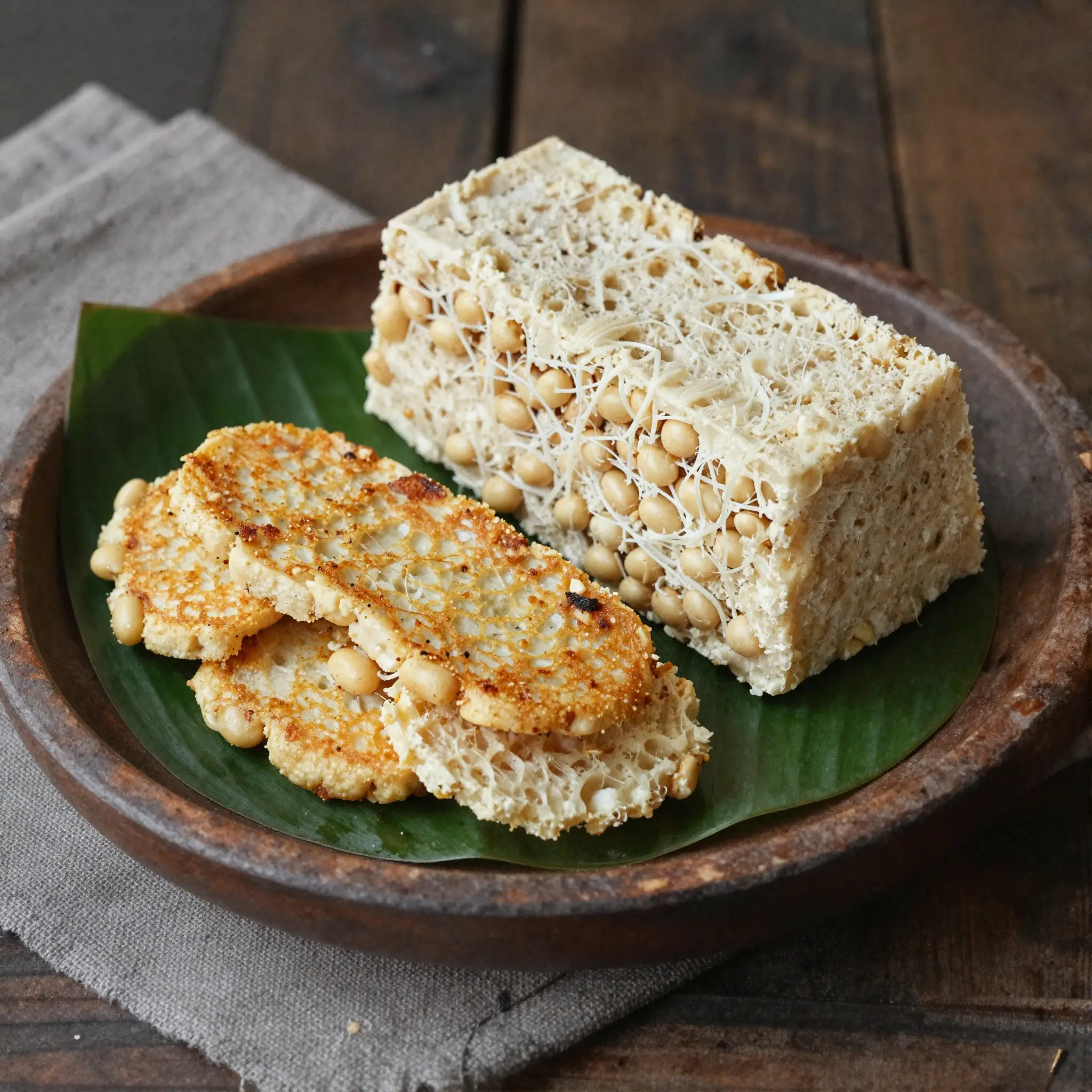
Tempeh
Legume ferment/protein staple
Facts
| Category | Grain / Legume |
|---|---|
| Origin | 🇮🇩 Indonesia |
Safety
- Documented risk factor — cooked soybeans at near-neutral pH held warm/moist for 24-48h before mold dominance is established is a hospitable window for bacterial contamination if the acidification step is skipped or inadequate. Safe-practice guidance:
(a) the pre-incubation acidification step (natural soak-derived or supplemented with vinegar) is a genuine safety control, not merely a traditional flavor step — it suppresses competing bacteria during the vulnerable pre-mycelial window;
(b) mold species discrimination — use verified commercial Rhizopus oligosporus spore inoculum rather than uncontrolled wild capture, since the broader Mucorales/mold environment includes contaminating species;
(c) a fully-bound, dense white mycelial mat is the safety-relevant completion indicator; sporulation/greying indicates over-ripeness (a quality, not acute-safety, concern) but any pink, black (beyond normal light sporulation), or foul-smelling patches indicate contamination and the batch should be discarded.
Method
Tempeh (Rhizopus-Bound Soybean Cake)
- Dried soybeans — 500 g
- Tempeh starter (Rhizopus oligosporus spores) — per the starter's own dosing, illustrative; a StarterCulture-class dependency
- Vinegar — ~1 tbsp, illustrative (mild acidification, see step 5)
- 1
Step 1
Soak the soybeans overnight — the soak itself acidifies mildly, which is part of the traditional process.
- 2
Step 2
Dehull the beans (slosh and rub them under water; the hulls float off) — the mold binds the bean surface, and hulls get in the way.
- 3
Step 3
Cook or parboil the dehulled beans until tender but not disintegrating.
- 4
Step 4
Drain thoroughly and spread the beans out to cool and surface-dry — surface water blocks the mold and invites competitors.
- 5
Step 5
When at body temperature or below, stir through the vinegar (if the beans are not already acidic enough).
- 6
Step 6
Inoculate with the R. oligosporus spores and mix until evenly distributed.
- 7
Step 7
Pack into perforated bags or a perforated form — the mold needs air exchange, and the holes are functional, not cosmetic.
- 8
Step 8
Incubate warm for 24–48 hours until the beans are bound into a firm white cake laced with mycelium.
- 9
Step 9
Refrigerate once fully bound.
Frequently asked questions
- What is Tempeh?
- Legume ferment/protein staple
- Where does Tempeh come from?
- Tempeh is traditionally made in Indonesia.
- Is Tempeh safe to make at home?
- Documented risk factor — cooked soybeans at near-neutral pH held warm/moist for 24-48h before mold dominance is established is a hospitable window for bacterial contamination if the acidification step is skipped or inadequate. Safe-practice guidance:
(a) the pre-incubation acidification step (natural soak-derived or supplemented with vinegar) is a genuine safety control, not merely a traditional flavor step — it suppresses competing bacteria during the vulnerable pre-mycelial window;
(b) mold species discrimination — use verified commercial Rhizopus oligosporus spore inoculum rather than uncontrolled wild capture, since the broader Mucorales/mold environment includes contaminating species;
(c) a fully-bound, dense white mycelial mat is the safety-relevant completion indicator; sporulation/greying indicates over-ripeness (a quality, not acute-safety, concern) but any pink, black (beyond normal light sporulation), or foul-smelling patches indicate contamination and the batch should be discarded.
Community results
No community results published for this ferment yet.
Related library reading
- Which Countries Have the Most Distinct Traditional Fermented Foods?Korea, China, Japan and India dominate every published count — and what that ranking actually measures is which traditions got written down in English.
- How Long Does Fermentation Take? A Timing Reference by FamilyTypical durations for vegetable, dairy, grain, legume and beverage ferments, why every range is wide, and what to measure instead of counting days.
- Natto, Thua Nao, Tempeh and Doenjang: The Two Ways Legumes FermentBacillus and mould take soybeans in opposite chemical directions. Which organism runs which ferment, and what that means for smell, texture and use.
- Temperature: The Most Underused Fermentation VariableWhy the same recipe tastes different in January and July, and how to use temperature deliberately rather than accidentally.