
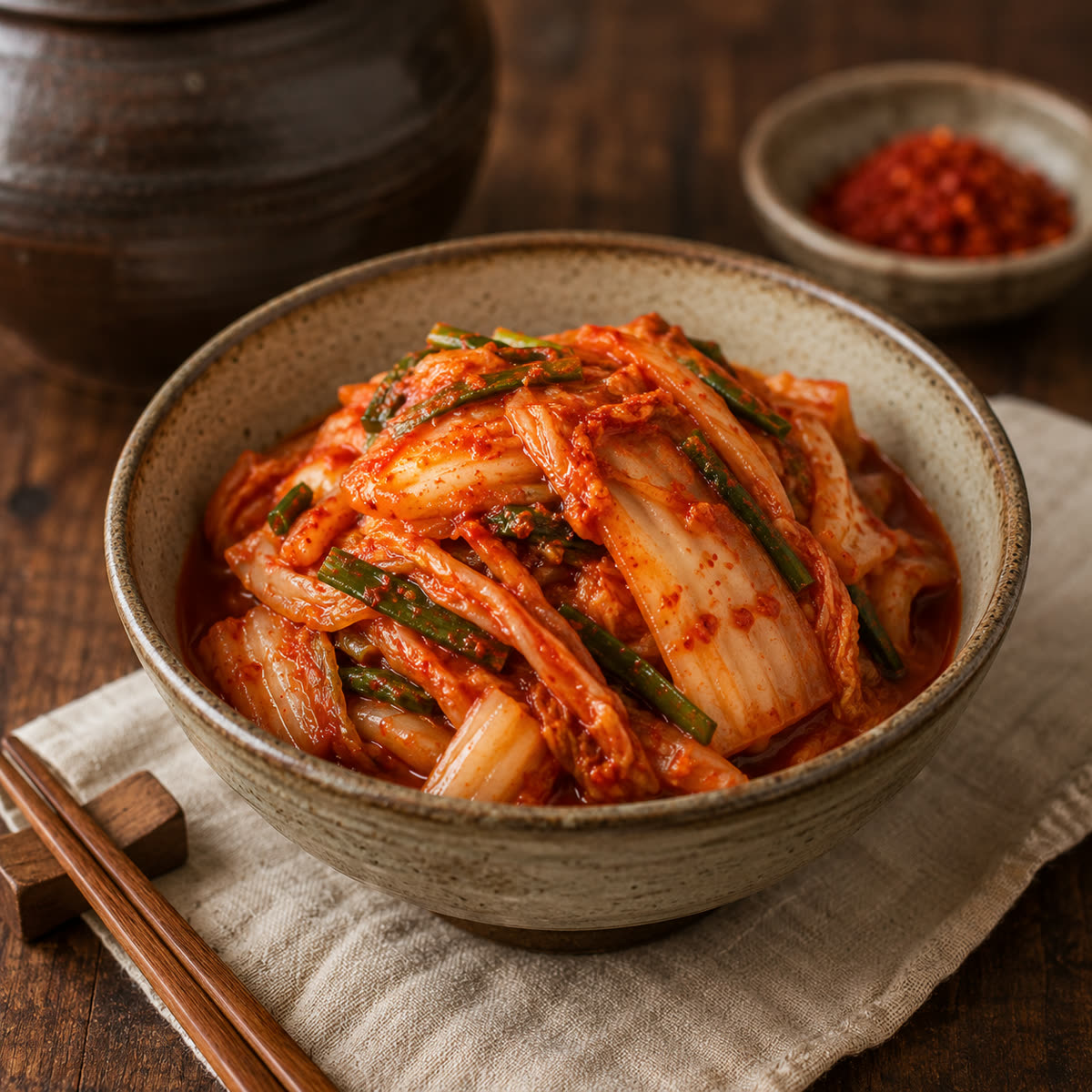
Kimchi
Vegetable ferment/condiment
Facts
| Category | Vegetable |
|---|---|
| Origin | 🇰🇷 South Korea · origin disputed |
Safety
- Same core anaerobic/salinity-floor principle as sauerkraut applies. Safe-practice guidance:
(a) adequate initial salting of the wilted cabbage and full submersion under liquid/seasoning paste;
(b) where jeotgal (fermented fish/shrimp) is used as a seasoning ingredient, its own high-salt fermentation (fish-ferment family) is a separate ingredient-level product with its own safety profile, not a novel kimchi-specific hazard;
(c) continued slow fermentation during refrigerated storage is expected and desired (progressive souring), distinct from spoilage — off-odor, sliminess, or surface mold (not to be confused with normal gas/bubbling) are the actionable spoilage indicators.
Method
Kimchi (Baechu-Kimchi, Napa-Cabbage Style)
- Napa cabbage, halved or quartered lengthwise — 2000 g
- Non-iodized salt, for the wilting brine — SAFETY CONTROL, see linked Variant; ~a heavy salting of each leaf layer, illustrative
- Korean chili powder (gochugaru) — to taste, illustrative
- Garlic and ginger, finely minced — illustrative
- Korean radish, julienned — ~300 g, illustrative
- Jeotgal (fermented-seafood seasoning, e.g. salted shrimp or anchovy sauce) — illustrative; traditional in many regional variants. Omit for a vegan kimchi: this is a documented regional-variation point, not a safety control.
- Spring onion, cut into lengths (flavour only)
- 1
Step 1
Salt the cabbage: work salt between every leaf layer, concentrating on the thick stem ends.
- 2
Step 2
Leave the salted cabbage to wilt for several hours, turning occasionally, until the stems bend without snapping.
- 3
Step 3
Rinse the wilted cabbage thoroughly to remove excess surface salt, then drain well.
- 4
Step 4
Make the seasoning paste: combine gochugaru, garlic, ginger, radish, jeotgal (if using), and spring onion.
- 5
Step 5
Coat every leaf of the cabbage with the seasoning paste, again working layer by layer.
- 6
Step 6
Pack tightly into a jar or crock, pressing down to drive out air and bring the liquid up over the solids.
- 7
Step 7
Keep the solids submerged below the liquid — SAFETY CONTROL (anaerobic, see linked Variant).
- 8
Step 8
Ferment at cool ambient temperature for a few days to taste (faster and sourer when warmer), then move to the refrigerator.
- 9
Step 9
Note that kimchi keeps fermenting slowly in cold storage — it continues to sour over its whole life, by design.
Frequently asked questions
- What is Kimchi?
- Vegetable ferment/condiment
- Where does Kimchi come from?
- Kimchi is traditionally made in South Korea.
- Is Kimchi safe to make at home?
- Same core anaerobic/salinity-floor principle as sauerkraut applies. Safe-practice guidance:
(a) adequate initial salting of the wilted cabbage and full submersion under liquid/seasoning paste;
(b) where jeotgal (fermented fish/shrimp) is used as a seasoning ingredient, its own high-salt fermentation (fish-ferment family) is a separate ingredient-level product with its own safety profile, not a novel kimchi-specific hazard;
(c) continued slow fermentation during refrigerated storage is expected and desired (progressive souring), distinct from spoilage — off-odor, sliminess, or surface mold (not to be confused with normal gas/bubbling) are the actionable spoilage indicators.
Community results
No community results published for this ferment yet.
Related library reading
- Which Countries Have the Most Distinct Traditional Fermented Foods?Korea, China, Japan and India dominate every published count — and what that ranking actually measures is which traditions got written down in English.
- How Long Does Fermentation Take? A Timing Reference by FamilyTypical durations for vegetable, dairy, grain, legume and beverage ferments, why every range is wide, and what to measure instead of counting days.
- Temperature: The Most Underused Fermentation VariableWhy the same recipe tastes different in January and July, and how to use temperature deliberately rather than accidentally.
- Salt and Brine Calculations Without GuessworkBrine percentage, dry salting and the arithmetic that makes vegetable ferments reproducible batch after batch.
- How Lactic Acid Fermentation Actually WorksThe microbial succession, pH curve and salt chemistry behind sauerkraut, kimchi and every other vegetable ferment.