
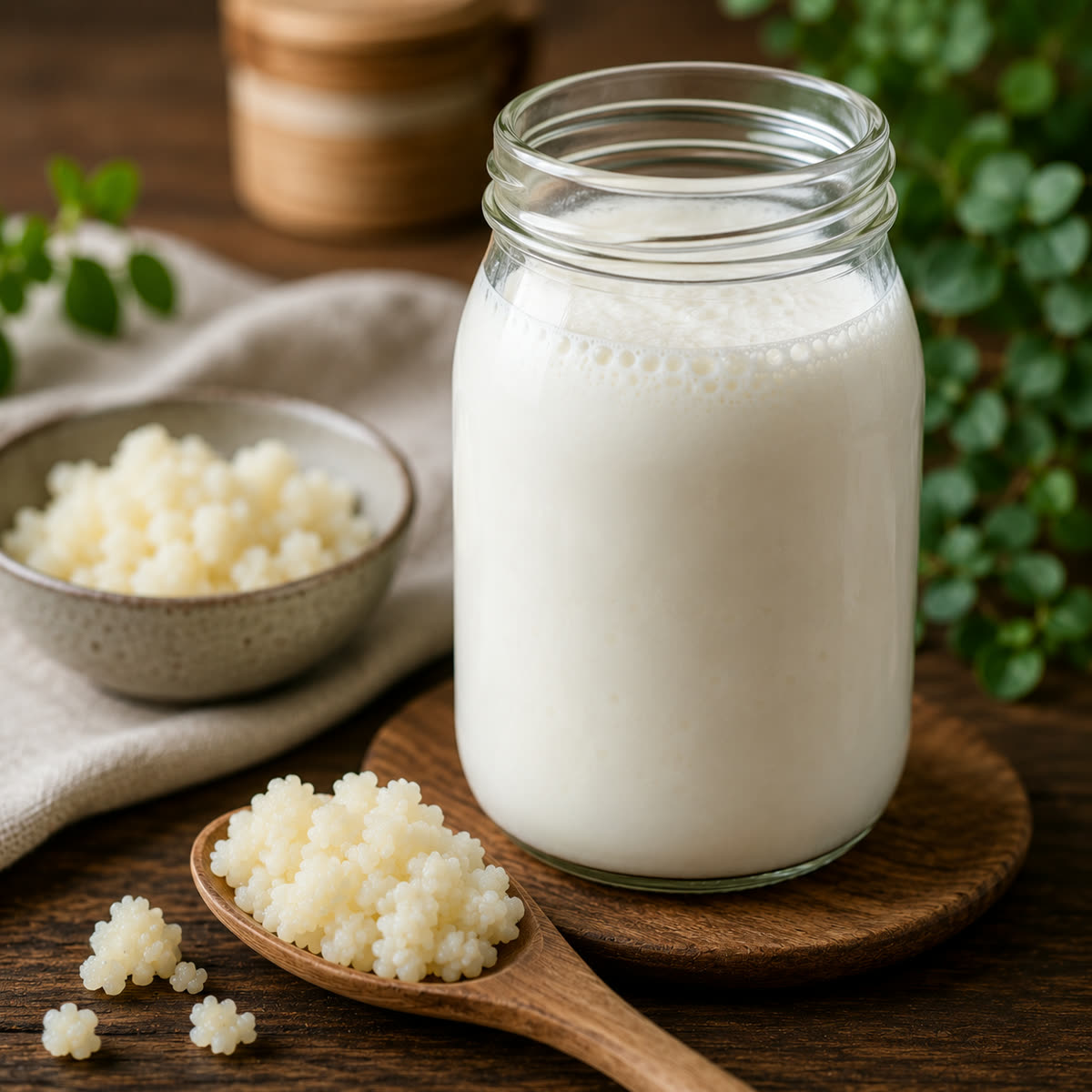
Kefir
Dairy beverage / Starter Culture-Living Ferment
Facts
| Category | Dairy |
|---|---|
| Origin | 🇬🇪 Georgia · origin disputed |
Safety
- No significant acute-hazard risk factors documented for kefir made with pasteurized milk and healthy, uncontaminated grains. Safe-practice guidance:
(a) use pasteurized milk for the same raw-milk pathogen reasons as yogurt;
(b) inspect grains for off-odor/discoloration before reuse — contaminated grains can propagate a fault forward batch-to-batch (the same back-slop-contamination-carryforward principle documented generically);
(c) use non-reactive (glass/food-grade plastic) vessels, since kefir's acidity can react with reactive metals over extended contact. Mild alcoholic content (typically <1% ABV, can rise with extended fermentation) should be disclosed to consumers avoiding alcohol.
Method
Kefir (Grain-Fermented Milk)
- Pasteurized cow's (or goat/sheep) milk — 500 mL — SAFETY CONTROL (pasteurized), see linked Variant
- Live kefir grains — ~1–2 tbsp, illustrative (the grains are a reusable living culture, never consumed — they are strained out and carried to the next batch)
- 1
Step 1
Inspect the grains before use: healthy grains are pale and springy; discard and restart if they smell putrid or look discoloured — SAFETY CONTROL, see linked Variant (a contaminated culture propagates the fault forward, batch to batch).
- 2
Step 2
Place the grains in a clean glass (or food-grade plastic) jar — avoid reactive metals, which kefir's acidity attacks over prolonged contact.
- 3
Step 3
Pour the milk over the grains, leaving headspace.
- 4
Step 4
Cover breathably (cloth or loose lid) — the ferment produces CO2 and must not be sealed tight.
- 5
Step 5
Ferment at room temperature for 12–48 hours, to taste; longer is more sour, more effervescent, and slightly higher in alcohol.
- 6
Step 6
Strain the liquid off, retaining the grains.
- 7
Step 7
Refrigerate the finished kefir; return the grains straight to fresh milk for the next batch.
Frequently asked questions
- What is Kefir?
- Dairy beverage / Starter Culture-Living Ferment
- Where does Kefir come from?
- Kefir is traditionally made in Georgia.
- Is Kefir safe to make at home?
- No significant acute-hazard risk factors documented for kefir made with pasteurized milk and healthy, uncontaminated grains. Safe-practice guidance:
(a) use pasteurized milk for the same raw-milk pathogen reasons as yogurt;
(b) inspect grains for off-odor/discoloration before reuse — contaminated grains can propagate a fault forward batch-to-batch (the same back-slop-contamination-carryforward principle documented generically);
(c) use non-reactive (glass/food-grade plastic) vessels, since kefir's acidity can react with reactive metals over extended contact. Mild alcoholic content (typically <1% ABV, can rise with extended fermentation) should be disclosed to consumers avoiding alcohol.
Community results
No community results published for this ferment yet.
Related library reading
- How Do I Know If My Kefir Grains Are Healthy or Contaminated?What healthy milk and water kefir grains look, smell and behave like, which changes are stress rather than contamination, and the three signs that mean discard.
- Water Kefir and Milk Kefir: Different Grains, Different DrinkWhat separates the two cultures, which is more forgiving for a beginner, and why the grains cannot be swapped between them.
- Kombucha microorganisms: which yeasts and bacteria do the workHow kombucha's yeasts and acetic acid bacteria divide the fermentation between them, why the pellicle forms at the surface, and which species claims remain unverified.
- How Long Does Fermentation Take? A Timing Reference by FamilyTypical durations for vegetable, dairy, grain, legume and beverage ferments, why every range is wide, and what to measure instead of counting days.
- Kefir, Kumis, Kashk and Skyr: How the World Ferments MilkThe families of fermented dairy, the organisms behind each, and why some are drinks, some are solid, and some keep for years without refrigeration.