
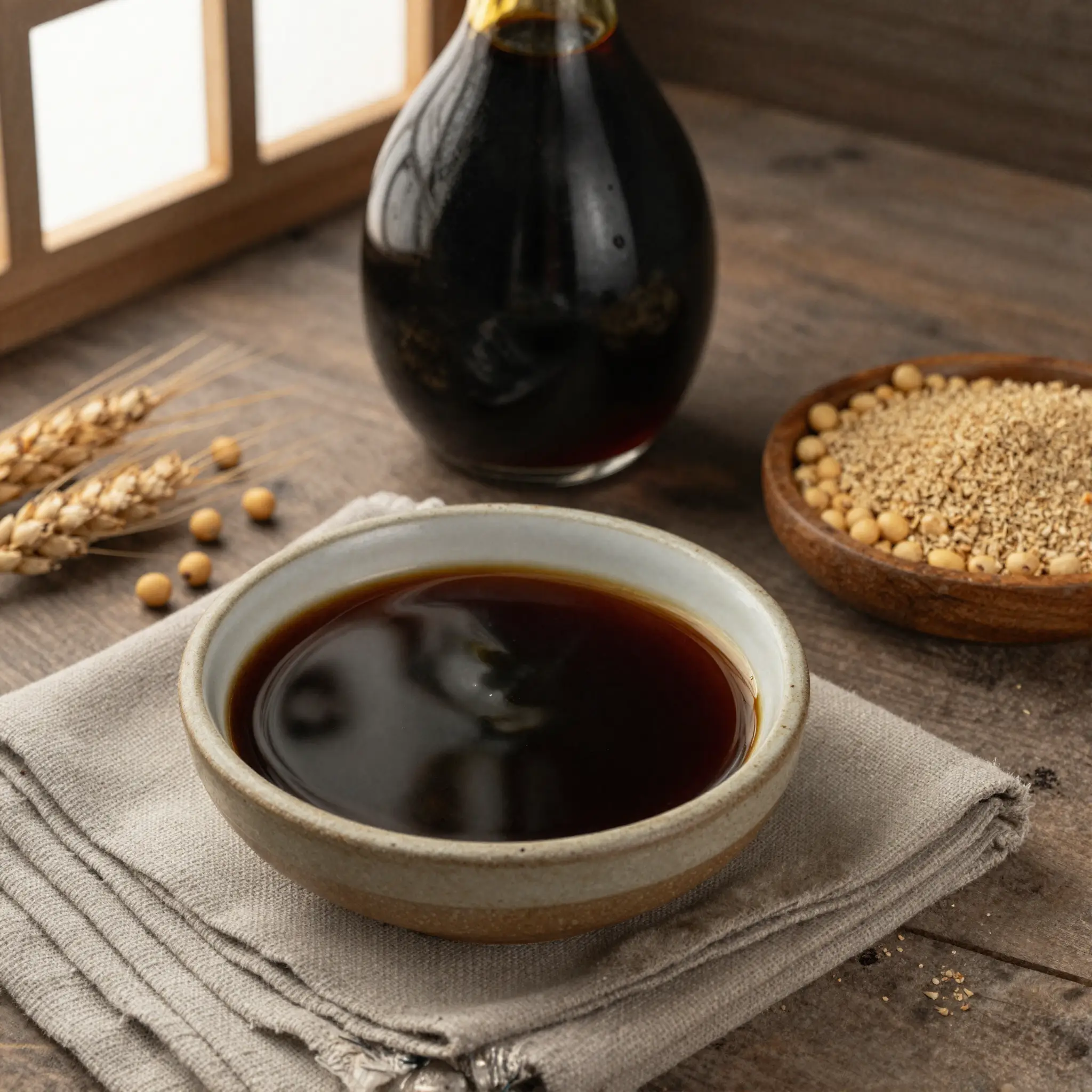
Soy Sauce
Condiment/liquid seasoning
Facts
| Category | Other |
|---|---|
| Origin | 🇨🇳 China |
Safety
- Documented risk factor — the moromi brine salinity is the single highest-stakes safety control point in this product's entire process, because the mash ferments anaerobically for months to over a year; inadequate salt concentration across that extended window is a materially serious theoretical vector for spoilage/pathogen risk, more consequential than in short-duration vegetable ferments precisely because of the much longer exposure window. Safe-practice guidance:
(a) moromi brine must be prepared at a high salinity sufficient to suppress non-halophilic/pathogenic bacterial growth while still permitting the specifically halophilic/halotolerant LAB and yeast to function — commercial/traditional practice treats this as a load-bearing, non-negotiable parameter, though there is no single standardized numeric threshold published for this (flagged as requiring dedicated food-safety-authority sourcing);
(b) koji-stage mold-species discrimination (as in miso) applies identically to stage 1 and is a separate, non-overlapping control point from moromi salinity;
(c) commercial soy sauce is pasteurized as a final safety/stability step, an additional margin beyond the fermentation's own inherent salt/time barrier.
Method
Soy Sauce (Koji + Moromi Brine Fermentation)
- Dried soybeans — 500 g
- Wheat, roasted and cracked — 500 g, illustrative (roughly equal parts is the conventional shoyu proportion)
- Aspergillus koji spores (soy-sauce koji) — per the starter's dosing, illustrative
- Non-iodized salt, for a strong brine — SAFETY CONTROL, see linked Variant; proportion illustrative
- Water — enough to form the moromi mash
- 1
Step 1
Soak and cook the soybeans until soft; drain.
- 2
Step 2
Roast and coarsely crack the wheat.
- 3
Step 3
Combine the cooked beans and cracked wheat and cool the mixture to below body temperature.
- 4
Step 4
Inoculate with the koji spores and mix evenly.
- 5
Step 5
Incubate aerobically for ~2–3 days, turning to prevent overheating, until well bloomed — this is the koji stage.
- 6
Step 6
Dissolve the salt in water to make a strong brine — SAFETY CONTROL, see linked Variant.
- 7
Step 7
Combine the finished koji with the brine to form the moromi mash.
- 8
Step 8
Ferment anaerobically for months to over a year, stirring periodically, through the halophilic LAB and yeast succession.
- 9
Step 9
Press the mature moromi to separate the liquid from the solids.
- 10
Step 10
Pasteurize the pressed liquid, then bottle.
Frequently asked questions
- What is Soy Sauce?
- Condiment/liquid seasoning
- Where does Soy Sauce come from?
- Soy Sauce is traditionally made in China.
- Is Soy Sauce safe to make at home?
- Documented risk factor — the moromi brine salinity is the single highest-stakes safety control point in this product's entire process, because the mash ferments anaerobically for months to over a year; inadequate salt concentration across that extended window is a materially serious theoretical vector for spoilage/pathogen risk, more consequential than in short-duration vegetable ferments precisely because of the much longer exposure window. Safe-practice guidance:
(a) moromi brine must be prepared at a high salinity sufficient to suppress non-halophilic/pathogenic bacterial growth while still permitting the specifically halophilic/halotolerant LAB and yeast to function — commercial/traditional practice treats this as a load-bearing, non-negotiable parameter, though there is no single standardized numeric threshold published for this (flagged as requiring dedicated food-safety-authority sourcing);
(b) koji-stage mold-species discrimination (as in miso) applies identically to stage 1 and is a separate, non-overlapping control point from moromi salinity;
(c) commercial soy sauce is pasteurized as a final safety/stability step, an additional margin beyond the fermentation's own inherent salt/time barrier.
Community results
No community results published for this ferment yet.
Related library reading
- How Long Does Fermentation Take? A Timing Reference by FamilyTypical durations for vegetable, dairy, grain, legume and beverage ferments, why every range is wide, and what to measure instead of counting days.
- Natto, Thua Nao, Tempeh and Doenjang: The Two Ways Legumes FermentBacillus and mould take soybeans in opposite chemical directions. Which organism runs which ferment, and what that means for smell, texture and use.