
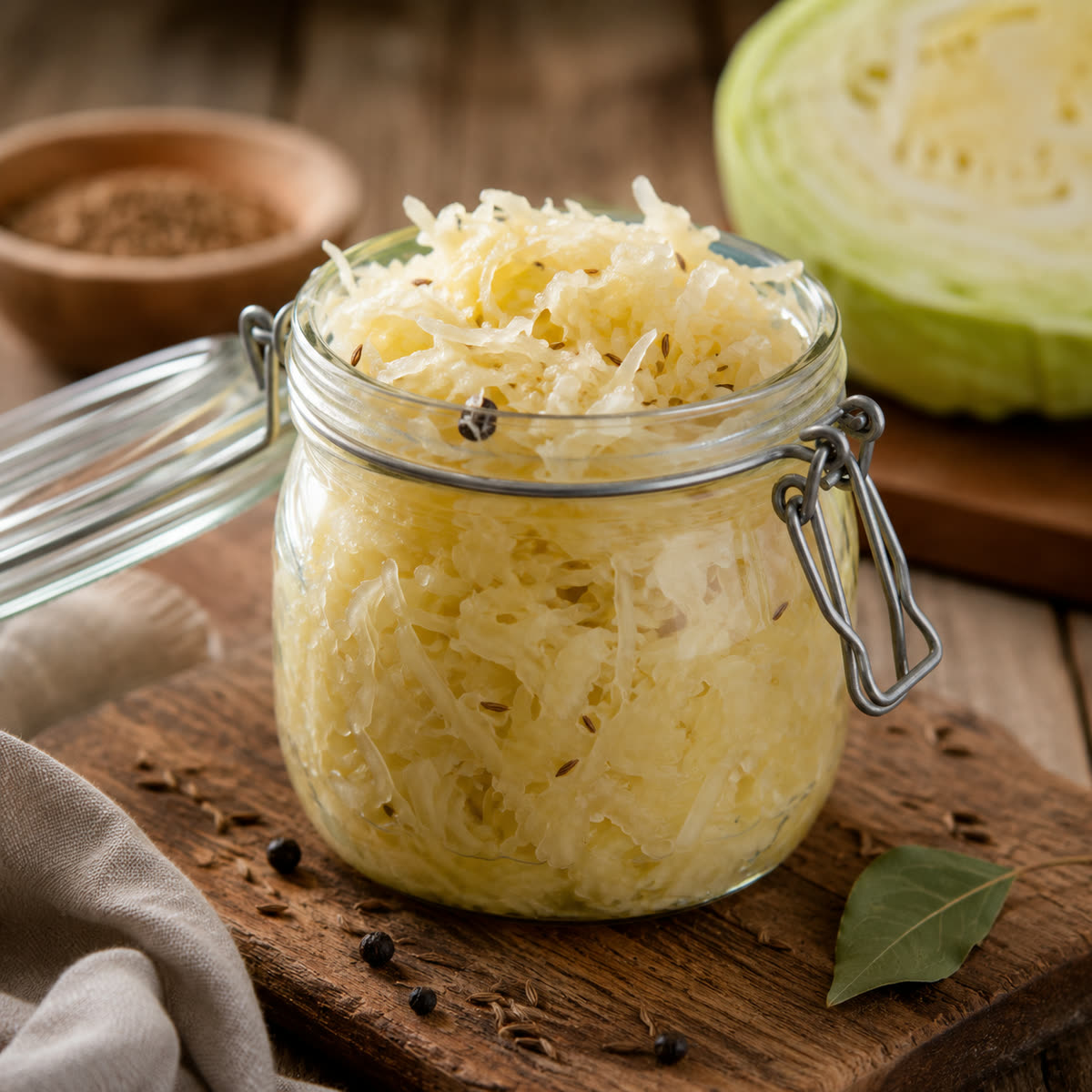
Sauerkraut
Vegetable ferment/pickle
Facts
| Category | Vegetable |
|---|---|
| Origin | 🇩🇪 Germany |
Safety
- Documented risk factor — insufficient salt concentration or incomplete submersion under liquid can permit spoilage organisms or, in a fully anaerobic low-acid pocket, theoretical Clostridium botulinum risk before acidification occurs. Safe-practice guidance:
(a) maintain ~2-3% salt-by-weight (the standard, widely-cited home-fermentation range; precise regulatory-grade thresholds are substrate/tradition-specific and should be re-confirmed per detailed recipe);
(b) ensure full submersion of solids below the brine/liquid line throughout fermentation — exposed vegetable matter above the brine line is the most common real-world failure point (visible mold/off-odor, a visually detectable and actionable warning sign);
(c) target pH ≤4.6, typically reached within days to 2-3 weeks;
(d) do not can/seal a sauerkraut ferment in a shelf-stable, non-refrigerated, sealed low-acid state without a validated canning-safety process — this compounds anaerobic low-acid risk as its own distinct checkpoint.
Method
Sauerkraut (Dry-Salted Fermented Cabbage)
- Cabbage, shredded — 1000 g
- Non-iodized salt — ~2–3% of the cabbage weight (~20–30 g), illustrative within the catalogue's stated range — SAFETY CONTROL, see linked Variant
- Optional: caraway, juniper, or dill (flavour only, non-safety)
- 1
Step 1
Discard damaged outer leaves; shred the cabbage finely.
- 2
Step 2
Weigh the shredded cabbage and calculate the salt at ~2–3% of that weight.
- 3
Step 3
Combine cabbage and salt and massage/knead firmly until the cabbage releases its own liquid — this self-expressed brine is the ferment's only liquid; no water is added.
- 4
Step 4
Pack tightly into a clean jar or crock, pressing down hard to drive out air pockets and raise the brine above the solids.
- 5
Step 5
Weight the cabbage so every shred stays submerged below the brine line — SAFETY CONTROL (anaerobic, see linked Variant).
- 6
Step 6
Cover with a breathable lid or airlock; ferment at ambient temperature.
- 7
Step 7
Check over the first days: confirm submersion, and skim any surface film (kahm yeast) — a fuzzy mould is different, see safety points.
- 8
Step 8
Taste from ~day 7; continue to the sourness you want (typically 1–4 weeks; cooler = slower and crisper).
- 9
Step 9
Refrigerate once at target flavour to slow further souring.
Frequently asked questions
- What is Sauerkraut?
- Vegetable ferment/pickle
- Where does Sauerkraut come from?
- Sauerkraut is traditionally made in Germany.
- Is Sauerkraut safe to make at home?
- Documented risk factor — insufficient salt concentration or incomplete submersion under liquid can permit spoilage organisms or, in a fully anaerobic low-acid pocket, theoretical Clostridium botulinum risk before acidification occurs. Safe-practice guidance:
(a) maintain ~2-3% salt-by-weight (the standard, widely-cited home-fermentation range; precise regulatory-grade thresholds are substrate/tradition-specific and should be re-confirmed per detailed recipe);
(b) ensure full submersion of solids below the brine/liquid line throughout fermentation — exposed vegetable matter above the brine line is the most common real-world failure point (visible mold/off-odor, a visually detectable and actionable warning sign);
(c) target pH ≤4.6, typically reached within days to 2-3 weeks;
(d) do not can/seal a sauerkraut ferment in a shelf-stable, non-refrigerated, sealed low-acid state without a validated canning-safety process — this compounds anaerobic low-acid risk as its own distinct checkpoint.
Community results
No community results published for this ferment yet.
Related library reading
- White Film on Your Ferment: Kahm Yeast or Mould?How to tell harmless kahm yeast from mould on sauerkraut and other brined vegetables, and what each one means for the jar.
- How Long Does Fermentation Take? A Timing Reference by FamilyTypical durations for vegetable, dairy, grain, legume and beverage ferments, why every range is wide, and what to measure instead of counting days.
- Sinki, Kabees el Lift and Nukazuke: Vegetable Ferments Beyond SauerkrautBrining is only one method. Pit-cured, bran-buried and beet-tinted vegetable ferments from the Himalaya, the Levant and Japan — and what actually changes between them.
- How Lactic Acid Fermentation Actually WorksThe microbial succession, pH curve and salt chemistry behind sauerkraut, kimchi and every other vegetable ferment.