
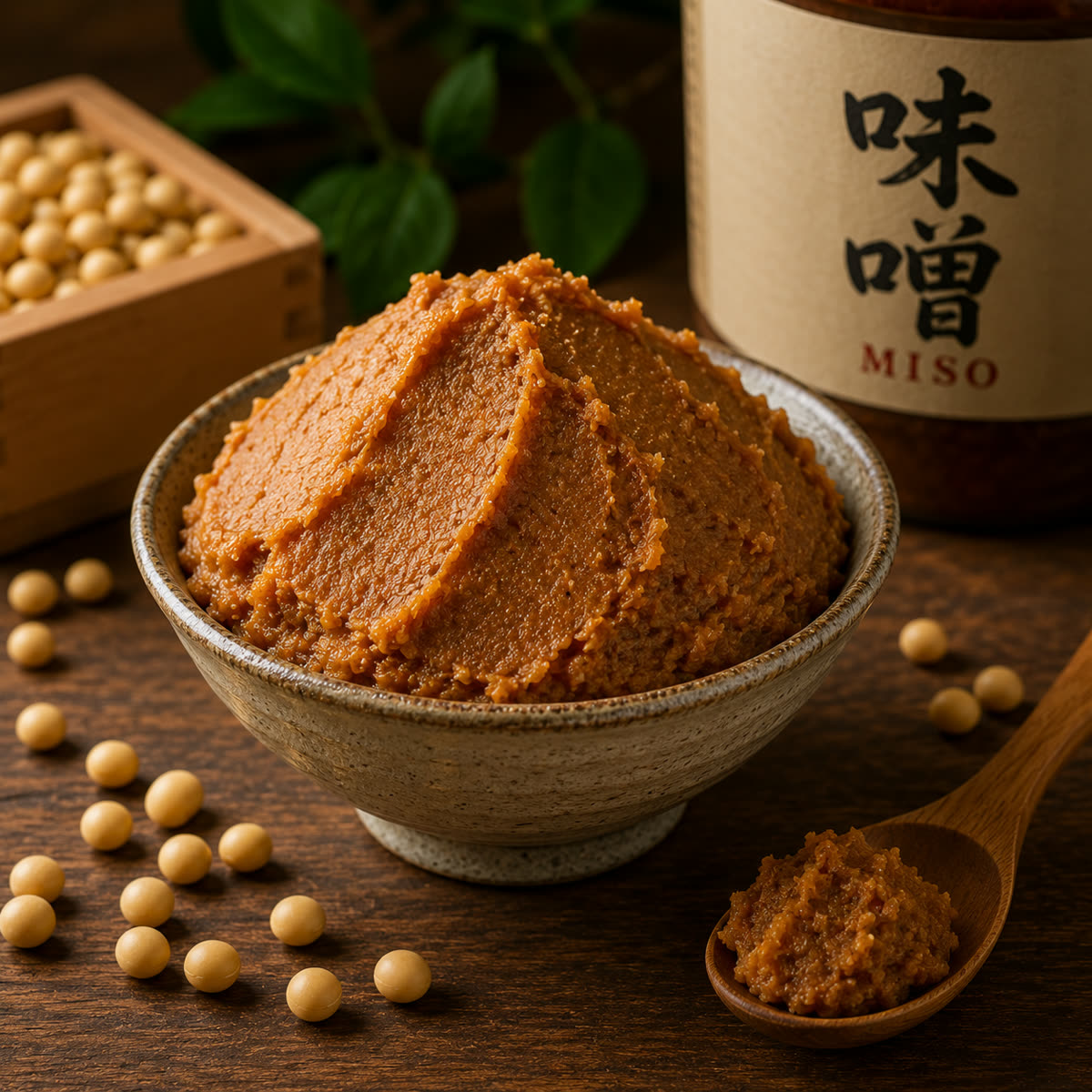
Miso
Condiment/paste
Facts
| Category | Other |
|---|---|
| Origin | 🇯🇵 Japan |
Safety
- The primary documented risk factor is at the koji-production stage, not the extended miso-aging stage. Safe-practice guidance:
(a) mold species/strain discrimination — only verified food-grade Aspergillus oryzae spore inoculum (commercial or long-verified heirloom lineage) should be used; the genus Aspergillus broadly includes aflatoxin-producing species (A. flavus, A. parasiticus) that can superficially resemble koji mold to an untrained eye, making controlled/verified inoculation (not open-air wild capture) the operative safety practice;
(b) once fermenting, miso's high salt content (commonly cited in the 8-13% range depending on style, precise value style-dependent) plus extended fermentation time provides a well-established inhibitory environment against pathogens, making finished/aged miso itself low-acute-risk;
(c) surface discoloration during aging is common and traditionally managed (skimming), distinct from the koji-stage mold-species concern.
Method
Miso (Rice-Koji Soybean Paste)
- Dried soybeans — 500 g
- Rice koji (or barley koji) — 500 g, illustrative; a StarterCulture-class dependency (rice/barley inoculated with Aspergillus oryzae). Buying finished koji is the normal home route; making it is the separate sub-procedure in step 1.
- Non-iodized salt — SAFETY CONTROL, see linked Variant; proportion illustrative (a long-aged paste is a high-salt preservation environment by design)
- Seed miso from a previous batch (optional back-slop, illustrative)
- 1
Step 1
Obtain koji. To make it: steam the rice or barley, cool it, inoculate with A. oryzae spores, and incubate aerobically ~2 days until fragrant and visibly bloomed. Otherwise use ready-made koji.
- 2
Step 2
Soak the soybeans overnight, then cook them until a bean crushes easily between finger and thumb.
- 3
Step 3
Drain (reserving a little cooking liquid) and cool the beans to below body temperature — never mix hot beans into koji, whose enzymes are heat-sensitive.
- 4
Step 4
Mash the beans to a coarse paste.
- 5
Step 5
Mix the mashed beans thoroughly with the koji and salt (and seed miso if using), adding reserved cooking liquid until the mass just holds together.
- 6
Step 6
Pack into a clean crock, pressing hard as you fill to drive out every air pocket.
- 7
Step 7
Smooth the surface, cover it directly, and weight it so liquid (tamari) rises above the paste over time.
- 8
Step 8
Age at ambient cellar-to-room temperature for months to years, checking periodically; scrape off any surface mould that forms at the edges.
Frequently asked questions
- What is Miso?
- Condiment/paste
- Where does Miso come from?
- Miso is traditionally made in Japan.
- Is Miso safe to make at home?
- The primary documented risk factor is at the koji-production stage, not the extended miso-aging stage. Safe-practice guidance:
(a) mold species/strain discrimination — only verified food-grade Aspergillus oryzae spore inoculum (commercial or long-verified heirloom lineage) should be used; the genus Aspergillus broadly includes aflatoxin-producing species (A. flavus, A. parasiticus) that can superficially resemble koji mold to an untrained eye, making controlled/verified inoculation (not open-air wild capture) the operative safety practice;
(b) once fermenting, miso's high salt content (commonly cited in the 8-13% range depending on style, precise value style-dependent) plus extended fermentation time provides a well-established inhibitory environment against pathogens, making finished/aged miso itself low-acute-risk;
(c) surface discoloration during aging is common and traditionally managed (skimming), distinct from the koji-stage mold-species concern.
Community results
No community results published for this ferment yet.
Related library reading
- How Long Does Fermentation Take? A Timing Reference by FamilyTypical durations for vegetable, dairy, grain, legume and beverage ferments, why every range is wide, and what to measure instead of counting days.
- Natto, Thua Nao, Tempeh and Doenjang: The Two Ways Legumes FermentBacillus and mould take soybeans in opposite chemical directions. Which organism runs which ferment, and what that means for smell, texture and use.
- Koji, Enzymes and the Long Ferments of East AsiaHow Aspergillus oryzae converts starch and protein into the amino acid backbone of miso, shoyu and amazake.