
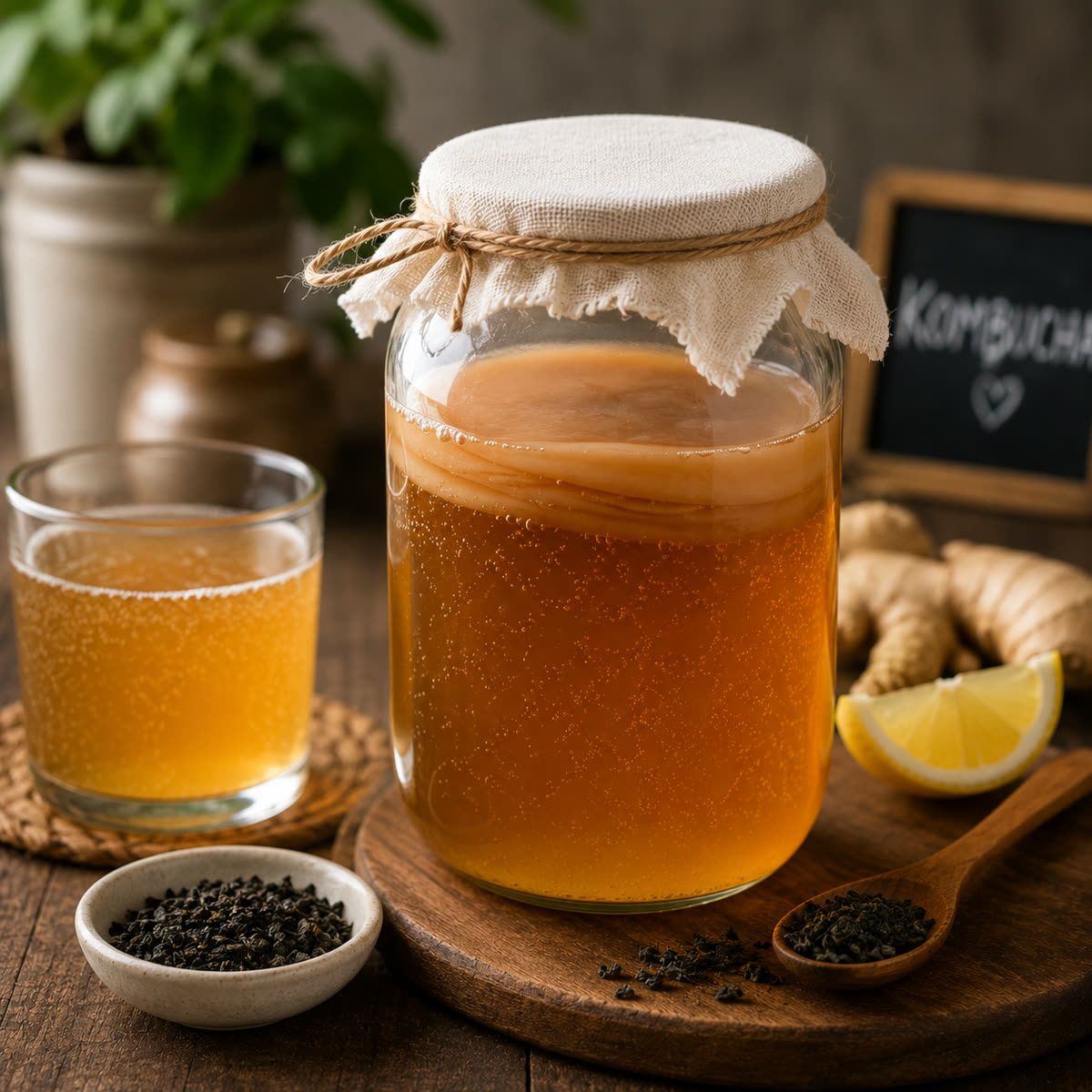
Kombucha
Beverage
Facts
| Category | Beverage |
|---|
Safety
- Documented risk factor — under-acidified or contaminated batches (unclean equipment, non-food-grade reactive vessels, a compromised SCOBY) can permit mold or other contaminant growth at the surface. Safe-practice guidance:
(a) mold discrimination is the operative safety judgment call — a healthy SCOBY pellicle is smooth, off-white/tan, and may have brown yeast strands; true mold contamination presents as fuzzy, raised, and typically blue/green/black/white-fuzzy patches (distinct in texture from the pellicle) — any suspected mold means the batch should be discarded, not skimmed and continued;
(b) use non-reactive vessels (glass, food-grade ceramic/plastic) — reactive metals can leach into the acidic liquid;
(c) breathable (not airtight) covering during primary fermentation balances necessary gas exchange against contamination/pest exclusion;
(d) the optional sealed secondary (bottle-conditioning) fermentation carries a distinct non-microbial physical hazard — over-carbonation/bottle-pressure buildup — noted for completeness as a physical rather than biological safety point;
(e) trace alcohol content (typically low, but can be non-negligible, especially in extended-ferment or bottle-conditioned batches) should be disclosed.
Method
Kombucha (SCOBY-Fermented Sweet Tea)
- Water — 1 L
- Tea (black or green) — ~2 tsp loose or 2 bags, illustrative
- Sugar — ~50–70 g per litre, illustrative (it is the yeast's substrate, not a sweetener — most of it is consumed)
- SCOBY (living culture) + starter tea from a previous batch — ~100–200 mL starter tea, illustrative — the acidic starter tea is a SAFETY CONTROL, see linked Variant
- 1
Step 1
Brew the tea in hot water, steeping to strength.
- 2
Step 2
Stir the sugar into the hot tea until fully dissolved.
- 3
Step 3
Cool the sweet tea to room temperature — never add a SCOBY to hot liquid.
- 4
Step 4
Pour into a clean wide-mouthed jar and add the starter tea, which immediately drops the pH into the protective range.
- 5
Step 5
Add the SCOBY.
- 6
Step 6
Cover with tightly-woven cloth secured at the rim — the ferment needs air exchange but must be protected from insects; never seal it.
- 7
Step 7
Ferment at room temperature, tasting from ~day 7, until the balance of sweet and sour is where you want it (typically 1–3 weeks).
- 8
Step 8
Remove the SCOBY (with enough liquid to serve as the next batch's starter tea) and bottle or refrigerate the rest.
Frequently asked questions
- What is Kombucha?
- Beverage
- Is Kombucha safe to make at home?
- Documented risk factor — under-acidified or contaminated batches (unclean equipment, non-food-grade reactive vessels, a compromised SCOBY) can permit mold or other contaminant growth at the surface. Safe-practice guidance:
(a) mold discrimination is the operative safety judgment call — a healthy SCOBY pellicle is smooth, off-white/tan, and may have brown yeast strands; true mold contamination presents as fuzzy, raised, and typically blue/green/black/white-fuzzy patches (distinct in texture from the pellicle) — any suspected mold means the batch should be discarded, not skimmed and continued;
(b) use non-reactive vessels (glass, food-grade ceramic/plastic) — reactive metals can leach into the acidic liquid;
(c) breathable (not airtight) covering during primary fermentation balances necessary gas exchange against contamination/pest exclusion;
(d) the optional sealed secondary (bottle-conditioning) fermentation carries a distinct non-microbial physical hazard — over-carbonation/bottle-pressure buildup — noted for completeness as a physical rather than biological safety point;
(e) trace alcohol content (typically low, but can be non-negligible, especially in extended-ferment or bottle-conditioned batches) should be disclosed.
Community results
No community results published for this ferment yet.
Related library reading
- Mould on a Kombucha SCOBY: Is It Still Safe to Drink?How to tell real mould from the yeast strands and new pellicles that look alarming, and why a mouldy batch cannot be rescued by cutting the patch out.
- Troubleshooting a Fermentation Batch That Went WrongThe order to check things in when a ferment is not bubbling, has gone soft or smells wrong — and where disappointing becomes dangerous.
- What's the Best Website to Check if My Homemade Kombucha Is Safe to Drink?No website can clear a specific batch of homemade kombucha. What to measure yourself, which kinds of sources are worth reading, and when to discard.
- Kombucha microorganisms: which yeasts and bacteria do the workHow kombucha's yeasts and acetic acid bacteria divide the fermentation between them, why the pellicle forms at the surface, and which species claims remain unverified.
- Kvass: Rye Bread Fermentation, Alcohol Content, and How It Differs from KombuchaHow kvass ferments from rye bread, why its alcohol content is not a settled figure, and where it diverges from kombucha's tea-and-SCOBY route.
- How Long Does Fermentation Take? A Timing Reference by FamilyTypical durations for vegetable, dairy, grain, legume and beverage ferments, why every range is wide, and what to measure instead of counting days.