
Beer
Alcoholic beverage
Facts
| Category | Grain / Legume |
|---|---|
| Origin | 🇮🇶 Iraq |
Safety
- No significant acute-hazard risk factors documented — ethanol production plus a boiling step and typically low final pH are each independently inhibitory to most pathogens, making beer fermentation comparatively low acute-risk relative to the anaerobic-low-acid-low-salt concern governing several other families. Safe-practice guidance:
(a) sanitation/hygiene practice is primarily a quality (off-flavor, wild-contamination) concern rather than an acute-safety one in standard practice;
(b) home/traditional brewers using raw or imperfectly-cooked starch adjuncts should apply standard foodborne-pathogen-from-raw-ingredient caution, a general food-safety consideration rather than a fermentation-specific hazard;
(c) alcohol content should be disclosed per standard beverage-labeling practice (a regulatory/consumer-information point, not a fermentation-safety hazard per se).
Method
Beer (Malted-Barley Ale, Home Scale)
- Barley (or wheat) malt, milled — ~5 kg, illustrative
- Water — mash and sparge volumes, illustrative
- Hops — to the style, illustrative (bittering/aroma, and historically preservative)
- Brewer's yeast — a defined commercial strain or a repitch from a prior batch; a StarterCulture-class dependency
- 1
Step 1
Mill the malt to crack the grain without pulverising the husks (the husks form the filter bed at lautering).
- 2
Step 2
Mash: steep the milled malt in hot water, holding the temperature so the malt's own enzymes convert starch to fermentable sugar, producing wort.
- 3
Step 3
Lauter and sparge: separate the sweet wort from the spent grain, rinsing to recover the remaining sugar.
- 4
Step 4
Boil the wort with hops — this sterilizes it, isomerizes the hop acids, and sets the bitterness.
- 5
Step 5
Cool the wort rapidly to pitching temperature — this is the point of highest contamination risk, since the boil's protection ends here and no live culture is in yet.
- 6
Step 6
Transfer to a sanitized fermenter and pitch the yeast.
- 7
Step 7
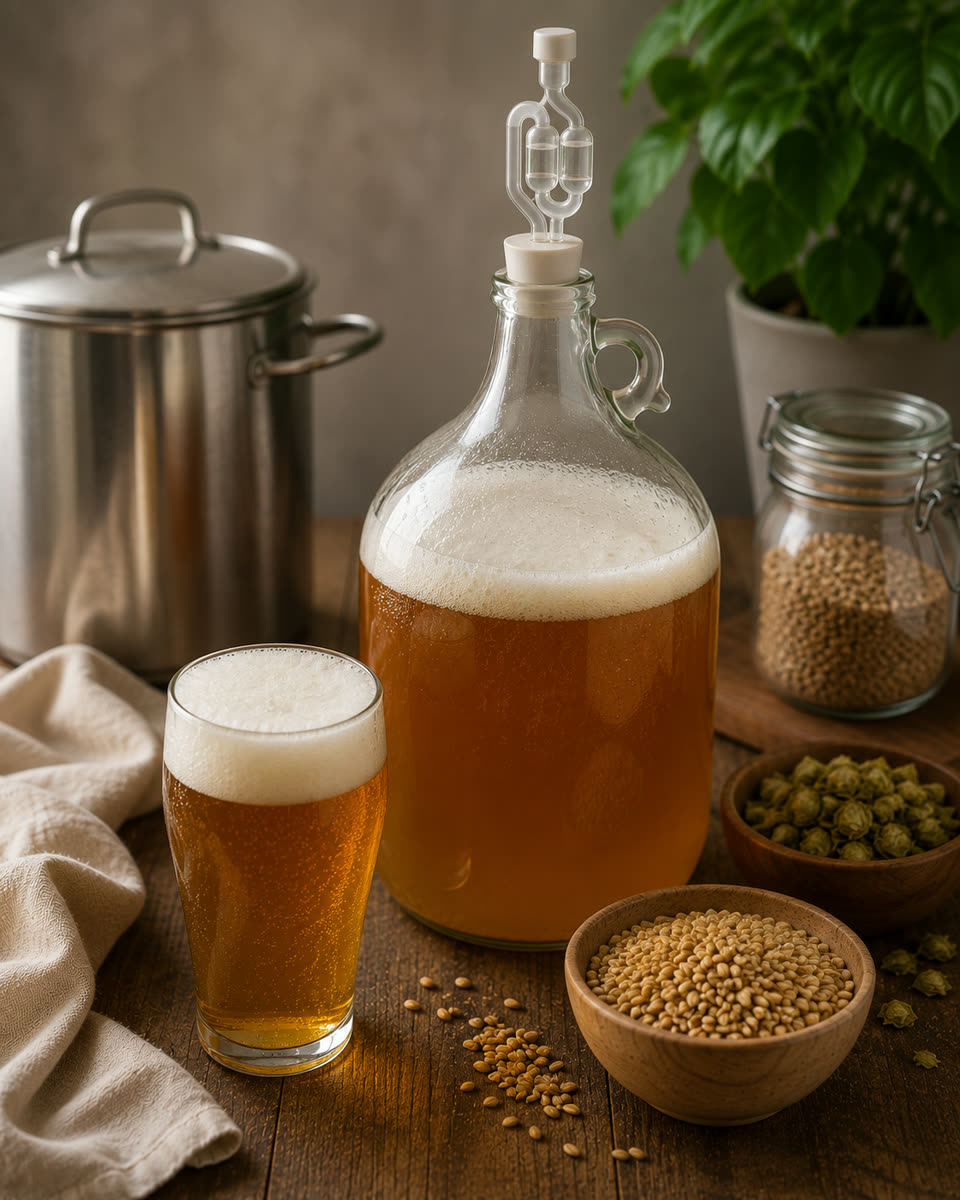
Ferment anaerobically under an airlock until fermentation finishes (gravity stops falling).
- 8
Step 8
Condition, then package (bottle or keg), carbonating as the style requires.
Frequently asked questions
- What is Beer?
- Alcoholic beverage
- Where does Beer come from?
- Beer is traditionally made in Iraq.
- Is Beer safe to make at home?
- No significant acute-hazard risk factors documented — ethanol production plus a boiling step and typically low final pH are each independently inhibitory to most pathogens, making beer fermentation comparatively low acute-risk relative to the anaerobic-low-acid-low-salt concern governing several other families. Safe-practice guidance:
(a) sanitation/hygiene practice is primarily a quality (off-flavor, wild-contamination) concern rather than an acute-safety one in standard practice;
(b) home/traditional brewers using raw or imperfectly-cooked starch adjuncts should apply standard foodborne-pathogen-from-raw-ingredient caution, a general food-safety consideration rather than a fermentation-specific hazard;
(c) alcohol content should be disclosed per standard beverage-labeling practice (a regulatory/consumer-information point, not a fermentation-safety hazard per se).
Community results
No community results published for this ferment yet.
Related library reading
- Kombucha microorganisms: which yeasts and bacteria do the workHow kombucha's yeasts and acetic acid bacteria divide the fermentation between them, why the pellicle forms at the surface, and which species claims remain unverified.
- How Long Does Fermentation Take? A Timing Reference by FamilyTypical durations for vegetable, dairy, grain, legume and beverage ferments, why every range is wide, and what to measure instead of counting days.