
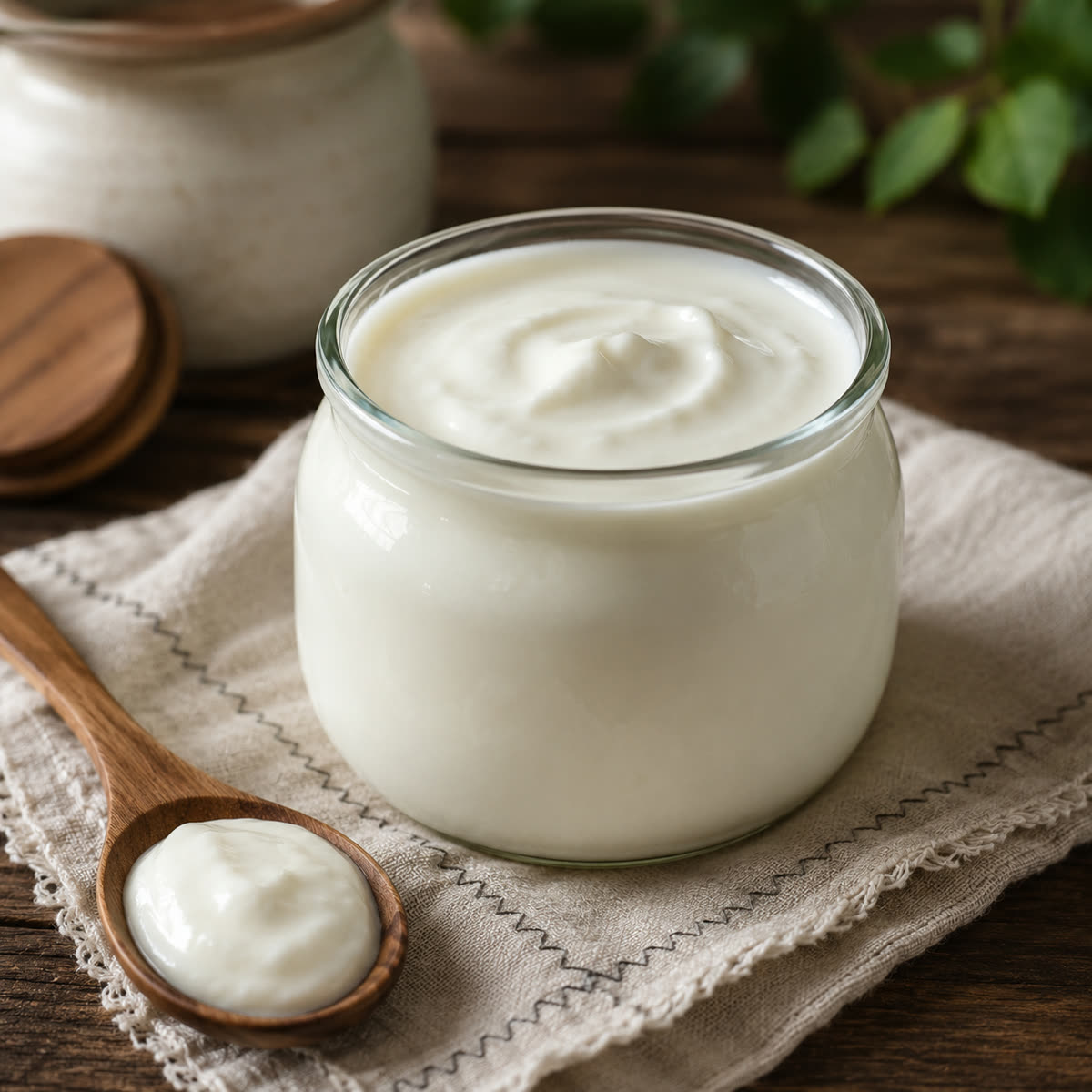
Yogurt
Dairy product
Facts
| Category | Dairy |
|---|---|
| Origin | 🇹🇷 Türkiye · origin disputed |
| Key microorganisms | lactic-acid-bacteria |
Safety
- Yogurt made from pasteurized milk at correct incubation temperature has a well-documented, low-risk safety profile — no significant acute-hazard risk factors documented beyond standard dairy-hygiene practice. Safe-practice guidance:
(a) use pasteurized milk — raw-milk yogurt carries materially higher pathogen risk (Listeria, Salmonella, pathogenic E. coli) not reliably eliminated by the short (hours) fermentation/acidification window;
(b) hold milk at target incubation temperature (~43-45°C) promptly after inoculation to minimize time in the bacterial "danger zone" (4-60°C) before the starter culture establishes dominance;
(c) target pH ≤4.6 at set completion (standard consensus dairy-safety threshold).
Method
Yogurt (Set Yogurt from Pasteurized Milk)
- Whole pasteurized cow's milk (or sheep/goat/buffalo, regional) — 1 L — SAFETY CONTROL (pasteurized), see linked Variant
- Live yogurt with active cultures, as back-slop starter (or a commercial thermophilic S. thermophilus + L. delbrueckii subsp. bulgaricus starter) — ~2 tbsp per litre, illustrative
- 1
Step 1
Heat the milk to ~85°C and hold briefly, then remove from heat — this pasteurizes and denatures whey proteins for a firmer set.
- 2
Step 2
Cool the milk to the target incubation temperature, ~43–45°C — SAFETY CONTROL, see linked Variant.
- 3
Step 3
Temper the starter with a little of the warm milk, then stir it evenly through the rest.
- 4
Step 4
Cover and hold undisturbed at ~43–45°C for 4–8 hours; do not stir or move the vessel while it sets.
- 5
Step 5
Check for a clean set (the curd pulls away from the vessel wall and the whey runs clear).
- 6
Step 6
Refrigerate promptly once set to arrest further acidification.
- 7
Step 7
Optional: strain through cloth for a thicker Greek/labneh/süzme-style yogurt.
Frequently asked questions
- What is Yogurt?
- Dairy product
- Which microorganisms ferment Yogurt?
- Yogurt is primarily driven by lactic-acid-bacteria.
- Where does Yogurt come from?
- Yogurt is traditionally made in Türkiye.
- Is Yogurt safe to make at home?
- Yogurt made from pasteurized milk at correct incubation temperature has a well-documented, low-risk safety profile — no significant acute-hazard risk factors documented beyond standard dairy-hygiene practice. Safe-practice guidance:
(a) use pasteurized milk — raw-milk yogurt carries materially higher pathogen risk (Listeria, Salmonella, pathogenic E. coli) not reliably eliminated by the short (hours) fermentation/acidification window;
(b) hold milk at target incubation temperature (~43-45°C) promptly after inoculation to minimize time in the bacterial "danger zone" (4-60°C) before the starter culture establishes dominance;
(c) target pH ≤4.6 at set completion (standard consensus dairy-safety threshold).
Community results
No community results published for this ferment yet.