
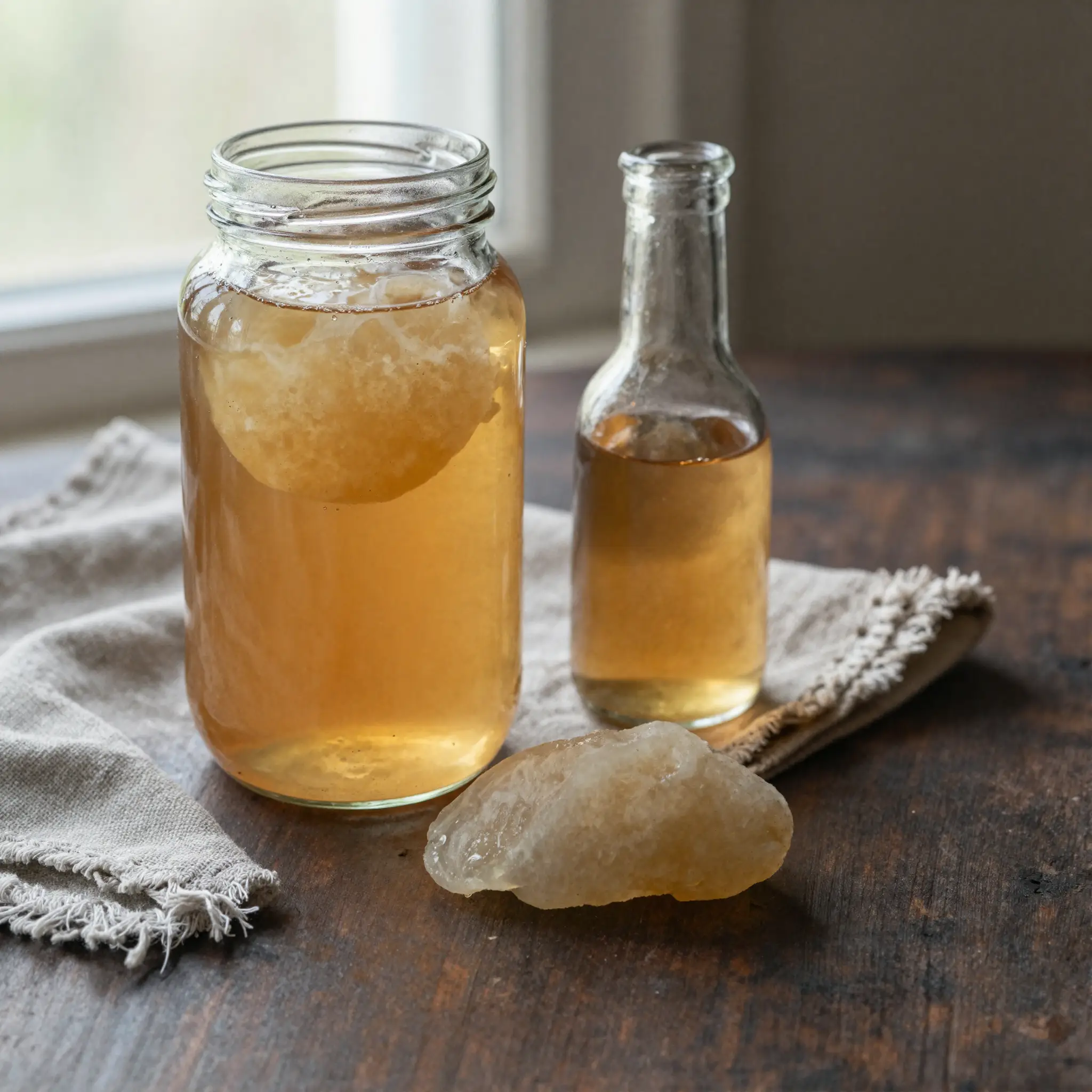
Vinegar
Condiment
Facts
| Category | Beverage |
|---|
Safety
- No significant acute-hazard risk factors documented — the strongly acidic, obligately aerobic end-product environment is broadly inhospitable to most pathogens, including anaerobic spore-formers. Safe-practice guidance:
(a) safety risk primarily inherits from the preceding alcoholic-fermentation stage — a safely-produced wine/cider base carries that safety profile forward;
(b) for home/traditional unpasteurized "mother" vinegar, standard food-contact-surface sanitation prevents unrelated surface contamination riding along on the mother culture;
(c) no distinct novel critical hazard is documented for the acetic-conversion step itself beyond quality-level concerns (e.g., fruit flies, incomplete conversion).
Method
Vinegar (Wine Vinegar, Static Surface Method)
- An alcoholic base — wine, cider, or similar — 1 L. This ferment consumes alcohol; it does not create it. A base with no alcohol produces no vinegar.
- Mother of vinegar (a back-slopped or defined acetic-acid-bacteria culture), or an active raw unpasteurized vinegar as starter — ~100–200 mL, illustrative
- 1
Step 1
Choose the alcoholic base; if it is strongly alcoholic, dilute it with water toward the range typical for vinegar-making (illustrative — too much alcohol stalls the bacteria).
- 2
Step 2
Pour the base into a wide vessel — surface area is the rate-limiting factor in the static method, since the bacteria work at the liquid/air interface.
- 3
Step 3
Add the mother or raw-vinegar starter.
- 4
Step 4
Cover with tightly-woven cloth: this ferment requires oxygen (it is an oxidation, not an anaerobic ferment) but must be protected from fruit flies, which are drawn to it.
- 5
Step 5
Leave undisturbed at ambient temperature — moving the vessel repeatedly disrupts the surface film.
- 6
Step 6
Wait weeks to months, tasting periodically as the sharpness builds.
- 7
Step 7
Bottle when it reaches the acidity you want; optionally pasteurize gently to stop further change and stabilize it.
Frequently asked questions
- What is Vinegar?
- Condiment
- Is Vinegar safe to make at home?
- No significant acute-hazard risk factors documented — the strongly acidic, obligately aerobic end-product environment is broadly inhospitable to most pathogens, including anaerobic spore-formers. Safe-practice guidance:
(a) safety risk primarily inherits from the preceding alcoholic-fermentation stage — a safely-produced wine/cider base carries that safety profile forward;
(b) for home/traditional unpasteurized "mother" vinegar, standard food-contact-surface sanitation prevents unrelated surface contamination riding along on the mother culture;
(c) no distinct novel critical hazard is documented for the acetic-conversion step itself beyond quality-level concerns (e.g., fruit flies, incomplete conversion).
Community results
No community results published for this ferment yet.
Related library reading
- Mould on a Kombucha SCOBY: Is It Still Safe to Drink?How to tell real mould from the yeast strands and new pellicles that look alarming, and why a mouldy batch cannot be rescued by cutting the patch out.
- Sinki, Kabees el Lift and Nukazuke: Vegetable Ferments Beyond SauerkrautBrining is only one method. Pit-cured, bran-buried and beet-tinted vegetable ferments from the Himalaya, the Levant and Japan — and what actually changes between them.
- Natto, Thua Nao, Tempeh and Doenjang: The Two Ways Legumes FermentBacillus and mould take soybeans in opposite chemical directions. Which organism runs which ferment, and what that means for smell, texture and use.
- Fermentation Safety: What to Keep and What to DiscardEvidence-based rules for judging a batch — pH thresholds, mould identification, and the myths worth ignoring.
- Inside the SCOBY: The Microbiology of KombuchaWhat the pellicle really is, which organisms live in the liquid, and why acidity — not the disc — keeps kombucha safe.