
Meat / Fish
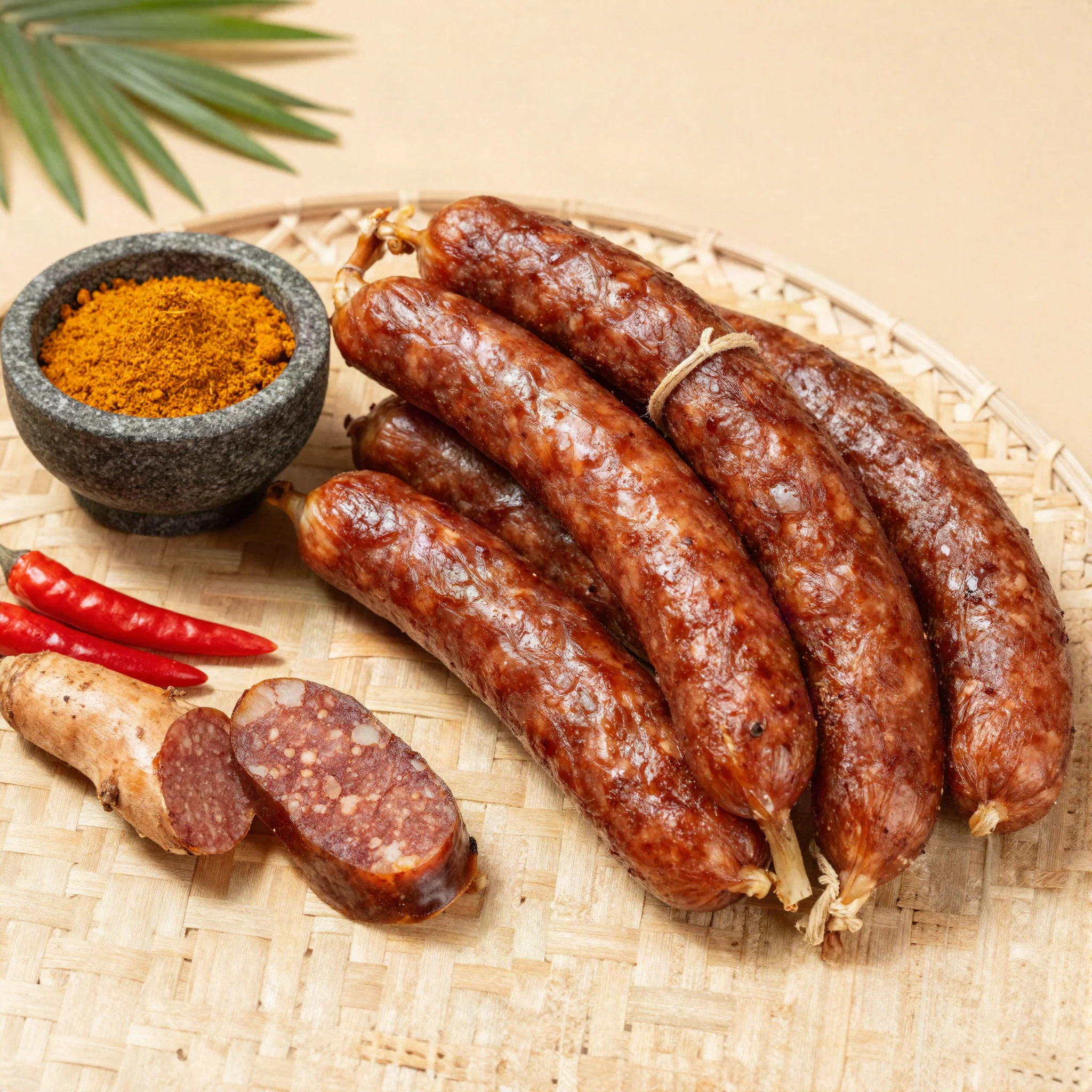
Urutan (Balinese spiced fermented-dried pork sausage)
Meat ferment/sausage
Facts
| Category | Meat / Fish |
|---|---|
| Product family | Southeast Asian Fermented Pork Sausage |
| Origin | 🇮🇩 Indonesia |
| Key microorganisms | lactic-acid-bacteria |
Safety
- The fermented-pork hazard profile applies, with this entry's own uncertainty stated plainly:
(a) Trichinella and other pork parasites — the governing hazard for any pork ferment; neither fermentation nor sun-drying is a reliable parasite-inactivation step, and inspected sourcing, regulated freezing or thorough cooking are the recognized controls. Urutan is traditionally cooked before eating, which materially reduces this and the bacterial hazards — this is an important difference from nem chua and naem and is stated rather than assumed.
(b) Bacterial pathogens of raw pork — Salmonella, Listeria, pathogenic E. coli — during preparation and the pre-cooking stages.
(c) Staphylococcus aureus toxin — hazard if acidification is slow during ambient holding.
(d) Clostridium botulinum — relevant in stuffed, anaerobic meat held at ambient temperature; whether curing salts are used in traditional urutan is not established.
(e) Sun-drying at ambient tropical temperatures carries its own hazards — insect/animal contact, uneven drying, and a temperature range that can favour pathogen growth before the product firms; traditional practice manages this by short, hot, well-ventilated drying, but no numeric parameter is asserted.
(f) Biogenic amines in over-held product. Safe-practice guidance: use pork from an inspected supply; treat parasite control as a sourcing/freezing question; keep preparation clean and cold; protect the product during sun-drying; cook thoroughly before eating, as the tradition does; discard on off-odour, sliminess or atypical mould. Numerics: no pH, temperature, drying-duration, salt or nitrite figure asserted — (illustrative) / not established.
Method
Urutan (Balinese spiced fermented-dried pork sausage)
- Pork meat ~800 g and fat ~200 g, chopped/ground (illustrative) — SAFETY CONTROL (inspected supply)
- Salt — SAFETY CONTROL — ~25 g per kg (2.5 %) (illustrative at this precision; 2.5 % is the level United States guidance pairs with nitrite for Clostridium botulinum control)
- Balinese spice paste (base genep-type: shallot, garlic, chilli, turmeric, galangal, ginger, coriander, candlenut and related aromatics) — ~100 g (illustrative; household proportions vary widely and are not standardised)
- Natural casings — ~1.5 m of 30–35 mm (illustrative)
- Curing-salt use in traditional Balinese practice: not established. No retrieved instrument addresses this product.
- 1
Step 1
Keep the pork cold; work clean.
- 2
Step 2
Chop/grind the meat and fat; mix thoroughly with salt and the spice paste.
- 3
Step 3
Stuff into natural casings, excluding air pockets; tie into links.
- 4
Step 4
Fermentation stage: hold so the sausage sours and sets. (Parameters: not established.)
- 5
Step 5
Drying stage: dry — traditionally in the sun — until firm, protecting the product from insects and animals and ensuring good ventilation. (Duration and conditions: not established.)
- 6
Step 6
Cook thoroughly (commonly fried or grilled) before eating, as the tradition does.
Frequently asked questions
- What is Urutan (Balinese spiced fermented-dried pork sausage)?
- Meat ferment/sausage
- Which microorganisms ferment Urutan (Balinese spiced fermented-dried pork sausage)?
- Urutan (Balinese spiced fermented-dried pork sausage) is primarily driven by lactic-acid-bacteria.
- Where does Urutan (Balinese spiced fermented-dried pork sausage) come from?
- Urutan (Balinese spiced fermented-dried pork sausage) is traditionally made in Indonesia.
- Is Urutan (Balinese spiced fermented-dried pork sausage) safe to make at home?
- The fermented-pork hazard profile applies, with this entry's own uncertainty stated plainly:
(a) Trichinella and other pork parasites — the governing hazard for any pork ferment; neither fermentation nor sun-drying is a reliable parasite-inactivation step, and inspected sourcing, regulated freezing or thorough cooking are the recognized controls. Urutan is traditionally cooked before eating, which materially reduces this and the bacterial hazards — this is an important difference from nem chua and naem and is stated rather than assumed.
(b) Bacterial pathogens of raw pork — Salmonella, Listeria, pathogenic E. coli — during preparation and the pre-cooking stages.
(c) Staphylococcus aureus toxin — hazard if acidification is slow during ambient holding.
(d) Clostridium botulinum — relevant in stuffed, anaerobic meat held at ambient temperature; whether curing salts are used in traditional urutan is not established.
(e) Sun-drying at ambient tropical temperatures carries its own hazards — insect/animal contact, uneven drying, and a temperature range that can favour pathogen growth before the product firms; traditional practice manages this by short, hot, well-ventilated drying, but no numeric parameter is asserted.
(f) Biogenic amines in over-held product. Safe-practice guidance: use pork from an inspected supply; treat parasite control as a sourcing/freezing question; keep preparation clean and cold; protect the product during sun-drying; cook thoroughly before eating, as the tradition does; discard on off-odour, sliminess or atypical mould. Numerics: no pH, temperature, drying-duration, salt or nitrite figure asserted — (illustrative) / not established.
Community results
No community results published for this ferment yet.