
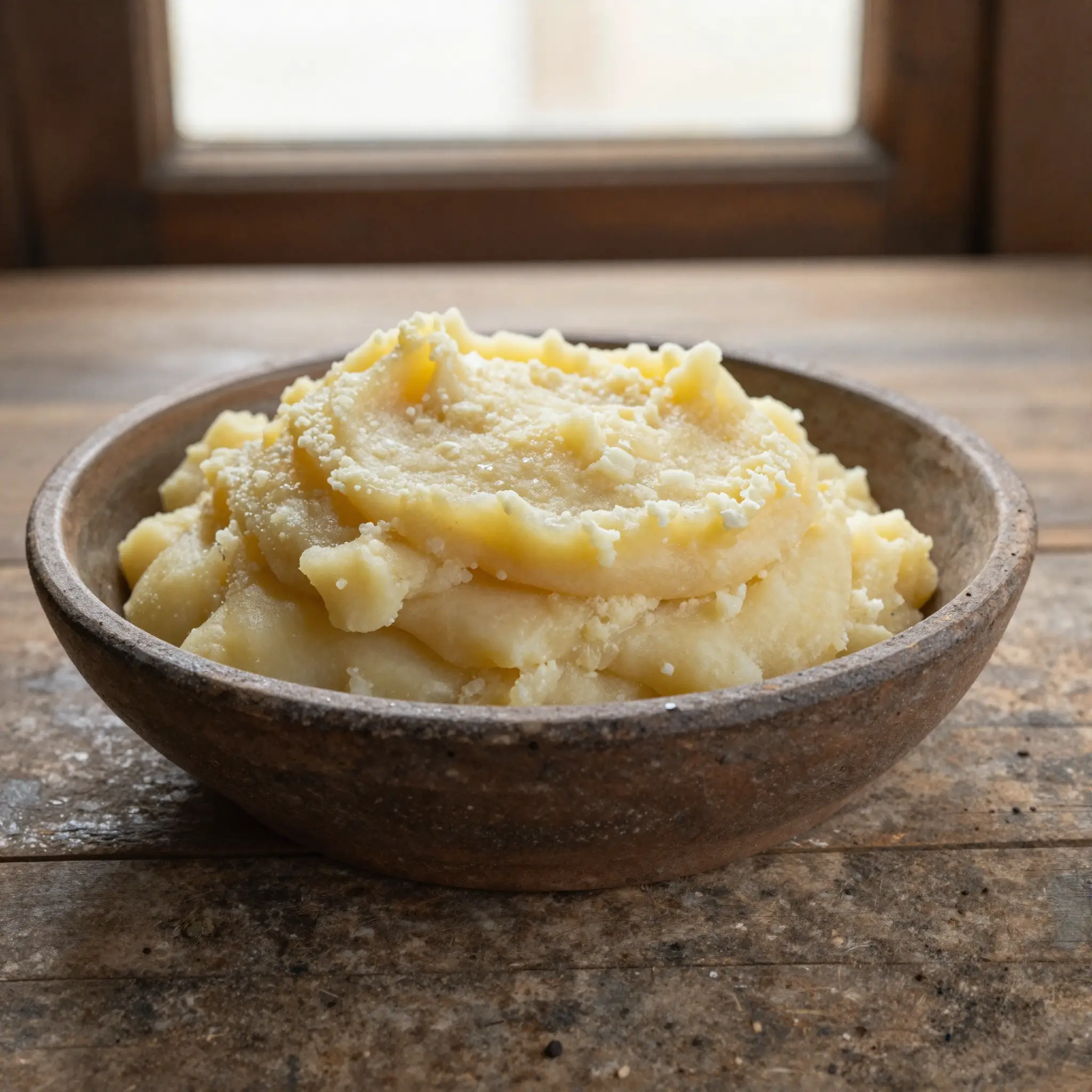
Tocosh (Andean pit-fermented potato)
Tocosh (Peruvian/Andean pit-fermented potato)
staple/starch preparation
Facts
| Category | Vegetable |
|---|---|
| Product family | Andean Pit-Fermented Root/Starch Staple |
| Origin | 🇵🇪 Peru |
Safety
- Tocosh's safety profile is structurally different from the other two Variants in this sub-batch and should not be assumed to share their salinity-floor logic, since no salt brine is used — the defining safety-relevant control here is sustained cold, flowing or frequently-refreshed water (which limits stagnant anaerobic low-acid pockets and helps suppress pathogens relative to a still, warm, unsalted soak) and full submersion of the potatoes throughout the fermentation period. Documented risk factor: an inadequately flowing/refreshed water source, insufficient submersion, or fermenting at excessively warm temperatures could in principle permit spoilage organisms or pathogenic growth in an unsalted, extended aqueous fermentation, though no substrate-specific incident data, pH figures, or a peer-reviewed hazard analysis for tocosh specifically was identified — this absence is stated honestly rather than filled with an invented number. Safe-practice guidance:
(a) use clean, cold, ideally flowing or frequently-refreshed water as the fermentation medium;
(b) keep potatoes fully submerged throughout;
(c) rely on the traditional, experience-based endpoint markers (softened texture, characteristic strong aroma) rather than a numeric target, since no pH or duration threshold for tocosh is available in the sources consulted (not established);
(d) cook tocosh thoroughly before eating, as it is traditionally consumed cooked (mazamorra/soup), not raw, which provides an additional safety margin beyond the fermentation step itself;
(e) discard on clearly putrid (as distinct from tocosh's normal strong, expected pungency) odour, visible non-food-grade contamination, or any sign the water source was stagnant/unclean.
Method
Tocosh (Peruvian/Andean Pit-Fermented Potato)
- Whole potatoes (traditionally a bitter/high-altitude variety) — ~1500 g (illustrative quantity)
- Clean, cold, ideally flowing or frequently-refreshed water — enough to fully submerge — SAFETY CONTROL, see linked Variant
- No salt is used — a defining structural difference from the other two Variants in this sub-batch, see linked Variant item 6
- 1
Step 1
Select whole, unblemished potatoes.
- 2
Step 2
Place potatoes in a mesh or breathable sack.
- 3
Step 3
Submerge the sack fully in a clean, cold, flowing water source (traditionally a highland stream or spring-fed pit) or, as a home approximation, a container of water changed frequently to keep it fresh and cold.
- 4
Step 4
Weight or anchor the sack so the potatoes remain fully submerged throughout.
- 5
Step 5
Leave to ferment at cool ambient/water temperature for an extended period — traditionally weeks to a few months (illustrative range; precise duration is genuinely variable and not pinned to a single figure in sources reviewed).
- 6
Step 6
Periodically check that submersion is maintained and the water source remains clean/flowing (or is refreshed, in a home approximation).
- 7
Step 7
Retrieve the potatoes once softened and characteristically pungent-smelling.
- 8
Step 8
Rinse the retrieved potatoes.
- 9
Step 9
Cook thoroughly — traditionally into a mazamorra (porridge) or soup — before eating; tocosh is not traditionally eaten raw.
Frequently asked questions
- What is Tocosh (Andean pit-fermented potato)?
- staple/starch preparation
- Where does Tocosh (Andean pit-fermented potato) come from?
- Tocosh (Andean pit-fermented potato) is traditionally made in Peru.
- Is Tocosh (Andean pit-fermented potato) safe to make at home?
- Tocosh's safety profile is structurally different from the other two Variants in this sub-batch and should not be assumed to share their salinity-floor logic, since no salt brine is used — the defining safety-relevant control here is sustained cold, flowing or frequently-refreshed water (which limits stagnant anaerobic low-acid pockets and helps suppress pathogens relative to a still, warm, unsalted soak) and full submersion of the potatoes throughout the fermentation period. Documented risk factor: an inadequately flowing/refreshed water source, insufficient submersion, or fermenting at excessively warm temperatures could in principle permit spoilage organisms or pathogenic growth in an unsalted, extended aqueous fermentation, though no substrate-specific incident data, pH figures, or a peer-reviewed hazard analysis for tocosh specifically was identified — this absence is stated honestly rather than filled with an invented number. Safe-practice guidance:
(a) use clean, cold, ideally flowing or frequently-refreshed water as the fermentation medium;
(b) keep potatoes fully submerged throughout;
(c) rely on the traditional, experience-based endpoint markers (softened texture, characteristic strong aroma) rather than a numeric target, since no pH or duration threshold for tocosh is available in the sources consulted (not established);
(d) cook tocosh thoroughly before eating, as it is traditionally consumed cooked (mazamorra/soup), not raw, which provides an additional safety margin beyond the fermentation step itself;
(e) discard on clearly putrid (as distinct from tocosh's normal strong, expected pungency) odour, visible non-food-grade contamination, or any sign the water source was stagnant/unclean.
Community results
No community results published for this ferment yet.