
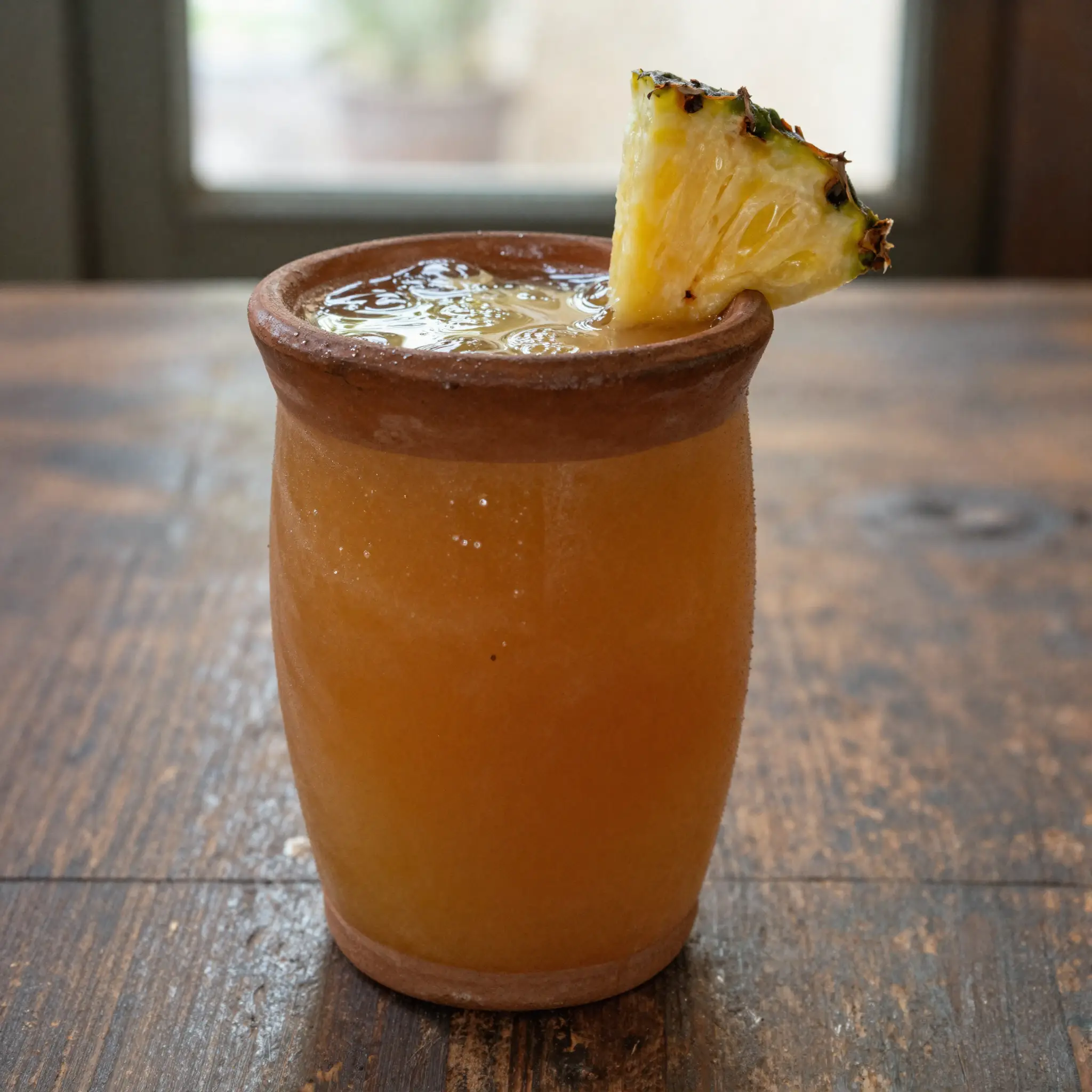
Tepache (Mexican fermented pineapple-peel beverage)
Beverage
Facts
| Category | Fruit |
|---|---|
| Product family | Fermented Fruit-Peel Beverage |
| Origin | 🇲🇽 Mexico |
| Key microorganisms | lactic-acid-bacteria, yeasts |
Safety
- Documented considerations (honest, beverage-appropriate):
(a) tepache is a spontaneous fermentation with no defined starter culture, so adequate acidification and visible fermentation activity (bubbling, aroma) are the primary indicators that the process is proceeding safely rather than merely sitting as a static sugar-fruit mixture;
(b) as with any open-vessel spontaneous ferment, mould or markedly off/putrid odours (as opposed to the expected sour-sweet, mildly yeasty aroma) signal spoilage rather than successful fermentation — such batches should be discarded, not consumed;
(c) the mild alcohol content that develops, particularly with extended fermentation, should be disclosed to consumers avoiding alcohol (children, pregnant individuals, those abstaining for health/religious/personal reasons), per the same boundary-note discipline as kefir/kumis/shubat;
(d) if fermented in a sealed or tightly-capped vessel, the CO2 produced by the yeast component can build pressure — traditional practice uses a loosely covered vessel for this reason; a tightly sealed container risks over-carbonation/bottle-pressure buildup and potential vessel rupture, an honest mechanical risk rather than a fabricated numeric pressure threshold;
(e) potable water must be used throughout. Safe-practice guidance: use clean equipment and potable water; ferment in a loosely covered (not airtight) vessel at ambient temperature; taste/smell-check before consuming and discard on any mould growth or clearly putrid off-odour; refrigerate once at the desired sourness/carbonation level to slow further fermentation and further alcohol development; disclose the mild alcohol content where relevant. No specific pathogen thresholds, pH figures, or alcohol percentages are asserted — any such figure is illustrative or not established.
Method
Tepache (Mexican Fermented Pineapple-Peel Beverage)
- Pineapple peel/rind (and often a portion of the core) — from about 1 whole pineapple, well-washed
- Piloncillo (unrefined cane sugar) or brown sugar — ~150–200 g (illustrative), quantity a matter of household taste, not a safety parameter
- Water — ~2 L, potable
- Optional: a cinnamon stick, whole cloves (flavour only, non-safety); optional regional substitutions (maize/apple/orange) per the linked Variant's item 6 note — not elaborated further here
- 1
Step 1
Wash the pineapple well before peeling, to reduce surface contaminants while still retaining the naturally-occurring epiphytic LAB and wild yeasts that drive the spontaneous fermentation.
- 2
Step 2
Place the pineapple peel (and optional core) in a clean, non-reactive vessel.
- 3
Step 3
Dissolve the piloncillo/brown sugar in the potable water and pour over the peel; add any optional spices.
- 4
Step 4
Cover loosely (cloth or lid ajar, not airtight) to allow gas escape while limiting contamination.
- 5
Step 5
Leave to ferment spontaneously at ambient temperature.
- 6
Step 6
Check daily: naturally-occurring LAB acidify the liquid while wild yeasts concurrently produce mild carbonation and a low level of alcohol.
- 7
Step 7
Taste from around day 1–2 onward; continue fermenting to the desired sourness/carbonation (typically 1–3 days, illustrative, tradition- and household-variable — longer fermentation drifts the product toward a more distinctly alcoholic beverage).
- 8
Step 8
Strain out the solids.
- 9
Step 9
Refrigerate and serve over ice; optionally floated with a splash of beer per modern serving custom (a serving custom, not part of the ferment).
Frequently asked questions
- What is Tepache (Mexican fermented pineapple-peel beverage)?
- Beverage
- Which microorganisms ferment Tepache (Mexican fermented pineapple-peel beverage)?
- Tepache (Mexican fermented pineapple-peel beverage) is primarily driven by lactic-acid-bacteria, yeasts.
- Where does Tepache (Mexican fermented pineapple-peel beverage) come from?
- Tepache (Mexican fermented pineapple-peel beverage) is traditionally made in Mexico.
- Is Tepache (Mexican fermented pineapple-peel beverage) safe to make at home?
- Documented considerations (honest, beverage-appropriate):
(a) tepache is a spontaneous fermentation with no defined starter culture, so adequate acidification and visible fermentation activity (bubbling, aroma) are the primary indicators that the process is proceeding safely rather than merely sitting as a static sugar-fruit mixture;
(b) as with any open-vessel spontaneous ferment, mould or markedly off/putrid odours (as opposed to the expected sour-sweet, mildly yeasty aroma) signal spoilage rather than successful fermentation — such batches should be discarded, not consumed;
(c) the mild alcohol content that develops, particularly with extended fermentation, should be disclosed to consumers avoiding alcohol (children, pregnant individuals, those abstaining for health/religious/personal reasons), per the same boundary-note discipline as kefir/kumis/shubat;
(d) if fermented in a sealed or tightly-capped vessel, the CO2 produced by the yeast component can build pressure — traditional practice uses a loosely covered vessel for this reason; a tightly sealed container risks over-carbonation/bottle-pressure buildup and potential vessel rupture, an honest mechanical risk rather than a fabricated numeric pressure threshold;
(e) potable water must be used throughout. Safe-practice guidance: use clean equipment and potable water; ferment in a loosely covered (not airtight) vessel at ambient temperature; taste/smell-check before consuming and discard on any mould growth or clearly putrid off-odour; refrigerate once at the desired sourness/carbonation level to slow further fermentation and further alcohol development; disclose the mild alcohol content where relevant. No specific pathogen thresholds, pH figures, or alcohol percentages are asserted — any such figure is illustrative or not established.
Community results
No community results published for this ferment yet.