
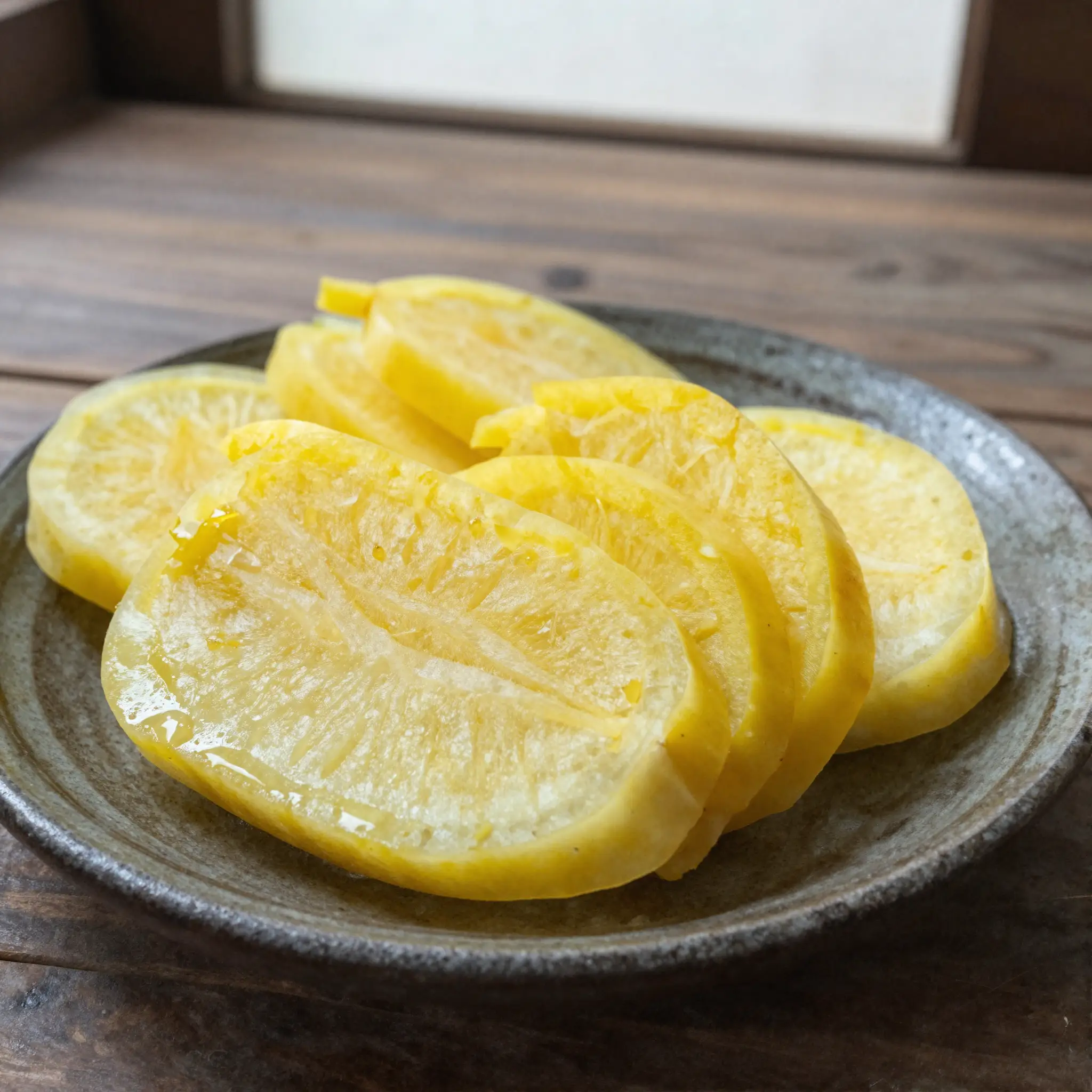
Takuan (fermented dried-daikon pickle)
Takuan (Japanese fermented dried-daikon pickle)
vegetable-ferment-pickle
Facts
| Category | Vegetable |
|---|---|
| Product family | Tsukemono |
| Origin | 🇯🇵 Japan |
Safety
- Documented risk factors follow the same bran-bed logic as Nukazuke plus a drying-stage consideration specific to takuan:
(a) inadequate pre-drying (daikon left too wet) can slow acidification and favour spoilage organisms in the early bed stage;
(b) as with any salt-dependent solid-state ferment, inadequate salt or a poorly-maintained/contaminated bed permits spoilage;
(c) a properly progressing ferment shows a pleasant sour/fermented aroma and the expected pale-yellow colour development — putrid odour, unusual sliming, or unexpected mould beyond a harmless surface film are actionable discard/rework signals. Safe-practice guidance: dry the daikon sufficiently before burying (home practice targets a visibly wilted, flexible root, not a fresh crisp one — precise regulatory-grade moisture-content floors are not established; maintain adequate bed salinity and hygiene during maintenance; keep the daikon fully buried; discard/rework on off-odour or contamination signs; this safety statement applies only to the traditional fermented Variant, not to the modern vinegar/colour/sweetener quick-pickled product, which is a distinct, non-fermented preparation outside this Variant's scope.
Method
Takuan (Fermented Dried-Daikon Pickle — Traditional Style)
- Whole daikon radish — ~2000 g
- Rice bran (nuka) — ~1000 g
- Non-iodized salt — quantity to layer with the bran (illustrative; precise regulatory-grade salt-% floor is not established) — SAFETY CONTROL, see linked Variant
- Kombu, dried chili, persimmon peel — optional traditional regional flavour additions (non-safety)
- 1
Step 1
Harvest and trim whole daikon; wash and leave whole.
- 2
Step 2
Sun-dry the daikon, traditionally hanging outdoors, until visibly wilted and flexible and substantially reduced in water content (precise moisture floor not established.
- 3
Step 3
Mix rice bran with salt (and any optional traditional additions) to form the burying medium.
- 4
Step 4
Layer the dried daikon with the bran-and-salt mixture in a weighted, non-reactive vessel, ensuring the daikon is fully buried.
- 5
Step 5
Weight the layered vessel so the daikon stays fully embedded in the bran bed.
- 6
Step 6
Ferment anaerobically at ambient-to-cool temperature over an extended period (traditionally weeks to a few months).
- 7
Step 7
Check periodically that the daikon remains fully buried and that the bed shows expected pale-yellow colour development and a pleasant sour/fermented aroma as fermentation progresses.
- 8
Step 8
Remove, rinse off clinging bran, slice, and serve once at target flavour; refrigerate remainder.
Frequently asked questions
- What is Takuan (fermented dried-daikon pickle)?
- vegetable-ferment-pickle
- Where does Takuan (fermented dried-daikon pickle) come from?
- Takuan (fermented dried-daikon pickle) is traditionally made in Japan.
- Is Takuan (fermented dried-daikon pickle) safe to make at home?
- Documented risk factors follow the same bran-bed logic as Nukazuke plus a drying-stage consideration specific to takuan:
(a) inadequate pre-drying (daikon left too wet) can slow acidification and favour spoilage organisms in the early bed stage;
(b) as with any salt-dependent solid-state ferment, inadequate salt or a poorly-maintained/contaminated bed permits spoilage;
(c) a properly progressing ferment shows a pleasant sour/fermented aroma and the expected pale-yellow colour development — putrid odour, unusual sliming, or unexpected mould beyond a harmless surface film are actionable discard/rework signals. Safe-practice guidance: dry the daikon sufficiently before burying (home practice targets a visibly wilted, flexible root, not a fresh crisp one — precise regulatory-grade moisture-content floors are not established; maintain adequate bed salinity and hygiene during maintenance; keep the daikon fully buried; discard/rework on off-odour or contamination signs; this safety statement applies only to the traditional fermented Variant, not to the modern vinegar/colour/sweetener quick-pickled product, which is a distinct, non-fermented preparation outside this Variant's scope.
Community results
No community results published for this ferment yet.