
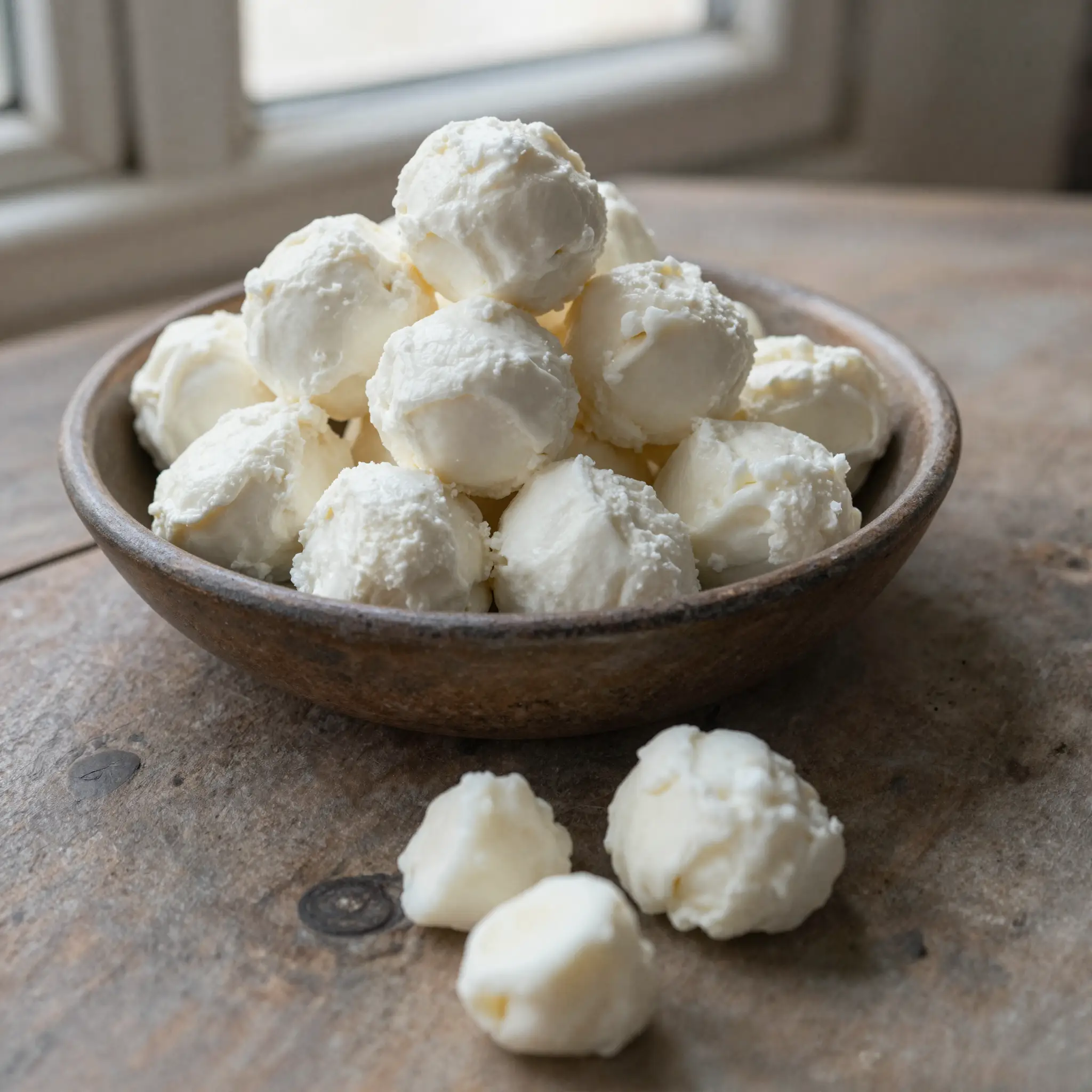
Suzma / Qurut (Central Asian strained-then-dried yogurt balls)
Dairy product
Facts
| Category | Dairy |
|---|---|
| Product family | Strained-and-Dried Fermented-Milk Preservation |
Safety
- Inherits the base dairy-lactic safety floor with drying/storage-specific considerations layered on top, recorded honestly given this product's genuinely thin sourcing (medium confidence). Documented risk factors:
(a) raw-milk vs. pasteurized-milk — as with labneh, starting from unpasteurized milk carries materially higher pathogen risk that fermentation's own acidification does not reliably eliminate; traditional household qurut is frequently made from raw milk in its region of origin, a real-world practice noted honestly rather than silently assumed safe;
(b) adequate acidification of the base ferment before straining/drying — a fully soured, low-pH base product is the primary safety margin carried into the dried form;
(c) straining hygiene, identical concern to labneh;
(d) the dried, low-moisture storage form is qurut's own safety mechanism — thorough, complete drying to a hard, low-water-activity state is what makes extended ambient storage viable; incomplete or uneven drying (a moist interior under a dry crust) is the primary documented failure mode for this preservation method and can permit spoilage or mould growth despite an apparently dry exterior;
(e) precise numeric safety floors (target water activity, minimum drying duration, safe ambient storage duration) are not present in our sources for this specific product and are not established.
Method
Suzma / Qurut (Central Asian Strained-Then-Dried Yogurt Balls)
- Whole milk (cow's, sheep's, or goat's) — ~1 L, or substitute plain full-fat soured milk/yogurt made from same — ~1 kg
- Starter (defined commercial culture, back-slopped previous batch, or spontaneous souring per regional household practice — see linked Variant item 6 for the either/or discipline) — for the base ferment stage only, if starting from milk
- Salt — a moderate amount, to taste, worked in after straining (illustrative quantity) — flavor and mild preservative role, not a substitute for the drying step's own safety function
- 1
Step 1
If starting from milk: ferment into a soured, set yogurt-type product per the household's regional practice (starter-driven or spontaneous, per linked Variant item 6).
- 2
Step 2
Line a colander or bowl with clean muslin/cloth; pour in the set soured milk.
- 3
Step 3
Gather the cloth corners and tie into a bag; suspend to drain at cool ambient temperature until a thick curd (suzma) remains — this intermediate strained stage is itself a distinct named product (suzma), comparable in texture to labneh.
- 4
Step 4
Work salt into the strained curd.
- 5
Step 5
Shape the salted curd by hand into small balls or flattened discs.
- 6
Step 6
Arrange the shaped pieces on a clean tray or cloth in full sun (traditionally outdoors or on a rooftop, in a dry climate).
- 7
Step 7
Sun-dry over several days to weeks (illustrative, duration depends on piece size, humidity, and sun exposure), turning periodically, until fully hardened all the way through — this fully dried stage is qurut.
- 8
Step 8
Once hard and completely dehydrated, store at ambient/room temperature in a dry, clean container.
- 9
Step 9
To use: rehydrate qurut pieces in water (soaking or simmering) before eating directly or incorporating into a dish (e.g. qurutob).
Frequently asked questions
- What is Suzma / Qurut (Central Asian strained-then-dried yogurt balls)?
- Dairy product
- Is Suzma / Qurut (Central Asian strained-then-dried yogurt balls) safe to make at home?
- Inherits the base dairy-lactic safety floor with drying/storage-specific considerations layered on top, recorded honestly given this product's genuinely thin sourcing (medium confidence). Documented risk factors:
(a) raw-milk vs. pasteurized-milk — as with labneh, starting from unpasteurized milk carries materially higher pathogen risk that fermentation's own acidification does not reliably eliminate; traditional household qurut is frequently made from raw milk in its region of origin, a real-world practice noted honestly rather than silently assumed safe;
(b) adequate acidification of the base ferment before straining/drying — a fully soured, low-pH base product is the primary safety margin carried into the dried form;
(c) straining hygiene, identical concern to labneh;
(d) the dried, low-moisture storage form is qurut's own safety mechanism — thorough, complete drying to a hard, low-water-activity state is what makes extended ambient storage viable; incomplete or uneven drying (a moist interior under a dry crust) is the primary documented failure mode for this preservation method and can permit spoilage or mould growth despite an apparently dry exterior;
(e) precise numeric safety floors (target water activity, minimum drying duration, safe ambient storage duration) are not present in our sources for this specific product and are not established.
Community results
No community results published for this ferment yet.