
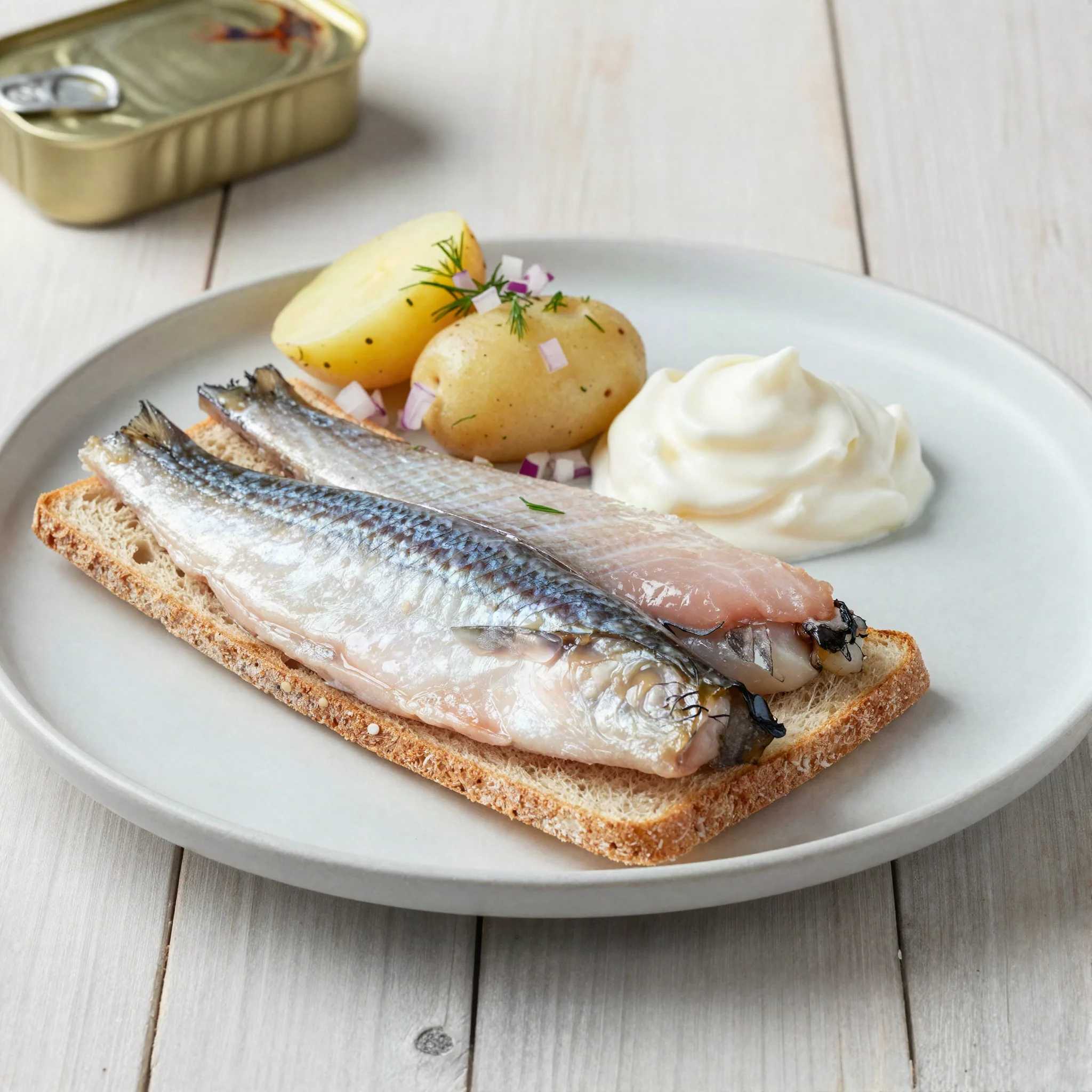
Surströmming (Swedish brine-fermented Baltic herring)
Fish ferment/preserved staple
Facts
| Category | Meat / Fish |
|---|---|
| Product family | Nordic Fermented Fish |
| Origin | 🇸🇪 Sweden |
| Key microorganisms | lactic-acid-bacteria, halophilic-other |
Safety
- (a) The bulging tin — handled honestly. Surströmming ferments inside its sealed tin; the gas and the bulge are the intended process, not evidence of failure. But the exception has limits: the product's safety rests on the salt level and the controlled commercial process, not on the absence of gas. The bulge is simply not an available warning sign here, so the usual "swollen can = discard" rule does not apply to this one product — and must not be relaxed for ordinary canned food, where a swollen can remains a discard signal. So the remaining checks carry more weight: discard any tin that is damaged, punctured, rusted, leaking, or that smells wrong on opening (pungent by design is not the same as putrid or chemically "off"), and buy only from a commercial supply chain that has kept it cool.
(b) Clostridium botulinum type E — the fish-associated, cold-tolerant type, which is exactly why the point above matters: a low-oxygen, sealed, cool fish product is its niche, and the salt level plus an acidification that actually proceeds are the hurdles. This is not a home-production project — commercial surströmming is made under food-regulation oversight; improvised low-salt fish fermentation in a sealed container is genuinely dangerous.
(c) Salt is the primary hurdle — deliberately moderate to permit the ferment, which leaves less margin than a fully salted preserve; reducing it further removes the control the process depends on.
(d) Histamine / scombroid poisoning — herring is a documented histamine-forming species, and histamine is heat-stable and NOT destroyed by cooking; the control is fresh, cold-handled fish before salting and cool storage after, and nothing downstream removes it.
(e) Parasites — anisakid nematodes occur in Baltic herring; fermentation is not a reliable inactivation step, whereas regulated freezing regimes are the documented control.
(f) Listeria monocytogenes and Salmonella — ready-to-eat, no cooking step.
(g) Fish allergen — a major regulated allergen.
(h) Practical handling — the tin is pressurized and will spray; open cool, outdoors, away from other food. Safe-practice guidance: buy commercially produced surströmming; keep it refrigerated; check the tin's integrity before opening; open cool and outdoors; refrigerate and eat promptly; do not attempt home fermentation of fish in a sealed container. Numerics: no salt percentage, pH, histamine ppm, temperature or duration figure is asserted here — regulated, authority-grade values; every such figure is (illustrative) or not established.
Method
Surströmming (Swedish brine-fermented Baltic herring)
- Baltic herring (strömming), traditionally caught in spring before spawning, gutted with roe/milt often left in — ~3 kg (illustrative). Freshness and cold handling — SAFETY CONTROL.
- Salt — SAFETY CONTROL, and the defining variable of this process. Used first as a strong brine, then as a deliberately weaker brine for the long ferment. No brine strength is given here, and that is deliberate rather than an omission: the weak second brine is precisely what makes this product what it is, and Clostridium botulinum type E — the cold-tolerant marine type — grows at 3.3 °C, i.e. at refrigerator temperature. A published home brine figure for this one product would be the most dangerous line.
- This is not a home project. Surströmming is made commercially under a controlled, validated salt-and-temperature regime and packed under supervision. Read the linked Variant before going further.
- Fermentation barrels/vats; tins and a seaming line for the packed stage
- Note: no sugar, no vinegar, no spice, no smoke, no starter — herring, salt and time
- 1
Step 1
Catch and gut the herring, keeping it cold; the roe or milt is commonly left in.
- 2
Step 2
Hold the fish briefly in a strong brine.
- 3
Step 3
Transfer to a weaker brine in barrels or vats for the fermentation proper, at cool ambient temperature. (Salt concentrations, temperature and duration: not established.)
- 4
Step 4
Fermentation stage: hold for a period of weeks-to-months while the flesh softens and sours and the characteristic aroma develops.
- 5
Step 5
Pack into tins with brine and seal. (Timing of the transfer to tin: not established.)
- 6
Step 6
Fermentation continues inside the sealed tin, generating gas and pressure — this is why tins bulge, and it is the product working as intended, not a defect.
- 7
Step 7
Store the tins cool; by long custom the product is released for sale only after a set point in the season. (Season conventions: not established.)
- 8
Step 8
Serving: check the tin's physical integrity, then open it cool and outdoors — traditionally in or under water to contain the spray and aroma. Rinse and fillet, and serve with thin bread (tunnbröd), almond potato, onion, sour cream and dill.
Frequently asked questions
- What is Surströmming (Swedish brine-fermented Baltic herring)?
- Fish ferment/preserved staple
- Which microorganisms ferment Surströmming (Swedish brine-fermented Baltic herring)?
- Surströmming (Swedish brine-fermented Baltic herring) is primarily driven by lactic-acid-bacteria, halophilic-other.
- Where does Surströmming (Swedish brine-fermented Baltic herring) come from?
- Surströmming (Swedish brine-fermented Baltic herring) is traditionally made in Sweden.
- Is Surströmming (Swedish brine-fermented Baltic herring) safe to make at home?
- (a) The bulging tin — handled honestly. Surströmming ferments inside its sealed tin; the gas and the bulge are the intended process, not evidence of failure. But the exception has limits: the product's safety rests on the salt level and the controlled commercial process, not on the absence of gas. The bulge is simply not an available warning sign here, so the usual "swollen can = discard" rule does not apply to this one product — and must not be relaxed for ordinary canned food, where a swollen can remains a discard signal. So the remaining checks carry more weight: discard any tin that is damaged, punctured, rusted, leaking, or that smells wrong on opening (pungent by design is not the same as putrid or chemically "off"), and buy only from a commercial supply chain that has kept it cool.
(b) Clostridium botulinum type E — the fish-associated, cold-tolerant type, which is exactly why the point above matters: a low-oxygen, sealed, cool fish product is its niche, and the salt level plus an acidification that actually proceeds are the hurdles. This is not a home-production project — commercial surströmming is made under food-regulation oversight; improvised low-salt fish fermentation in a sealed container is genuinely dangerous.
(c) Salt is the primary hurdle — deliberately moderate to permit the ferment, which leaves less margin than a fully salted preserve; reducing it further removes the control the process depends on.
(d) Histamine / scombroid poisoning — herring is a documented histamine-forming species, and histamine is heat-stable and NOT destroyed by cooking; the control is fresh, cold-handled fish before salting and cool storage after, and nothing downstream removes it.
(e) Parasites — anisakid nematodes occur in Baltic herring; fermentation is not a reliable inactivation step, whereas regulated freezing regimes are the documented control.
(f) Listeria monocytogenes and Salmonella — ready-to-eat, no cooking step.
(g) Fish allergen — a major regulated allergen.
(h) Practical handling — the tin is pressurized and will spray; open cool, outdoors, away from other food. Safe-practice guidance: buy commercially produced surströmming; keep it refrigerated; check the tin's integrity before opening; open cool and outdoors; refrigerate and eat promptly; do not attempt home fermentation of fish in a sealed container. Numerics: no salt percentage, pH, histamine ppm, temperature or duration figure is asserted here — regulated, authority-grade values; every such figure is (illustrative) or not established.
Community results
No community results published for this ferment yet.