
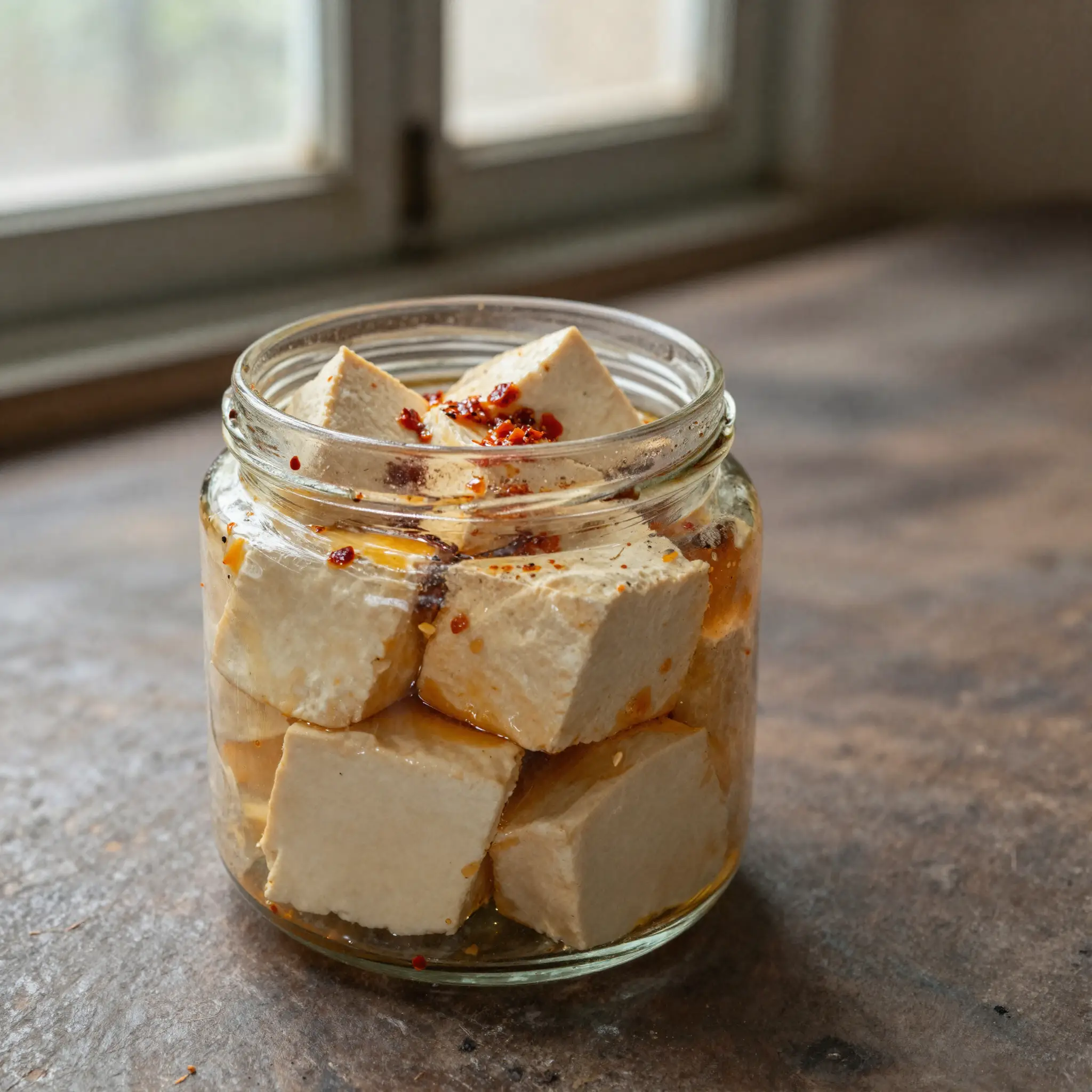
Sufu (Chinese mold-fermented tofu)
Sufu (Chinese fermented/mold-ripened tofu)
Legume ferment/condiment
Facts
| Category | Grain / Legume |
|---|---|
| Product family | Chinese Mold-Fermented Tofu Condiment |
| Origin | 🇨🇳 China |
| Key microorganisms | filamentous-fungi-molds |
Safety
- Documented considerations (honest, soy/legume-appropriate):
(a) sufu's defining mold-ripening step relies on a deliberately cultivated, food-safe mold culture, categorically distinct from incidental/uncontrolled spoilage mould — genuine production requires using a known, intentionally propagated starter mold under controlled conditions, and any tofu cube showing unexpected colours (e.g. green, black, or otherwise atypical for the intended culture), off-odours, or signs of contamination from unintended organisms should be discarded, not used; this is not independently confirmed as specific to this product;
(b) the tofu substrate itself is made from cooked/processed soybeans (soy milk is produced by cooking soaked, ground soybeans), so the general soy-allergen consideration applies — sufu is not suitable for individuals with soybean allergy;
(c) the brining/salting stage is a significant, defining safety-relevant step — the salt concentration in the brine inhibits undesired microbial growth during the extended aging period, though this is not independently confirmed as specific to this product, since none is independently documented for this specific product; any such figure is illustrative or not established;
(d) potable water and clean equipment must be used throughout tofu preparation, mold inoculation, and brining. Safe-practice guidance: use a known, food-safe mold starter culture (not ambient/spontaneous mould growth) for the ripening stage; discard any cubes showing atypical colouration, off-odours, or signs of unintended contamination; ensure adequate salt in the brine to support safe extended aging, without asserting a specific numeric threshold; be aware of the soy-allergen status of the finished product; use potable water and clean equipment throughout. No specific pathogen thresholds, salt-percentage figures, pH figures, or aging-duration numerics are asserted — any such figure is illustrative or not established.
Method
Sufu (Chinese Mold-Fermented Tofu, Brined/Aged)
- Firm tofu — ~500 g, cut into small cubes
- Mold starter culture (traditionally Actinomucor or Mucor spp., a defined food-safe starter) — as required for inoculation, SAFETY CONTROL item (must be a known, food-safe culture, not ambient/spontaneous mould)
- Salt — for dry-salting and/or brine, quantity (illustrative)
- Brine/seasoning liquid — potable water, salt, optionally rice wine, chili, or red yeast rice (regional variants, flavour only)
- 1
Step 1
Cut firm tofu into small, evenly-sized cubes.
- 2
Step 2
Arrange the cubes with space between them on a clean tray or rack under controlled humidity and temperature.
- 3
Step 3
Inoculate the cube surfaces with the mold starter culture (a known, food-safe Actinomucor/Mucor culture).
- 4
Step 4
Allow the mold to grow over several days until the cubes are visibly coated with a white/grey mycelial layer (the "pehtze" stage).
- 5
Step 5
Once fully mold-coated, lightly salt the cubes (dry-salt or brief brine dip).
- 6
Step 6
Pack the salted, mold-coated cubes into clean jars with a brine/seasoning liquid (potable water, salt, and optionally rice wine, chili, or red yeast rice per regional preference).
- 7
Step 7
Seal and age the submerged cubes for an extended period (weeks to months), during which they soften and develop sufu's characteristic pungent, creamy flavour.
- 8
Step 8
Store the finished sufu in its brine, refrigerated or in a cool place, and use as a condiment or seasoning ingredient.
Frequently asked questions
- What is Sufu (Chinese mold-fermented tofu)?
- Legume ferment/condiment
- Which microorganisms ferment Sufu (Chinese mold-fermented tofu)?
- Sufu (Chinese mold-fermented tofu) is primarily driven by filamentous-fungi-molds.
- Where does Sufu (Chinese mold-fermented tofu) come from?
- Sufu (Chinese mold-fermented tofu) is traditionally made in China.
- Is Sufu (Chinese mold-fermented tofu) safe to make at home?
- Documented considerations (honest, soy/legume-appropriate):
(a) sufu's defining mold-ripening step relies on a deliberately cultivated, food-safe mold culture, categorically distinct from incidental/uncontrolled spoilage mould — genuine production requires using a known, intentionally propagated starter mold under controlled conditions, and any tofu cube showing unexpected colours (e.g. green, black, or otherwise atypical for the intended culture), off-odours, or signs of contamination from unintended organisms should be discarded, not used; this is not independently confirmed as specific to this product;
(b) the tofu substrate itself is made from cooked/processed soybeans (soy milk is produced by cooking soaked, ground soybeans), so the general soy-allergen consideration applies — sufu is not suitable for individuals with soybean allergy;
(c) the brining/salting stage is a significant, defining safety-relevant step — the salt concentration in the brine inhibits undesired microbial growth during the extended aging period, though this is not independently confirmed as specific to this product, since none is independently documented for this specific product; any such figure is illustrative or not established;
(d) potable water and clean equipment must be used throughout tofu preparation, mold inoculation, and brining. Safe-practice guidance: use a known, food-safe mold starter culture (not ambient/spontaneous mould growth) for the ripening stage; discard any cubes showing atypical colouration, off-odours, or signs of unintended contamination; ensure adequate salt in the brine to support safe extended aging, without asserting a specific numeric threshold; be aware of the soy-allergen status of the finished product; use potable water and clean equipment throughout. No specific pathogen thresholds, salt-percentage figures, pH figures, or aging-duration numerics are asserted — any such figure is illustrative or not established.
Community results
No community results published for this ferment yet.