
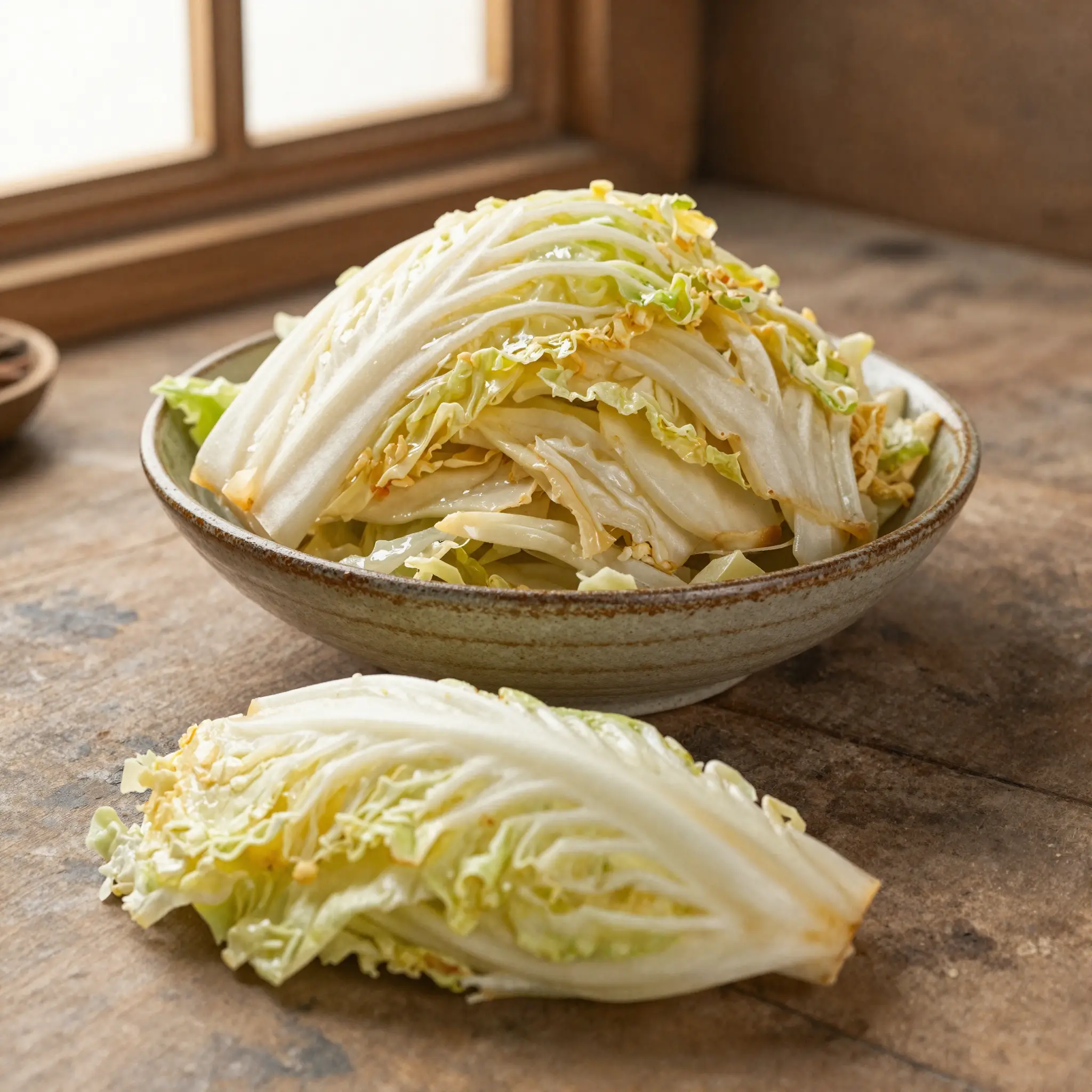
Suan cai (Northeast Chinese fermented cabbage)
vegetable-ferment-pickle
Facts
| Category | Vegetable |
|---|---|
| Product family | Fermented Cabbage |
| Origin | 🇨🇳 China |
Safety
- Same core anaerobic/salinity-floor logic as sauerkraut and kiselo zele. Documented risk factor — insufficient brine salinity or cabbage left exposed above the brine line permits spoilage organisms and, in a fully anaerobic low-acid pocket before acidification, a theoretical Clostridium botulinum concern. Safe-practice guidance:
(a) maintain an adequate salt brine (~2–4% by weight is the widely-cited home range for whole/large-cut cabbage ferments; precise regulatory-grade floors are substrate/recipe-specific — re-confirm before publishing a hard number);
(b) keep all cabbage fully submerged below the brine — exposed leaf above the line is the most common real-world failure point, and surface mould/off-odour there is a visible, actionable warning;
(c) target pH ≤4.6, typically reached within one to several weeks;
(d) do not seal into a shelf-stable, non-refrigerated low-acid state without a validated canning process.
Method
Suan Cai (Northeast Chinese Whole-Leaf Fermented Cabbage)
- Napa cabbage, whole heads or halved/large-cut leaves — ~2500 g (2–3 heads)
- Non-iodized salt — quantity to make a ~2–4% brine (illustrative) — SAFETY CONTROL, see linked Variant
- Water — enough to fully submerge (~2–2.5 L)
- Optional: a small amount of prior-batch brine for back-slopping (traditional; flavour/consistency aid, non-safety)
- 1
Step 1
Trim damaged outer leaves from napa cabbage; wash whole heads or halve/large-cut them.
- 2
Step 2
Wilt or lightly dry the cabbage briefly (traditionally a light sun- or air-wilt) to soften the leaves slightly before packing.
- 3
Step 3
Prepare the salt brine: dissolve salt fully in water to the target concentration.
- 4
Step 4
Pack the whole or large-cut cabbage tightly into a large clean jar or crock, leaving headspace.
- 5
Step 5
Pour brine over to fully cover the cabbage.
- 6
Step 6
Weight the cabbage so all leaf material stays submerged below the brine line.
- 7
Step 7
Cover with a breathable lid; ferment at cool ambient or cellar temperature.
- 8
Step 8
Check periodically: confirm submersion; skim any surface film; top up brine if the level drops.
- 9
Step 9
Ferment for several weeks (traditionally through the winter) until pleasantly sour.
- 10
Step 10
Store cold; use directly from the brine as a cooking ingredient (e.g. suan cai bai rou, stir-fries, dumpling fillings) rather than as a standalone side.
Frequently asked questions
- What is Suan cai (Northeast Chinese fermented cabbage)?
- vegetable-ferment-pickle
- Where does Suan cai (Northeast Chinese fermented cabbage) come from?
- Suan cai (Northeast Chinese fermented cabbage) is traditionally made in China.
- Is Suan cai (Northeast Chinese fermented cabbage) safe to make at home?
- Same core anaerobic/salinity-floor logic as sauerkraut and kiselo zele. Documented risk factor — insufficient brine salinity or cabbage left exposed above the brine line permits spoilage organisms and, in a fully anaerobic low-acid pocket before acidification, a theoretical Clostridium botulinum concern. Safe-practice guidance:
(a) maintain an adequate salt brine (~2–4% by weight is the widely-cited home range for whole/large-cut cabbage ferments; precise regulatory-grade floors are substrate/recipe-specific — re-confirm before publishing a hard number);
(b) keep all cabbage fully submerged below the brine — exposed leaf above the line is the most common real-world failure point, and surface mould/off-odour there is a visible, actionable warning;
(c) target pH ≤4.6, typically reached within one to several weeks;
(d) do not seal into a shelf-stable, non-refrigerated low-acid state without a validated canning process.
Community results
No community results published for this ferment yet.