
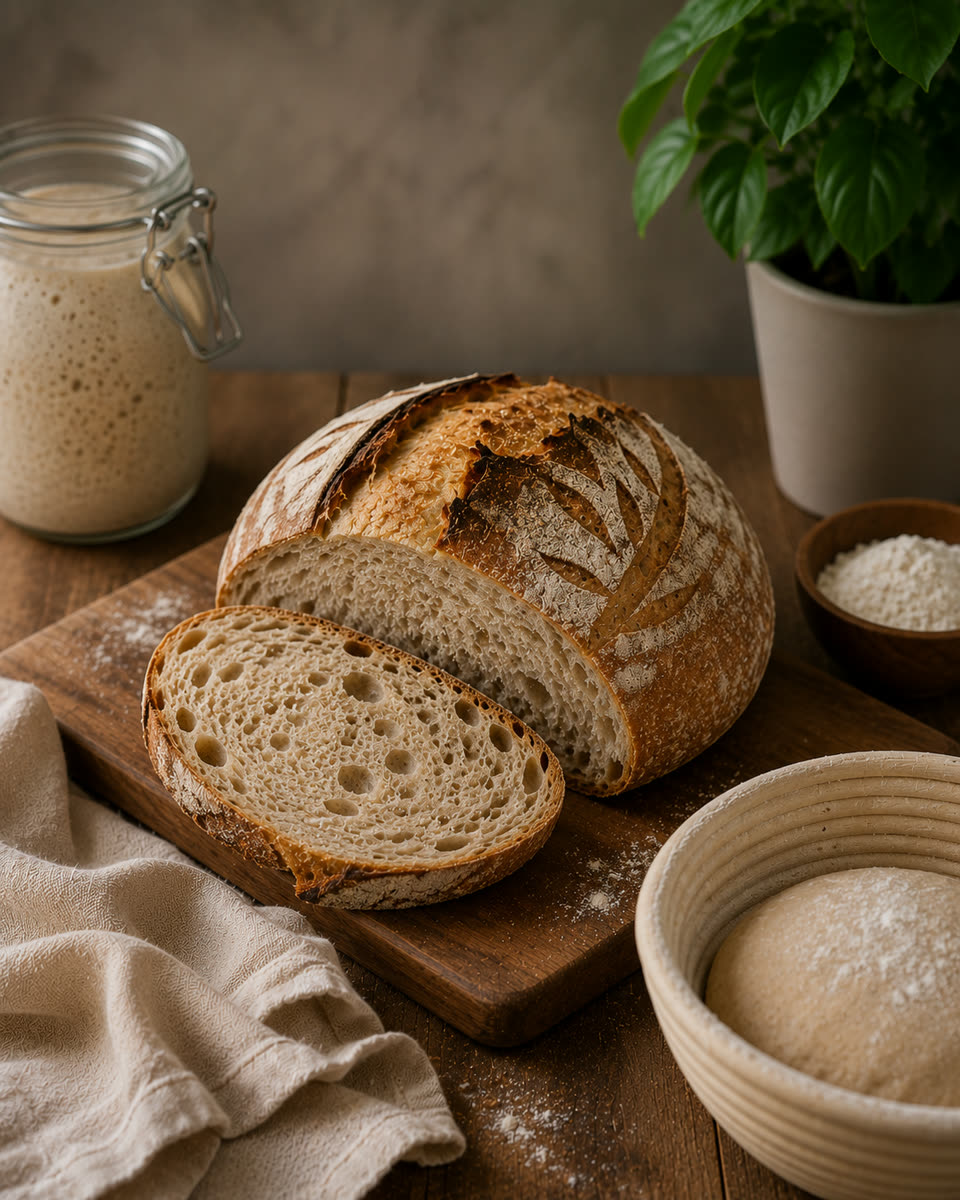
Sourdough Bread
Bread/staple
Facts
| Category | Grain / Legume |
|---|---|
| Origin | 🇪🇬 Egypt · origin disputed |
Safety
- No significant acute-hazard risk factors documented for standard sourdough bread-baking — the process concludes with a high-temperature bake, which is independently pathogen-inhibitory regardless of the fermentation stage's own safety profile. Safe-practice guidance:
(a) maintain starter hygiene (clean vessel, regular feeding) — a neglected/contaminated starter can develop off-odors or surface mold (visually/olfactorily detectable, actionable discard signal) rather than posing a silent hazard;
(b) liquid ("hooch") separation on a healthy starter is a normal sign of hunger, not spoilage, and is distinguished from true mold contamination (fuzzy, colored patches) — the same category of mold-discrimination judgment call as kombucha and koji, though at comparatively lower stakes given the terminal bake step.
Method
Sourdough Bread (Levain-Leavened Wheat Loaf)
- Active sourdough starter (a living LAB + wild-yeast co-culture, maintained by periodic feeding) — ~100 g, illustrative
- Wheat (or rye) flour — 500 g
- Water — ~350 mL, illustrative (hydration is a texture choice, not a safety control)
- Salt — ~10 g, illustrative (flavour and fermentation-rate control here — unlike the vegetable ferments, salt is not the preservation mechanism in bread)
- 1
Step 1
Maintain the starter: feed it flour and water on a regular schedule until it reliably doubles and smells pleasantly sour — an underfed starter simply won't leaven.
- 2
Step 2
Mix the active starter into the flour and water; hold before adding salt if you want an autolyse rest.
- 3
Step 3
Add the salt and work it through the dough.
- 4
Step 4
Bulk ferment at room temperature, folding periodically, until visibly risen and aerated — the LAB acidify while the wild yeast leavens via CO2.
- 5
Step 5
Shape the dough and place it in a banneton or lined bowl.
- 6
Step 6
Proof until ready (at room temperature, or overnight refrigerated for a slower, more sour result).
- 7
Step 7
Bake hot, ideally in a covered vessel for the first part of the bake to trap steam.
- 8
Step 8
Cool fully on a rack before cutting — the crumb is still setting as it cools.
Frequently asked questions
- What is Sourdough Bread?
- Bread/staple
- Where does Sourdough Bread come from?
- Sourdough Bread is traditionally made in Egypt.
- Is Sourdough Bread safe to make at home?
- No significant acute-hazard risk factors documented for standard sourdough bread-baking — the process concludes with a high-temperature bake, which is independently pathogen-inhibitory regardless of the fermentation stage's own safety profile. Safe-practice guidance:
(a) maintain starter hygiene (clean vessel, regular feeding) — a neglected/contaminated starter can develop off-odors or surface mold (visually/olfactorily detectable, actionable discard signal) rather than posing a silent hazard;
(b) liquid ("hooch") separation on a healthy starter is a normal sign of hunger, not spoilage, and is distinguished from true mold contamination (fuzzy, colored patches) — the same category of mold-discrimination judgment call as kombucha and koji, though at comparatively lower stakes given the terminal bake step.
Community results
No community results published for this ferment yet.