
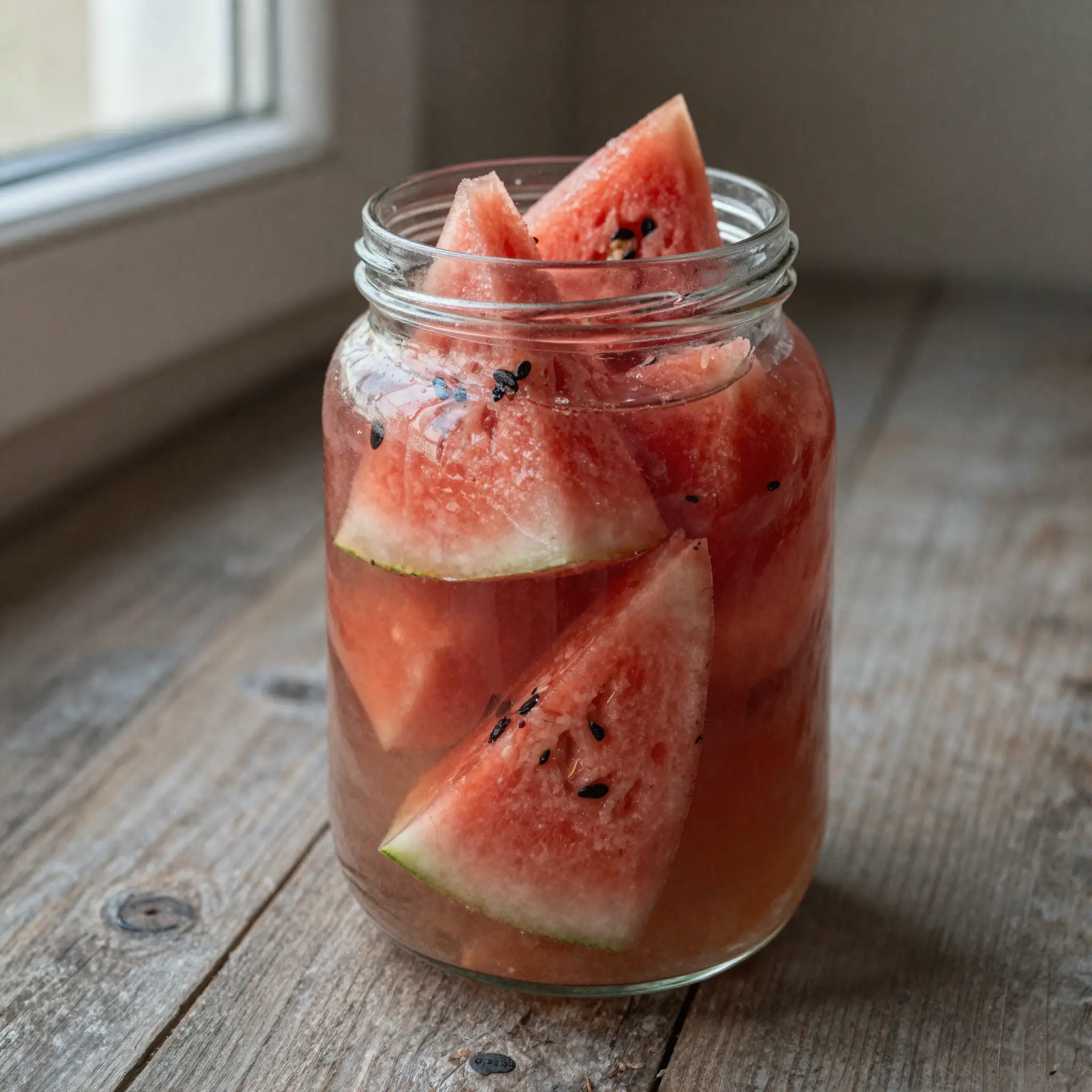
Solyonye arbuzy (Russian/Ukrainian brine-fermented watermelon)
Solyonye arbuzy (Russian/Ukrainian salt-brine-fermented watermelon)
vegetable-ferment-pickle
Facts
| Category | Fruit |
|---|---|
| Product family | Brine/Solution-Fermented Whole Fruit |
| Origin | 🇷🇺 Russia |
Safety
- Documented risk factor — as with mochyonye yabloki and kvashenye pomidory, inadequate brine salinity or loss of full submersion (fruit floating above the brine) permits spoilage; a whole, thick-rinded fruit can also acidify unevenly at its interior relative to cut produce unless pierced and given adequate fermentation time. Safe-practice guidance:
(a) maintain an adequate salt brine (~4–6% by weight is a widely-cited home range for whole-fruit vegetable-style brine ferments in this family; precise regulatory-grade floors are recipe-specific — re-confirm before publishing a hard number);
(b) pierce the rind to aid even brine penetration;
(c) keep fruit fully submerged below the brine throughout;
(d) target pH ≤4.6 before extended storage;
(e) do not seal into a shelf-stable, non-refrigerated low-acid state without a validated canning process.
Method
Solyonye Arbuzy (Russian/Ukrainian Salt-Brine-Fermented Watermelon)
- Small whole watermelons (less-ripe fruit ferments more reliably) — 2–3 small melons (~4–5 kg total)
- Non-iodized salt — quantity to make a ~4–6% brine (illustrative) — SAFETY CONTROL, see linked Variant
- Fresh dill, garlic, bay leaf — small handful total (flavour + traditional); optional horseradish or currant leaf
- Water — enough to fully submerge the melons
- 1
Step 1
Wash whole watermelons; pierce the rind in several places with a skewer to help brine penetrate to the interior.
- 2
Step 2
Prepare the salt brine: dissolve salt fully in water to the target concentration.
- 3
Step 3
Pack melons into a large barrel, crock, or food-grade vessel, tucking dill, garlic, and bay around them.
- 4
Step 4
Pour brine over to fully submerge the melons.
- 5
Step 5
Weight the melons so they stay fully submerged below the brine (whole melons tend to float and need active weighting).
- 6
Step 6
Cover with a breathable lid or cloth; ferment at cool ambient/cellar temperature.
- 7
Step 7
Check regularly to confirm submersion and skim any surface film.
- 8
Step 8
Ferment over several weeks (historically continuing through the cold season in an unheated cellar or barrel) to desired sourness.
- 9
Step 9
Serve chilled; the brine may be consumed alongside as part of the same zakuski tradition as fermented cucumbers/tomatoes.
Frequently asked questions
- What is Solyonye arbuzy (Russian/Ukrainian brine-fermented watermelon)?
- vegetable-ferment-pickle
- Where does Solyonye arbuzy (Russian/Ukrainian brine-fermented watermelon) come from?
- Solyonye arbuzy (Russian/Ukrainian brine-fermented watermelon) is traditionally made in Russia.
- Is Solyonye arbuzy (Russian/Ukrainian brine-fermented watermelon) safe to make at home?
- Documented risk factor — as with mochyonye yabloki and kvashenye pomidory, inadequate brine salinity or loss of full submersion (fruit floating above the brine) permits spoilage; a whole, thick-rinded fruit can also acidify unevenly at its interior relative to cut produce unless pierced and given adequate fermentation time. Safe-practice guidance:
(a) maintain an adequate salt brine (~4–6% by weight is a widely-cited home range for whole-fruit vegetable-style brine ferments in this family; precise regulatory-grade floors are recipe-specific — re-confirm before publishing a hard number);
(b) pierce the rind to aid even brine penetration;
(c) keep fruit fully submerged below the brine throughout;
(d) target pH ≤4.6 before extended storage;
(e) do not seal into a shelf-stable, non-refrigerated low-acid state without a validated canning process.
Community results
No community results published for this ferment yet.