
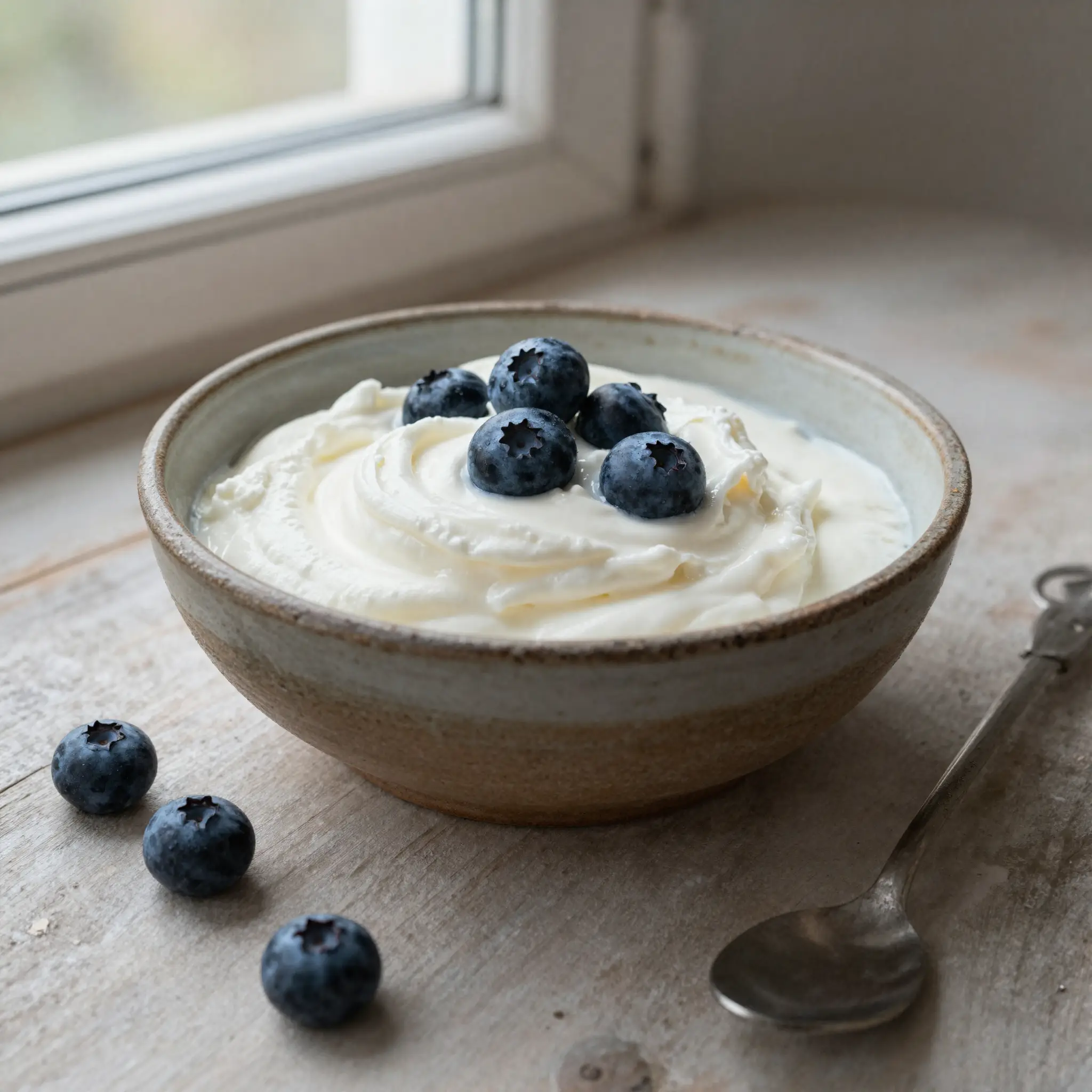
Skyr (Icelandic cultured-and-rennet-set skim-milk fresh cheese)
Dairy product
Facts
| Category | Dairy |
|---|---|
| Product family | Regional Set/Soured Milk & Fresh Cheese |
| Origin | 🇮🇸 Iceland |
Safety
- Inherits the general dairy-lactic-fermentation safety floor documented. Documented risk factors:
(a) raw-milk vs. pasteurized-milk considerations — starting from unpasteurized milk carries materially higher pathogen risk (e.g. Listeria, Salmonella, pathogenic E. coli) that fermentation's own acidification does not reliably eliminate within typical timeframes; commercial skyr production uses pasteurized milk, and this is recorded as the safer default;
(b) adequate acidification before/alongside the rennet-assisted set — an intermediate "danger-zone" hold before the culture establishes dominance can allow competing/pathogenic organisms a foothold, a consideration slightly compounded by the added rennet step, which itself carries no fermentation-safety function and does not substitute for adequate acidification;
(c) straining-stage hygiene — cloth/equipment used to strain the curd must be clean, since this is a post-set handling step with its own contamination potential;
(d) refrigeration — skyr is a fresh, perishable product and should be refrigerated promptly once strained. Safe-practice guidance: use pasteurized milk; maintain the intended incubation temperature range consistently; use clean straining equipment; refrigerate promptly once strained; discard on off-odour, visible mould, or gas production, none of which are characteristic of a properly-set ferment. All numerics are (illustrative); no regulatory-grade pH/temperature/duration thresholds are asserted.
Method
Skyr (Icelandic Cultured-and-Rennet-Set Skim-Milk Fresh Cheese)
- Skimmed cow's milk — ~1 L
- Skyr starter culture — a small spoonful (~1–2 tbsp, illustrative) of previous-batch skyr, or a commercial skyr/mixed mesophilic-thermophilic starter culture if no back-slop is available — SAFETY CONTROL, see linked Variant
- A small amount of rennet (traditional, liquid or tablet form, illustrative quantity, per manufacturer/traditional-household guidance, not independently specified in our sources) — part of the traditional coagulation method, see linked Variant
- 1
Step 1
Heat-treat the skimmed milk, then cool to the target incubation temperature.
- 2
Step 2
Whisk the back-slopped starter culture into the cooled, warm milk until evenly distributed.
- 3
Step 3
Add the small measured amount of rennet and stir briefly to combine.
- 4
Step 4
Pour into a clean vessel, cover, and leave undisturbed in a warm location.
- 5
Step 5
Incubate without moving or stirring until a firm coagulum sets throughout.
- 6
Step 6
Cut/break the set coagulum gently to release whey.
- 7
Step 7
Strain the curd (traditionally through a clean cloth) over a period of several hours, draining off whey until the remaining curd reaches skyr's characteristic thick, dense consistency.
- 8
Step 8
Refrigerate the strained skyr once at the desired thickness.
- 9
Step 9
Reserve a small portion, unrefrigerated briefly, as the starter for the next batch.
Frequently asked questions
- What is Skyr (Icelandic cultured-and-rennet-set skim-milk fresh cheese)?
- Dairy product
- Where does Skyr (Icelandic cultured-and-rennet-set skim-milk fresh cheese) come from?
- Skyr (Icelandic cultured-and-rennet-set skim-milk fresh cheese) is traditionally made in Iceland.
- Is Skyr (Icelandic cultured-and-rennet-set skim-milk fresh cheese) safe to make at home?
- Inherits the general dairy-lactic-fermentation safety floor documented. Documented risk factors:
(a) raw-milk vs. pasteurized-milk considerations — starting from unpasteurized milk carries materially higher pathogen risk (e.g. Listeria, Salmonella, pathogenic E. coli) that fermentation's own acidification does not reliably eliminate within typical timeframes; commercial skyr production uses pasteurized milk, and this is recorded as the safer default;
(b) adequate acidification before/alongside the rennet-assisted set — an intermediate "danger-zone" hold before the culture establishes dominance can allow competing/pathogenic organisms a foothold, a consideration slightly compounded by the added rennet step, which itself carries no fermentation-safety function and does not substitute for adequate acidification;
(c) straining-stage hygiene — cloth/equipment used to strain the curd must be clean, since this is a post-set handling step with its own contamination potential;
(d) refrigeration — skyr is a fresh, perishable product and should be refrigerated promptly once strained. Safe-practice guidance: use pasteurized milk; maintain the intended incubation temperature range consistently; use clean straining equipment; refrigerate promptly once strained; discard on off-odour, visible mould, or gas production, none of which are characteristic of a properly-set ferment. All numerics are (illustrative); no regulatory-grade pH/temperature/duration thresholds are asserted.
Community results
No community results published for this ferment yet.