
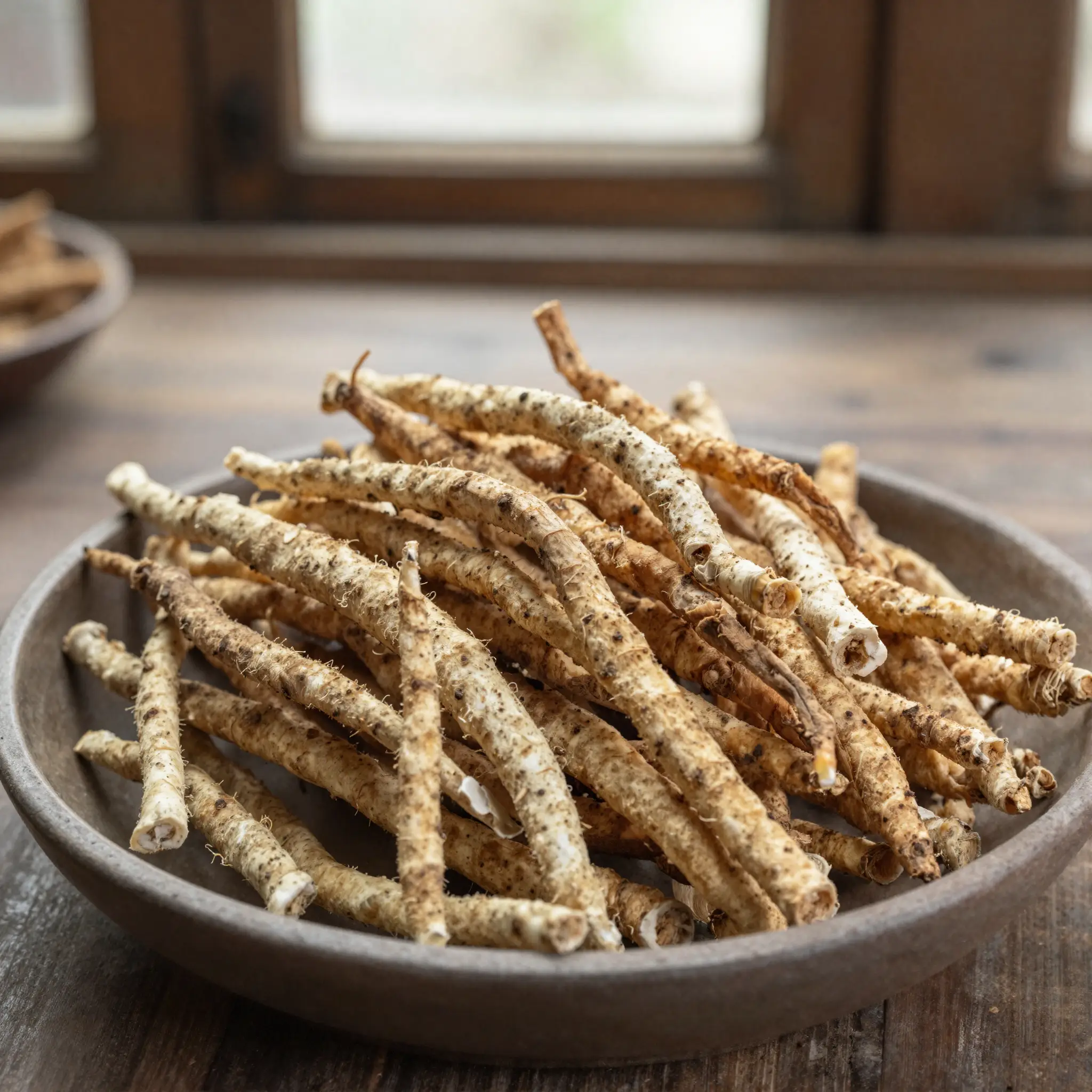
Sinki (Nepali fermented radish taproot)
vegetable-ferment-pickle
Facts
| Category | Vegetable |
|---|---|
| Product family | Himalayan Fermented Leafy-Green Preserve family, root-substrate sibling to Gundruk |
| Origin | 🇳🇵 Nepal |
Safety
- As with gundruk, sinki-specific quantified safety literature is thin — stated explicitly, not backfilled. The same two-stage safety logic applies:
(a) fermentation stage — with low/no added salt, adequate anaerobic packing/pressing and sufficient acidification are the operative controls; the root form (denser, higher moisture-retention than leaves) may ferment and dry on a somewhat different timeline than gundruk, but no gundruk-vs-sinki quantified comparative safety data was found in the sources reviewed — this difference is noted as a plausible mechanism, not asserted as measured fact;
(b) drying stage — thorough, even sun-drying to low final moisture is the primary long-term preservation control, as with gundruk. Safe-practice guidance:
(i) keep the shredded radish firmly packed/weighted, free of air pockets, during fermentation; (ii) ferment until distinctly sour before drying; (iii) dry thoroughly and evenly; (iv) discard any batch with putrid odour, sliminess, or mould inconsistent with normal LAB surface activity;
(v) store dry to prevent post-drying mould regrowth. Precise pH/salinity/moisture thresholds for sinki are not established.
Method
Sinki (Nepali Fermented Radish Taproot)
- Radish taproot (fresh) — ~1500 g, shredded or cut into strips
- Water — a small amount only, if needed to aid packing (traditionally minimal to none)
- Salt — traditionally little to no added salt — SAFETY CONTROL, see linked Variant
- 1
Step 1
Wash and shred or cut the radish taproot into strips or small pieces.
- 2
Step 2
Pack the shredded radish very tightly into a clean earthenware pot or jar, pressing firmly to exclude air pockets.
- 3
Step 3
Weight the packed radish to maintain firm, airless packing throughout the ferment.
- 4
Step 4
Cover breathably; ferment at ambient temperature, checking periodically that the mass stays firmly packed and shows no putrid odour or mould.
- 5
Step 5
Ferment until distinctly sour, roughly several days to about two weeks (illustrative) — potentially longer than gundruk given the denser root substrate; exact comparative timing is not separately confirmed in the sources reviewed.
- 6
Step 6
Remove the fermented radish and spread it out to sun-dry, turning periodically for even drying, over several days until fully dehydrated.
- 7
Step 7
Store the dried sinki in a dry container; rehydrate before cooking (soup, side dish, or pickle-style accompaniment).
Frequently asked questions
- What is Sinki (Nepali fermented radish taproot)?
- vegetable-ferment-pickle
- Where does Sinki (Nepali fermented radish taproot) come from?
- Sinki (Nepali fermented radish taproot) is traditionally made in Nepal.
- Is Sinki (Nepali fermented radish taproot) safe to make at home?
- As with gundruk, sinki-specific quantified safety literature is thin — stated explicitly, not backfilled. The same two-stage safety logic applies:
(a) fermentation stage — with low/no added salt, adequate anaerobic packing/pressing and sufficient acidification are the operative controls; the root form (denser, higher moisture-retention than leaves) may ferment and dry on a somewhat different timeline than gundruk, but no gundruk-vs-sinki quantified comparative safety data was found in the sources reviewed — this difference is noted as a plausible mechanism, not asserted as measured fact;
(b) drying stage — thorough, even sun-drying to low final moisture is the primary long-term preservation control, as with gundruk. Safe-practice guidance:
(i) keep the shredded radish firmly packed/weighted, free of air pockets, during fermentation; (ii) ferment until distinctly sour before drying; (iii) dry thoroughly and evenly; (iv) discard any batch with putrid odour, sliminess, or mould inconsistent with normal LAB surface activity;
(v) store dry to prevent post-drying mould regrowth. Precise pH/salinity/moisture thresholds for sinki are not established.
Community results
No community results published for this ferment yet.