
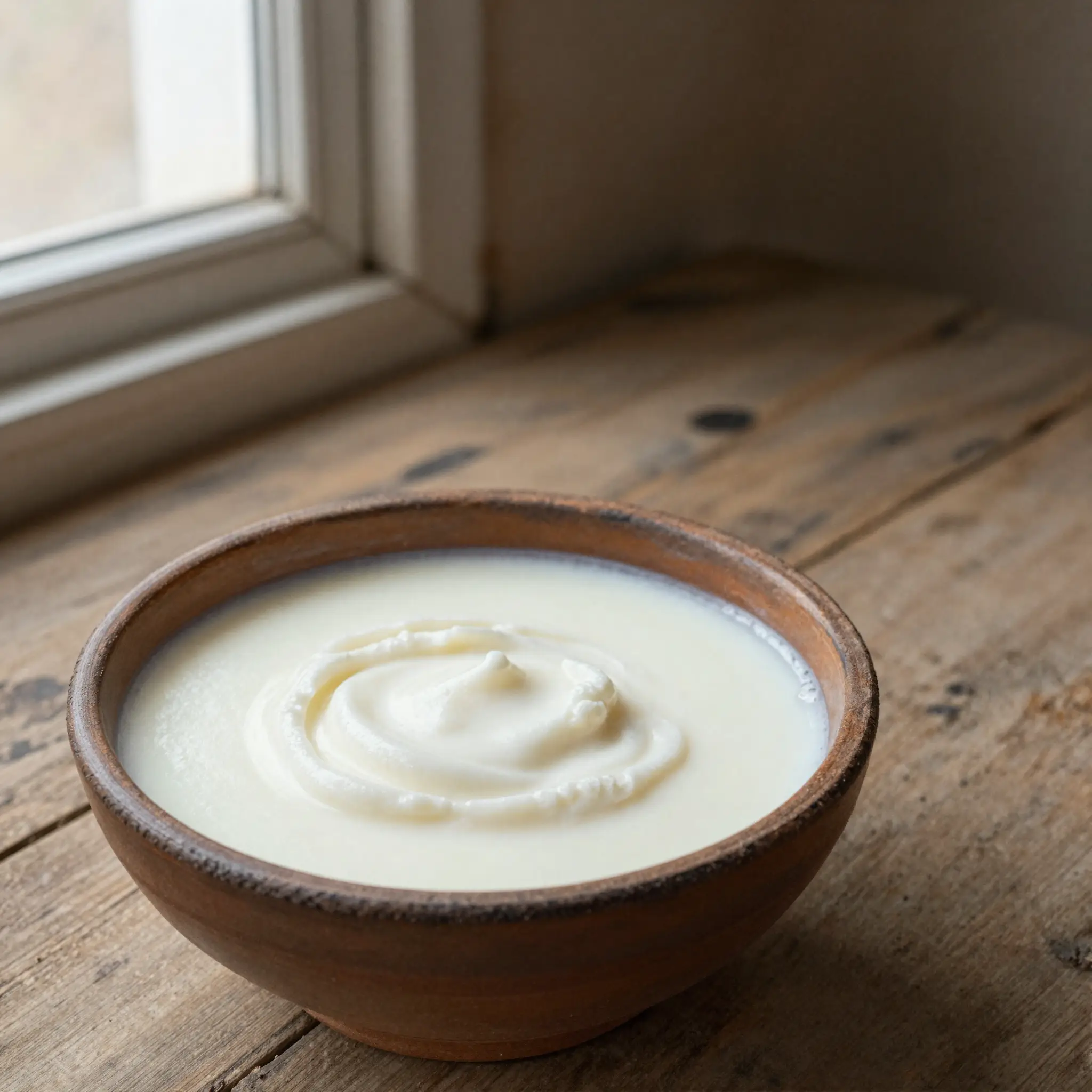
Shubat (Kazakh fermented camel's milk)
Dairy beverage
Facts
| Category | Dairy |
|---|---|
| Product family | Fermented Camel's-Milk Beverage |
| Origin | 🇰🇿 Kazakhstan |
| Key microorganisms | lactic-acid-bacteria, yeasts |
Safety
- Documented consideration (honest, dairy-appropriate, mirroring kumis): traditional shubat is very often made from raw (unpasteurized) camel's milk, consistent with Kazakh pastoral/nomadic tradition and camel-milk handling practices — an honest raw-milk consideration, carrying the same general raw-milk pathogen-exposure caution documented for other raw-milk dairy ferments, rather than a shubat-specific hazard finding from our sources. Safe-practice guidance:
(a) where raw camel's milk is used, source it from a clean, healthy, well-managed animal and handle with good hygiene, recognizing that adequate LAB acidification is the primary safety mechanism, not a substitute for sound raw-milk handling;
(b) where pasteurized milk is used instead, this reduces (but the source base does not claim eliminates) the raw-milk-specific exposure;
(c) ensure adequate acidification is well underway before extended ambient storage;
(d) refrigerate promptly once at desired sourness/effervescence;
(e) disclose the mild alcohol content to consumers avoiding alcohol, per the same boundary discipline as kefir and kumis. No specific pathogen thresholds, pH figures, or alcohol percentages are asserted — any such figure is illustrative or not established.
Method
Shubat (Kazakh Fermented Camel's Milk)
- Fresh camel's milk — ~2 L (traditional substrate; distinct from both cow/goat/sheep milk and mare's milk; sourcing availability is a real-world constraint noted honestly, not a recipe simplification)
- A small quantity of previously-fermented shubat (back-slop starter) — ~5–10% of the batch volume, illustrative — OR reliance on naturally-occurring milk/vessel/environmental microbiota where no back-slop is available
- 1
Step 1
Collect fresh camel's milk into a clean vessel.
- 2
Step 2
If available, add a small portion of previously-fermented shubat as a back-slop inoculant; if not, allow the milk to begin fermenting from naturally-occurring microbiota.
- 3
Step 3
Hold the vessel at ambient temperature.
- 4
Step 4
Allow the combined lactic-acid and mild alcoholic (yeast) fermentation to proceed; unlike kumis, shubat is not necessarily documented as requiring the same intensive regular-churning regimen, though periodic mixing supports even fermentation (noted as a plausible good practice rather than a source-confirmed requirement specific to shubat).
- 5
Step 5
Taste periodically for developing sourness and mild effervescence — our sources frame shubat's alcoholic character as milder than kumis's.
- 6
Step 6
Once at the desired sourness/mild effervescence (duration is tradition- and household-variable — ranging from several hours to a few days, illustrative only), consume fresh or refrigerate to slow further fermentation.
Frequently asked questions
- What is Shubat (Kazakh fermented camel's milk)?
- Dairy beverage
- Which microorganisms ferment Shubat (Kazakh fermented camel's milk)?
- Shubat (Kazakh fermented camel's milk) is primarily driven by lactic-acid-bacteria, yeasts.
- Where does Shubat (Kazakh fermented camel's milk) come from?
- Shubat (Kazakh fermented camel's milk) is traditionally made in Kazakhstan.
- Is Shubat (Kazakh fermented camel's milk) safe to make at home?
- Documented consideration (honest, dairy-appropriate, mirroring kumis): traditional shubat is very often made from raw (unpasteurized) camel's milk, consistent with Kazakh pastoral/nomadic tradition and camel-milk handling practices — an honest raw-milk consideration, carrying the same general raw-milk pathogen-exposure caution documented for other raw-milk dairy ferments, rather than a shubat-specific hazard finding from our sources. Safe-practice guidance:
(a) where raw camel's milk is used, source it from a clean, healthy, well-managed animal and handle with good hygiene, recognizing that adequate LAB acidification is the primary safety mechanism, not a substitute for sound raw-milk handling;
(b) where pasteurized milk is used instead, this reduces (but the source base does not claim eliminates) the raw-milk-specific exposure;
(c) ensure adequate acidification is well underway before extended ambient storage;
(d) refrigerate promptly once at desired sourness/effervescence;
(e) disclose the mild alcohol content to consumers avoiding alcohol, per the same boundary discipline as kefir and kumis. No specific pathogen thresholds, pH figures, or alcohol percentages are asserted — any such figure is illustrative or not established.
Community results
No community results published for this ferment yet.