
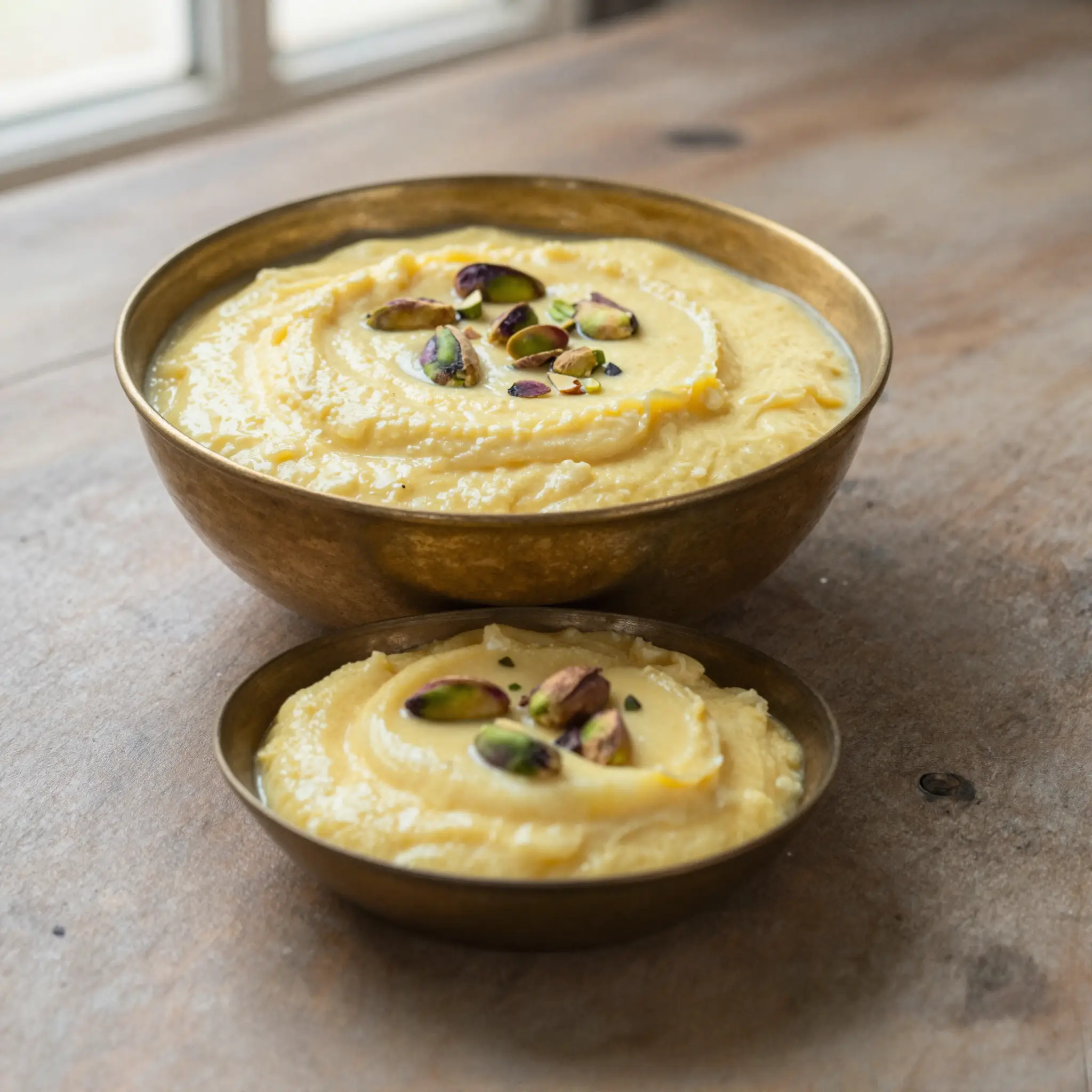
Shrikhand (Indian strained yogurt dessert)
Shrikhand (Indian strained yogurt sweetened dessert)
Dairy product
Facts
| Category | Dairy |
|---|---|
| Product family | Strained Fermented-Milk Sweetened Dessert |
| Origin | 🇮🇳 India |
Safety
- Inherits the base dairy-lactic safety floor, the same core considerations as labneh, with the finishing (sweetening) stage adding its own hygiene consideration. Documented risk factors:
(a) raw-milk vs. pasteurized-milk — as with labneh and qurut, starting from unpasteurized milk carries materially higher pathogen risk that fermentation's own acidification does not reliably eliminate; pasteurized milk is the safer default;
(b) adequate acidification of the base dahi ferment before straining — a fully set, sour dahi is the intended starting point;
(c) straining hygiene — cloth, hands, and containers must be clean/sanitized during the multi-hour gravity-drain stage;
(d) post-straining handling — because shrikhand is finished with sugar and flavorings and typically served cold/soon after preparation rather than further preserved, prompt refrigeration after preparation and before serving is the primary operative control, rather than any extended-storage mechanism (unlike qurut's drying-for-storage model);
(e) precise numeric straining-time/shelf-life floors specific to shrikhand are not established.
Method
Shrikhand (Indian Strained Yogurt Sweetened Dessert)
- Whole cow's or buffalo's milk — ~1 L, or substitute plain full-fat dahi/yogurt made from same — ~1 kg
- Yogurt/dahi starter culture (commercial thermophilic culture or a few tablespoons of live dahi from a prior batch) — for the base ferment stage only, if starting from milk
- Sugar — to taste, a substantial proportion by traditional recipes (illustrative quantity, not a safety control) — flavor/finishing role
- Cardamom powder, a pinch of saffron strands (soaked briefly in warm milk) — flavor/finishing, traditional
- Optional: chopped nuts (pistachio, almond), mango pulp (for the amrakhand variant) — flavor/finishing, non-safety
- 1
Step 1
If starting from milk: ferment into dahi/yogurt per the generalized dairy-lactic method, incubating until fully set and sour.
- 2
Step 2
Line a colander or bowl with clean muslin/cheesecloth; pour in the set dahi.
- 3
Step 3
Gather the cloth corners and tie into a bag; suspend over a bowl at cool/refrigerated temperature to drain whey for several hours (illustrative), until a thick strained curd (chakka) remains.
- 4
Step 4
Transfer the chakka to a clean bowl; whisk or beat until smooth.
- 5
Step 5
Fold in sugar, cardamom powder, and saffron (and any optional nuts or fruit pulp) until evenly combined and the sugar has dissolved into the curd.
- 6
Step 6
Chill thoroughly before serving.
Frequently asked questions
- What is Shrikhand (Indian strained yogurt dessert)?
- Dairy product
- Where does Shrikhand (Indian strained yogurt dessert) come from?
- Shrikhand (Indian strained yogurt dessert) is traditionally made in India.
- Is Shrikhand (Indian strained yogurt dessert) safe to make at home?
- Inherits the base dairy-lactic safety floor, the same core considerations as labneh, with the finishing (sweetening) stage adding its own hygiene consideration. Documented risk factors:
(a) raw-milk vs. pasteurized-milk — as with labneh and qurut, starting from unpasteurized milk carries materially higher pathogen risk that fermentation's own acidification does not reliably eliminate; pasteurized milk is the safer default;
(b) adequate acidification of the base dahi ferment before straining — a fully set, sour dahi is the intended starting point;
(c) straining hygiene — cloth, hands, and containers must be clean/sanitized during the multi-hour gravity-drain stage;
(d) post-straining handling — because shrikhand is finished with sugar and flavorings and typically served cold/soon after preparation rather than further preserved, prompt refrigeration after preparation and before serving is the primary operative control, rather than any extended-storage mechanism (unlike qurut's drying-for-storage model);
(e) precise numeric straining-time/shelf-life floors specific to shrikhand are not established.
Community results
No community results published for this ferment yet.