
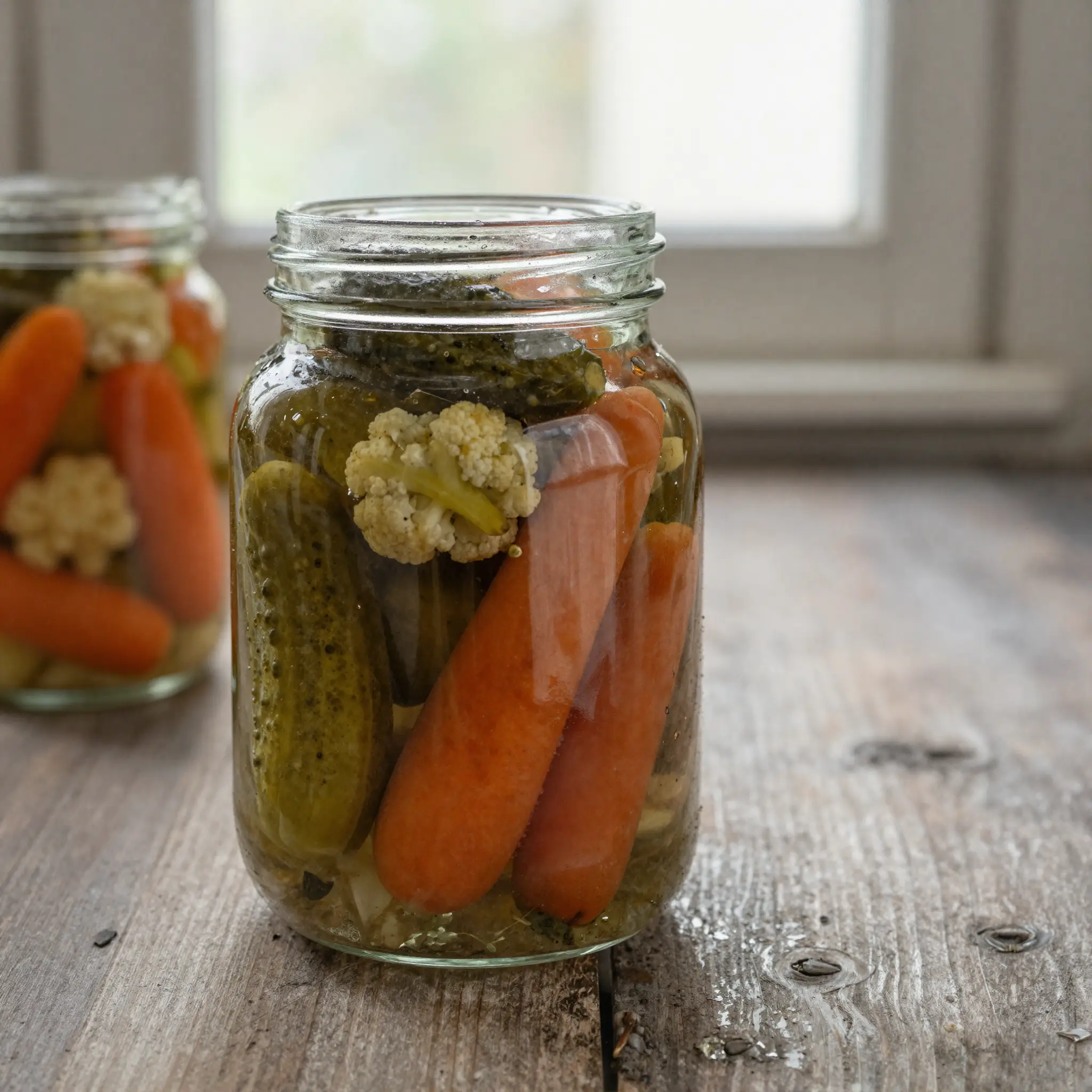
Shoor (Iranian salt-brine fermented vegetables)
Shoor (Iranian salt-brine fermented mixed vegetables)
vegetable-ferment-pickle
Facts
| Category | Vegetable |
|---|---|
| Product family | Brined Lacto-Fermented Vegetable Pickle |
| Origin | 🇮🇷 Iran |
Safety
- Same core anaerobic/salinity-floor logic as other brined vegetable ferments (turşu, kiselo zele, sauerkraut). Documented risk factor — insufficient brine salinity or vegetables exposed above the brine line permits spoilage organisms and a theoretical Clostridium botulinum concern in an anaerobic low-acid pocket before acidification; the addition of raw chickpeas/bread as a fermentation aid introduces an additional fresh-ingredient input that should itself be kept fully submerged. Safe-practice guidance:
(a) maintain the higher target brine salinity documented for this product (~5–7.5% by weight, illustrative; precise regulatory-grade floors are recipe-specific — re-confirm before publishing a hard number);
(b) keep all solids — including the chickpea/bread fermentation aid — fully submerged below the brine;
(c) loosen (don't fully remove) the lid daily during active fermentation to vent CO2 without exposing contents to contamination;
(d) target pH ≤4.6;
(e) discard on fuzzy surface mould, sliminess, or putrid (not sour) odour.
Method
Shoor (Iranian Salt-Brine Fermented Mixed Vegetables)
- Mixed firm vegetables (e.g. pickling cucumber, cauliflower florets, carrot, celery) — ~1500 g
- Garlic, hot pepper, tarragon (flavour, optional, non-safety); a small amount of beet for colour (optional)
- Non-iodized salt — quantity to make a ~5–7.5% brine (illustrative), markedly saltier than turşu/kabees — SAFETY CONTROL, see linked Variant
- Water — enough to fully submerge
- Raw chickpeas and/or a piece of plain (oil-free) sourdough bread — traditional fermentation aid, submerged in the brine
- 1
Step 1
Wash and cut vegetables into pieces or leave small ones whole.
- 2
Step 2
Prepare the high-salt brine: dissolve salt fully in water to the target concentration.
- 3
Step 3
Pack vegetables, garlic, and flavourings tightly into a clean jar.
- 4
Step 4
Add raw chickpeas and/or a piece of plain sourdough bread as a fermentation aid.
- 5
Step 5
Pour brine over to cover; press all solids, including the chickpeas/bread, below the surface.
- 6
Step 6
Weight or wedge the contents so nothing sits exposed above the brine line.
- 7
Step 7
Cover with a breathable lid; ferment at ambient temperature, ideally below ~26°C/80°F.
- 8
Step 8
Once bubbling begins, loosen (don't remove) the lid daily to release CO2, then reseal.
- 9
Step 9
Taste from about day 5; ready in roughly 5–10 days depending on temperature.
- 10
Step 10
Move to cold storage once at target flavour.
Frequently asked questions
- What is Shoor (Iranian salt-brine fermented vegetables)?
- vegetable-ferment-pickle
- Where does Shoor (Iranian salt-brine fermented vegetables) come from?
- Shoor (Iranian salt-brine fermented vegetables) is traditionally made in Iran.
- Is Shoor (Iranian salt-brine fermented vegetables) safe to make at home?
- Same core anaerobic/salinity-floor logic as other brined vegetable ferments (turşu, kiselo zele, sauerkraut). Documented risk factor — insufficient brine salinity or vegetables exposed above the brine line permits spoilage organisms and a theoretical Clostridium botulinum concern in an anaerobic low-acid pocket before acidification; the addition of raw chickpeas/bread as a fermentation aid introduces an additional fresh-ingredient input that should itself be kept fully submerged. Safe-practice guidance:
(a) maintain the higher target brine salinity documented for this product (~5–7.5% by weight, illustrative; precise regulatory-grade floors are recipe-specific — re-confirm before publishing a hard number);
(b) keep all solids — including the chickpea/bread fermentation aid — fully submerged below the brine;
(c) loosen (don't fully remove) the lid daily during active fermentation to vent CO2 without exposing contents to contamination;
(d) target pH ≤4.6;
(e) discard on fuzzy surface mould, sliminess, or putrid (not sour) odour.
Community results
No community results published for this ferment yet.