
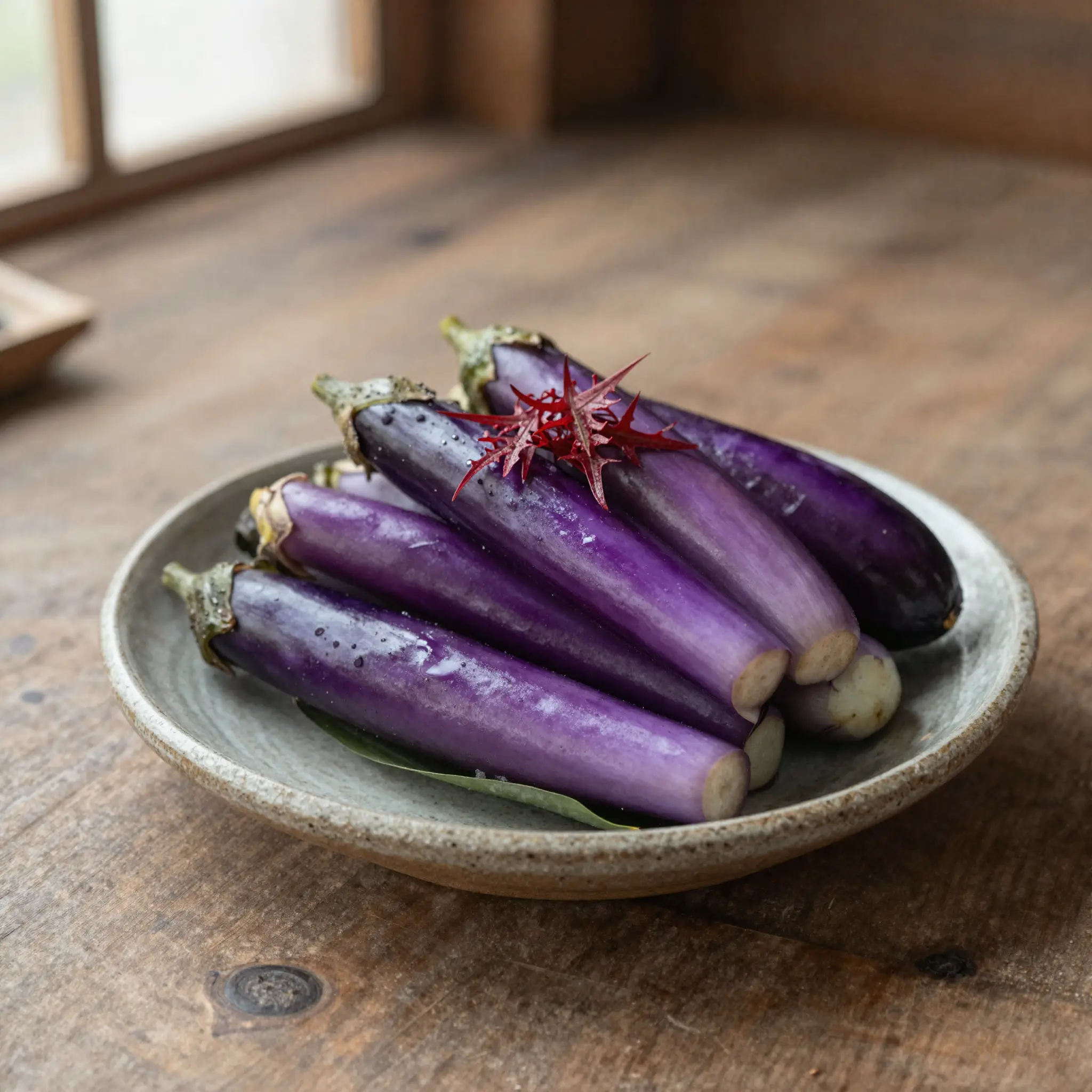
Shibazuke (Kyoto eggplant & shiso pickle)
Shibazuke (Kyoto eggplant and shiso lactic-fermented pickle)
vegetable-ferment-pickle
Facts
| Category | Vegetable |
|---|---|
| Product family | Tsukemono |
| Origin | 🇯🇵 Japan |
Safety
- Same core anaerobic/salinity-floor logic as other salt-fermented vegetable pickles in this content set (turşu, kiselo zele) — documented risk factor: inadequate salt concentration or failure to keep vegetables submerged under their own exuded liquid/weight permits spoilage organisms to establish. Safe-practice guidance:
(a) use adequate salt (home-scale practice is distinctly salty; precise regulatory-grade percentage is not established;
(b) keep vegetables weighted and submerged in their exuded liquid throughout the ferment;
(c) discard on putrid odour, unusual sliminess, or unexpected off-colour (distinct from the desired shiso-driven red-purple);
(d) this safety statement applies only to the traditional fermented Variant — it is not transferable to the modern vinegar/seasoning quick-pickle look-alike, which carries its own (non-fermentation) food-safety profile outside this Variant's scope.
Method
Shibazuke (Kyoto Eggplant & Shiso Lactic-Fermented Pickle — Traditional Style)
- Eggplant (nasu), cut into pieces — ~500 g
- Cucumber, cut into pieces — ~300 g
- Red shiso (perilla) leaves — a generous handful, traditionally chopped
- Non-iodized salt — quantity to salt-pack the vegetables (illustrative; precise regulatory-grade salt-% floor is not established) — SAFETY CONTROL, see linked Variant
- Myoga ginger or other regional additions — optional, traditional (flavour only, non-safety)
- Optional: a small amount of a prior batch's exuded liquid, used to back-slop a new batch (traditional practice; not a distinct named starter culture)
- 1
Step 1
Wash and cut eggplant and cucumber; chop red shiso leaves.
- 2
Step 2
Layer the vegetables and shiso with salt in a non-reactive vessel.
- 3
Step 3
Pack under a weight so the vegetables release their own liquid and become submerged in the salted exudate.
- 4
Step 4
Ferment anaerobically at ambient-to-cool temperature over an extended period (traditionally weeks).
- 5
Step 5
Check periodically that all solids remain submerged below the exuded liquid; re-weight as needed.
- 6
Step 6
Observe the shiso pigment gradually reacting with developing acidity, deepening the pickle's characteristic red-purple colour.
- 7
Step 7
Taste periodically; continue fermenting to the desired sourness.
- 8
Step 8
Drain, chop, and serve once at target flavour; refrigerate remainder.
Frequently asked questions
- What is Shibazuke (Kyoto eggplant & shiso pickle)?
- vegetable-ferment-pickle
- Where does Shibazuke (Kyoto eggplant & shiso pickle) come from?
- Shibazuke (Kyoto eggplant & shiso pickle) is traditionally made in Japan.
- Is Shibazuke (Kyoto eggplant & shiso pickle) safe to make at home?
- Same core anaerobic/salinity-floor logic as other salt-fermented vegetable pickles in this content set (turşu, kiselo zele) — documented risk factor: inadequate salt concentration or failure to keep vegetables submerged under their own exuded liquid/weight permits spoilage organisms to establish. Safe-practice guidance:
(a) use adequate salt (home-scale practice is distinctly salty; precise regulatory-grade percentage is not established;
(b) keep vegetables weighted and submerged in their exuded liquid throughout the ferment;
(c) discard on putrid odour, unusual sliminess, or unexpected off-colour (distinct from the desired shiso-driven red-purple);
(d) this safety statement applies only to the traditional fermented Variant — it is not transferable to the modern vinegar/seasoning quick-pickle look-alike, which carries its own (non-fermentation) food-safety profile outside this Variant's scope.
Community results
No community results published for this ferment yet.