
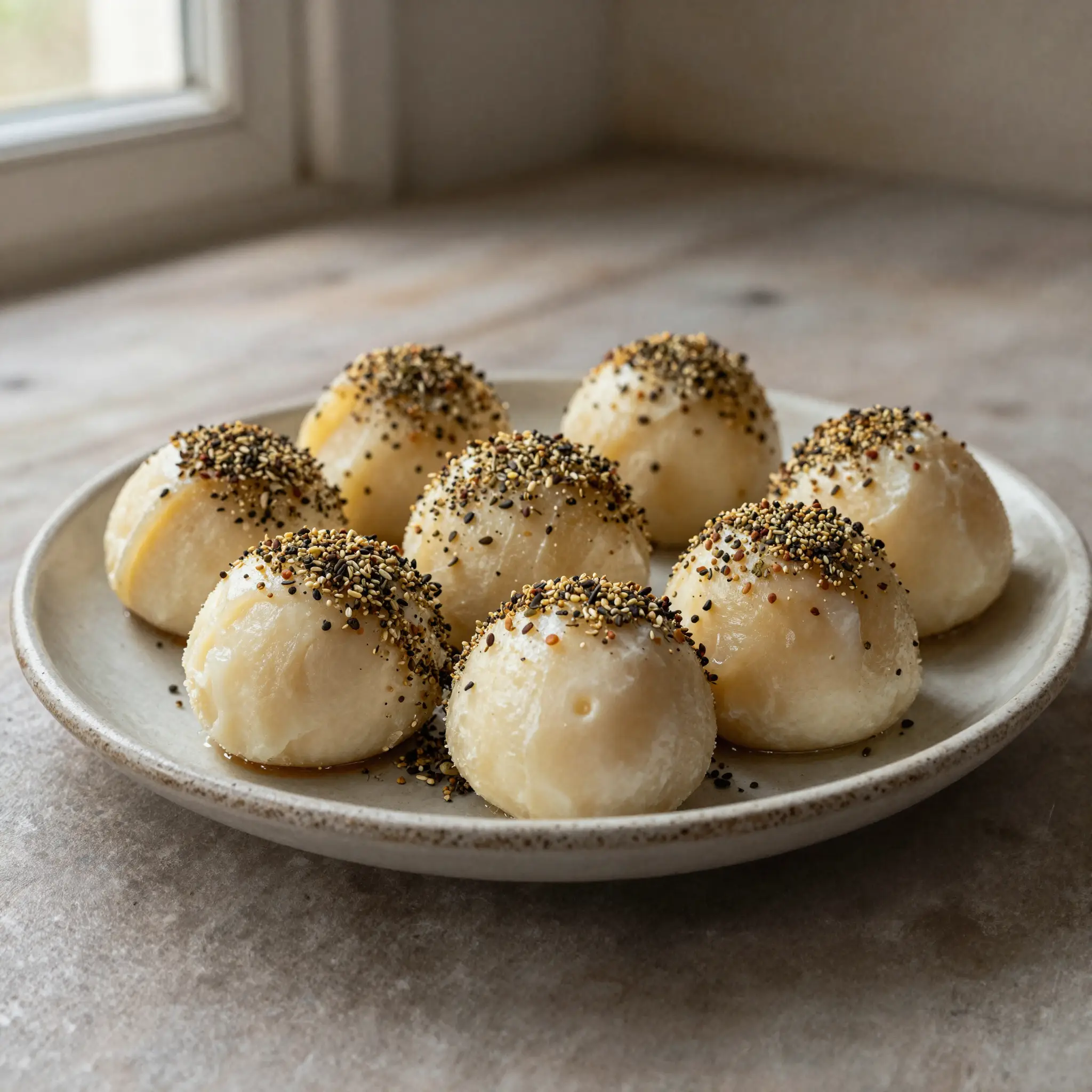
Shanklish (Levantine surface-mold-ripened labneh balls)
Shanklish (Lebanese/Syrian surface-mold-ripened labneh balls)
Dairy product
Facts
| Category | Dairy |
|---|---|
| Product family | Aged/Ripened Strained-Milk Cheese |
| Origin | 🇱🇧 Lebanon |
Safety
- Inherits the base dairy-lactic safety floor from Labneh with mold-ripening-specific considerations layered on top. Documented risk factors:
(a) raw-milk vs. pasteurized-milk for the base ferment — as with labneh, pasteurized milk is the safer default; unpasteurized milk carries materially higher pathogen risk not reliably eliminated by fermentation alone;
(b) adequate acidification of the base labneh before shaping/ripening — a fully soured, well-strained labneh is the necessary starting point;
(c) surface-mold-ripening hygiene, the defining additional control for this Variant: the ripening environment (surface, container, ambient air) must be clean and the traditional ripening conditions consistently followed, because this stage deliberately grows a surface mold over several days to weeks — a process that, done outside its traditional controlled conditions, is also hospitable to unintended spoilage organisms;
(d) discrimination between intended ripening mold and spoilage mold is the single most important operative safety judgment for this product: the traditional, expected ripening growth should be visually and olfactorily consistent with the maker's established batch-to-batch experience; any fuzzy growth in unexpected colors (black, pink, green outside the traditional pattern), wet sliminess, or putrid/ammonia-like off-odors is a sign of spoilage, not ripening, and such balls must be discarded rather than consumed — no numeric threshold for this discrimination is given in our sources, and none is fabricated here;
(e) precise numeric ripening-duration, water-activity, or salt-% floors specific to shanklish are not established.
Method
Shanklish (Lebanese/Syrian Surface-Mold-Ripened Labneh Balls)
- Labneh (strained yogurt cheese), homemade, or store-bought — ~1 kg
- Salt — a heavier proportion than for fresh labneh, worked in before shaping (illustrative quantity; not the primary safety control here — see linked Variant item 8 for the acidification/ripening-hygiene controls that are) — flavor/preservative role
- Za'atar (dried thyme/sumac/sesame blend), dried chili flakes — for coating, non-safety, flavor/finishing
- Olive oil — optional, for coating/serving or extended storage
- 1
Step 1
Prepare labneh (ferment milk into yogurt, strain, per the linked labneh recipe) or start from prepared labneh.
- 2
Step 2
Work additional salt into the strained labneh.
- 3
Step 3
Shape the salted labneh by hand into small balls.
- 4
Step 4
Set the balls on a clean, breathable surface (rack or tray) in a well-ventilated space at cool/ambient temperature.
- 5
Step 5
Allow the balls to air-dry and ripen over days to weeks (illustrative), during which a surface mold layer develops — check periodically against the maker's established traditional appearance for this stage.
- 6
Step 6
Once ripened to the traditional appearance, wash off or brush away the surface growth as appropriate.
- 7
Step 7
Roll the ripened balls in za'atar, dried chili flakes, or other dried herbs/spices; optionally drizzle with or submerge in olive oil.
- 8
Step 8
Store at cool/ambient temperature or refrigerate; serve as a mezze appetizer.
Frequently asked questions
- What is Shanklish (Levantine surface-mold-ripened labneh balls)?
- Dairy product
- Where does Shanklish (Levantine surface-mold-ripened labneh balls) come from?
- Shanklish (Levantine surface-mold-ripened labneh balls) is traditionally made in Lebanon.
- Is Shanklish (Levantine surface-mold-ripened labneh balls) safe to make at home?
- Inherits the base dairy-lactic safety floor from Labneh with mold-ripening-specific considerations layered on top. Documented risk factors:
(a) raw-milk vs. pasteurized-milk for the base ferment — as with labneh, pasteurized milk is the safer default; unpasteurized milk carries materially higher pathogen risk not reliably eliminated by fermentation alone;
(b) adequate acidification of the base labneh before shaping/ripening — a fully soured, well-strained labneh is the necessary starting point;
(c) surface-mold-ripening hygiene, the defining additional control for this Variant: the ripening environment (surface, container, ambient air) must be clean and the traditional ripening conditions consistently followed, because this stage deliberately grows a surface mold over several days to weeks — a process that, done outside its traditional controlled conditions, is also hospitable to unintended spoilage organisms;
(d) discrimination between intended ripening mold and spoilage mold is the single most important operative safety judgment for this product: the traditional, expected ripening growth should be visually and olfactorily consistent with the maker's established batch-to-batch experience; any fuzzy growth in unexpected colors (black, pink, green outside the traditional pattern), wet sliminess, or putrid/ammonia-like off-odors is a sign of spoilage, not ripening, and such balls must be discarded rather than consumed — no numeric threshold for this discrimination is given in our sources, and none is fabricated here;
(e) precise numeric ripening-duration, water-activity, or salt-% floors specific to shanklish are not established.
Community results
No community results published for this ferment yet.