
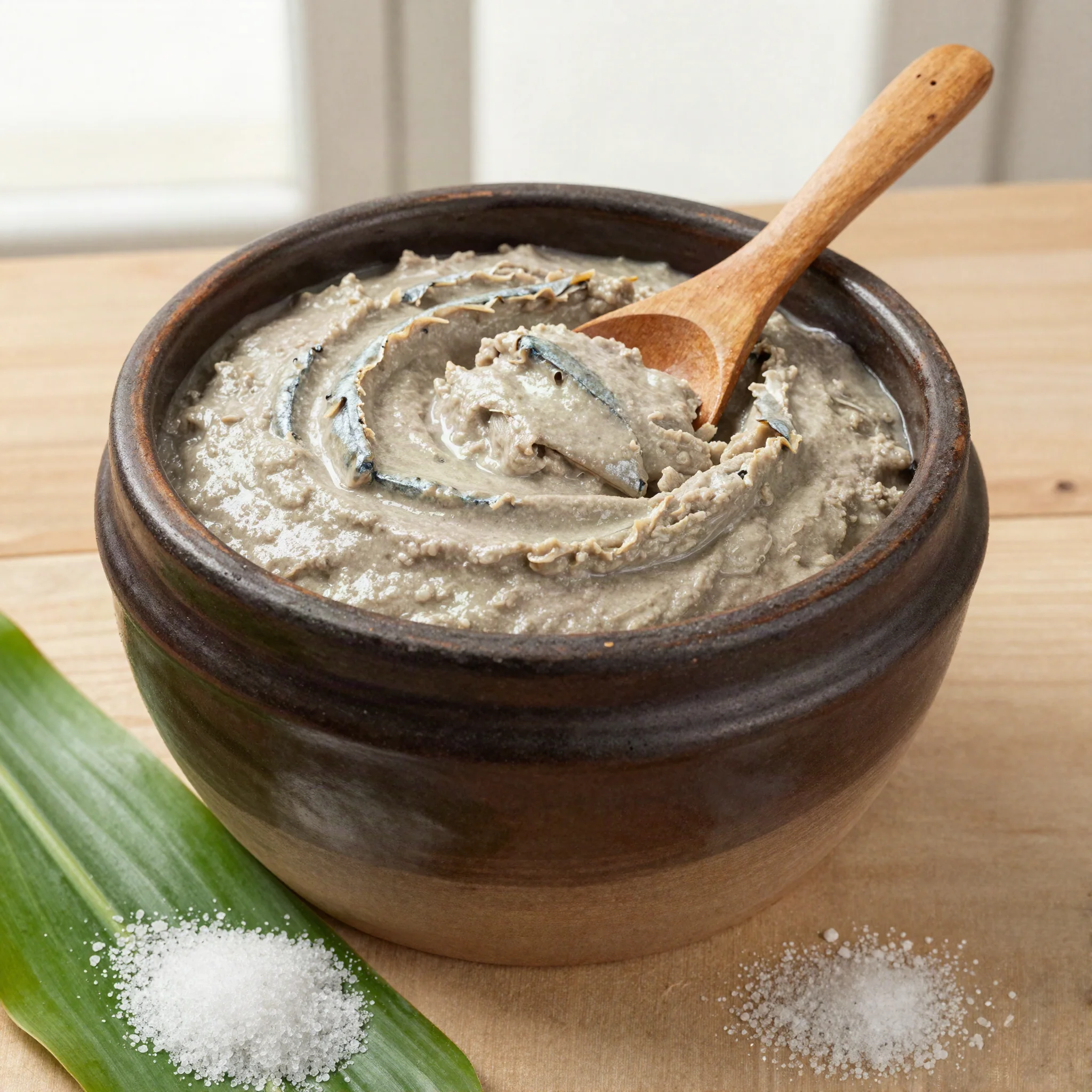
Prahok
Prahok (Cambodian fermented freshwater fish paste)
Condiment/paste
Facts
| Category | Meat / Fish |
|---|---|
| Product family | Southeast Asian Fermented Fish Paste |
| Key microorganisms | halophilic-other |
Safety
- Fermented fish is a high-hazard class and its safety rests on salt concentration as the primary preservation control — under-salting is the central failure mode of this entire product family, because salt is the only barrier holding across a months-long ambient ferment of raw protein. Documented risk factors:
(a) Histamine and other biogenic amines — the defining hazard of fermented fish. Bacteria decarboxylate histidine into histamine during fermentation and storage; histamine is heat-stable and is NOT destroyed by cooking, so cooking prahok into a dish does not remove it. The only effective control is upstream: genuinely fresh fish, salted promptly, never temperature-abused before salting.
(b) Clostridium botulinum type E — a fish-associated, cold-tolerant type that can grow at refrigeration temperatures other types cannot, in exactly the anaerobic, sealed, packed protein mass this product creates. Adequate salt is the hurdle; an under-salted sealed vessel removes it.
(c) Parasites — materially different here because prahok is made from FRESHWATER fish. Freshwater fish of the Mekong basin carry fish-borne liver flukes (Opisthorchis-type trematodes), a documented and serious regional public-health concern. Salting and fermentation do NOT reliably inactivate them, and this is a genuine, honestly stated difference from marine-fish and krill products. Traditional practice cooks prahok into dishes, which is protective against parasites (but not against histamine); raw or undercooked consumption of freshwater fish ferments is the risk behaviour.
(d) Listeria monocytogenes and Salmonella — handling hazards of raw fish and of a ready-to-use condiment: clean equipment, clean hands, no cross-contamination between raw fish and finished paste, covered storage.
(e) Spoilage/putrefaction — an under-salted or air-exposed batch putrefies rather than ferments; gas, slime, discoloration or off-odour beyond the normal pungency means discard. Safe-practice guidance: use genuinely fresh fish and salt it promptly; hold the traditional high salt proportion throughout; keep the mass packed and covered; use clean vessels and utensils; cook prahok into dishes as the tradition does; discard spoiled batches. Do not reduce the salt to make it milder — the salt is the safety system. Numerics: no salt percentage, histamine ppm, pH value, temperature or duration is asserted — (illustrative) / not established.
Method
Prahok (Cambodian fermented freshwater fish paste)
- Small freshwater fish from the Mekong–Tonle Sap system (mud fish, carp-family species) — ~3 kg (illustrative) — must be genuinely fresh; freshness before salting is a SAFETY CONTROL
- Salt — SAFETY CONTROL — ~1 kg (illustrative; the family convention is 3 parts fish to 1 part salt by weight — the direction matters, it is three times as much fish as salt). This proportion is the sole preservation control across the whole ferment and must not be reduced for palatability.
- Freshwater fish carries a liver-fluke risk that marine fish does not, and salt-and-time is the traditional control. This is a materially different hazard profile from the marine fish sauces — see the linked Variant before substituting fish.
- Clean earthenware or food-grade vessel with a cover and a weight
- (no starter culture — this ferment is spontaneous)
- 1
Step 1
Use freshly caught fish. Descale, gut and wash them thoroughly. (Delay or temperature abuse here cannot be corrected later — see the linked Variant on histamine.)
- 2
Step 2
Crush or pound the cleaned fish to break down the flesh.
- 3
Step 3
Mix the crushed fish thoroughly with the salt until every part of the mass is salted — even distribution is itself a control point.
- 4
Step 4
(Traditional in many preparations) Spread the salted mass in the sun for a short exposure before packing.
- 5
Step 5
Pack the mass tightly into a clean vessel, excluding air; weight it so any expressed liquid rises above the solids, and cover.
- 6
Step 6
Fermentation stage: hold at ambient temperature for an extended period while endogenous enzymes and halophilic flora convert the protein. (Temperature and duration: not established.)
- 7
Step 7
Check periodically that the mass stays covered by liquid and shows no spoilage signs; re-cover after any inspection.
- 8
Step 8
When matured, pack the paste into clean covered containers for storage.
- 9
Step 9
Use as a condiment cooked into a dish (soups, dips such as prahok ktiss, steamed or grilled preparations), as the tradition does.
Frequently asked questions
- What is Prahok?
- Condiment/paste
- Which microorganisms ferment Prahok?
- Prahok is primarily driven by halophilic-other.
- Is Prahok safe to make at home?
- Fermented fish is a high-hazard class and its safety rests on salt concentration as the primary preservation control — under-salting is the central failure mode of this entire product family, because salt is the only barrier holding across a months-long ambient ferment of raw protein. Documented risk factors:
(a) Histamine and other biogenic amines — the defining hazard of fermented fish. Bacteria decarboxylate histidine into histamine during fermentation and storage; histamine is heat-stable and is NOT destroyed by cooking, so cooking prahok into a dish does not remove it. The only effective control is upstream: genuinely fresh fish, salted promptly, never temperature-abused before salting.
(b) Clostridium botulinum type E — a fish-associated, cold-tolerant type that can grow at refrigeration temperatures other types cannot, in exactly the anaerobic, sealed, packed protein mass this product creates. Adequate salt is the hurdle; an under-salted sealed vessel removes it.
(c) Parasites — materially different here because prahok is made from FRESHWATER fish. Freshwater fish of the Mekong basin carry fish-borne liver flukes (Opisthorchis-type trematodes), a documented and serious regional public-health concern. Salting and fermentation do NOT reliably inactivate them, and this is a genuine, honestly stated difference from marine-fish and krill products. Traditional practice cooks prahok into dishes, which is protective against parasites (but not against histamine); raw or undercooked consumption of freshwater fish ferments is the risk behaviour.
(d) Listeria monocytogenes and Salmonella — handling hazards of raw fish and of a ready-to-use condiment: clean equipment, clean hands, no cross-contamination between raw fish and finished paste, covered storage.
(e) Spoilage/putrefaction — an under-salted or air-exposed batch putrefies rather than ferments; gas, slime, discoloration or off-odour beyond the normal pungency means discard. Safe-practice guidance: use genuinely fresh fish and salt it promptly; hold the traditional high salt proportion throughout; keep the mass packed and covered; use clean vessels and utensils; cook prahok into dishes as the tradition does; discard spoiled batches. Do not reduce the salt to make it milder — the salt is the safety system. Numerics: no salt percentage, histamine ppm, pH value, temperature or duration is asserted — (illustrative) / not established.
Community results
No community results published for this ferment yet.