
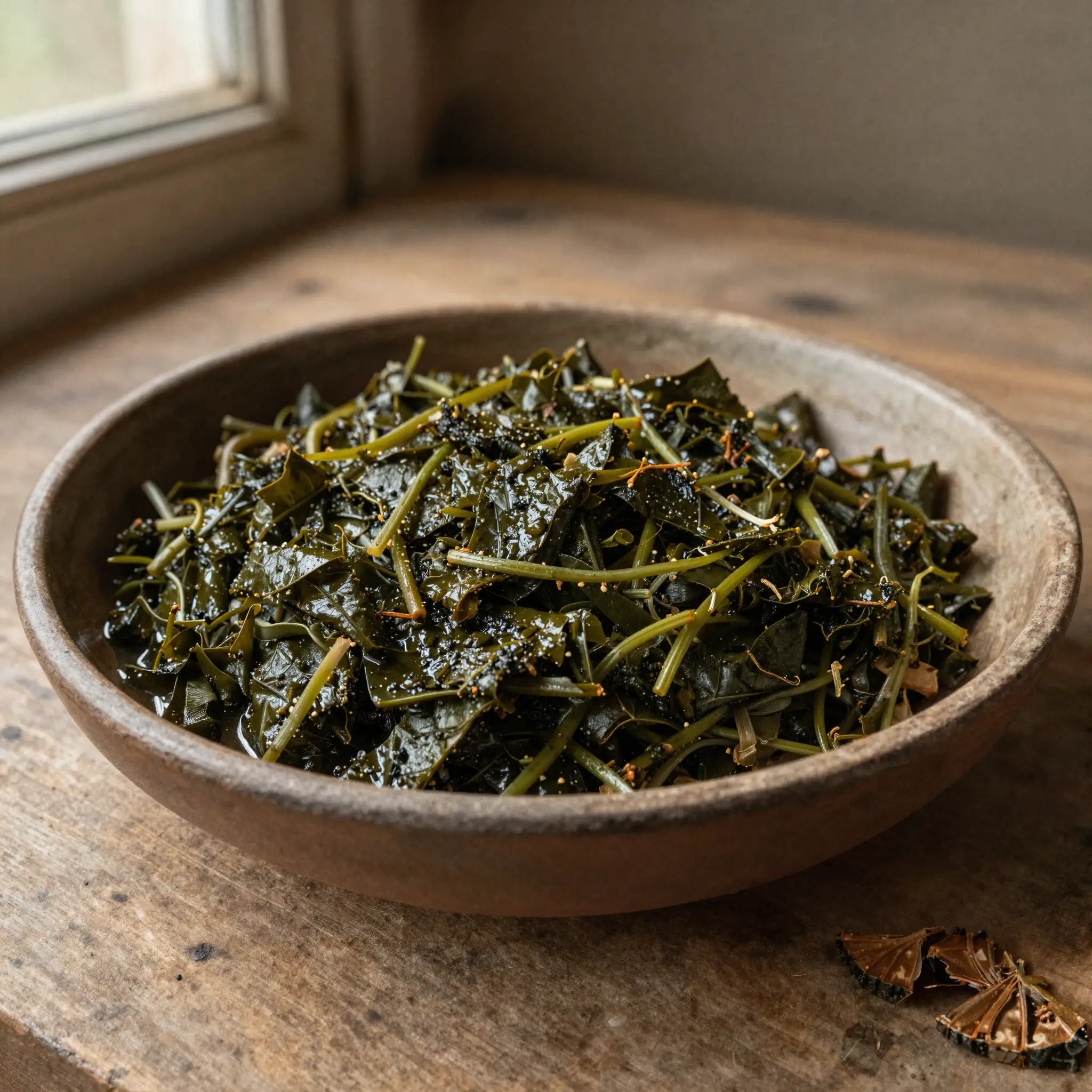
Pondu / Saka-saka (Central African cassava-leaf preparation)
Pondu / Saka-saka (Central African pounded and fermented cassava-leaf preparation)
vegetable-ferment-pickle
Facts
| Category | Vegetable |
|---|---|
| Product family | Fermented/Pounded Cassava-Leaf Vegetable Preparation |
| Origin | 🇨🇩 Congo - Kinshasa |
Safety
- Cassava-specific risk factor, distinct from every other entry in this content set: raw cassava leaves (like cassava root) contain cyanogenic glycosides, and adequate processing (pounding/crushing plus thorough cooking, and traditionally the rest/wilt period itself) is understood in general food-safety knowledge to be necessary to reduce cyanogenic compound levels to safe levels before consumption — this is a primary, well-established safety consideration for this product independent of whether fermentation in the strict LAB sense occurs at all, and is flagged here explicitly rather than folded silently into a generic lactic-fermentation safety template. Secondary, lower-confidence consideration: where a genuine multi-day rest/fermentation period is used, the same general spoilage-risk logic as other spontaneous vegetable ferments applies (off-odour, unusual sliminess, or visible mould are discard signals), though this is not independently sourced for pondu specifically. Safe-practice guidance: thorough pounding/crushing and thorough cooking are the well-established, primary safety-relevant steps for this substrate; precise cyanogenic-glycoside reduction thresholds and pH/salinity figures are not established. This safety statement's cyanogenic-glycoside content is a materially different risk-factor category from every other Variant in this batch and must not be conflated with the salt/pH-floor safety language used for the other two entries.
Method
Pondu / Saka-Saka (Central African Fermented Cassava Leaves) — fermented-tradition variant only
- Young cassava leaves, thoroughly cleaned — a substantial bunch, roughly 500 g–1 kg fresh leaf (illustrative)
- Water — as needed for pounding/moistening
- Palm oil — for the subsequent cooking step, quantity to taste (traditional; non-safety, flavour/cooking medium)
- Optional additions for the cooking stage: dried or fresh fish, meat, or ground peanut/groundnut paste (traditional; source from a food-safe supply chain, general food-handling practice, not specific to this Variant's fermentation safety)
- Salt — to taste in the final cooked dish (not established as a fermentation-safety control point for this specific product — see linked Variant item 8)
- 1
Step 1
Strip cassava leaves from stems; wash thoroughly.
- 2
Step 2
Pound/crush the leaves thoroughly using a mortar and pestle (or equivalent) to break down the fibrous structure — traditionally a labour-intensive step.
- 3
Step 3
Gather the pounded leaf mass into a container or wrapped bundle.
- 4
Step 4
Rest the pounded mass at ambient temperature for a period of roughly one to several days, per the fermented-tradition variant documented (illustrative, general ethnobotanical sourcing, not separately confirmed for this specific product) — check periodically for the expected mild sour/fermented aroma developing, distinct from any putrid or off-odour.
- 5
Step 5
After the rest period, proceed to cooking: place the rested leaf mass in a pot with water and palm oil.
- 6
Step 6
Add optional fish, meat, or peanut/groundnut paste per regional preference.
- 7
Step 7
Simmer/boil thoroughly until fully cooked — this cooking step is essential regardless of the rest period (see safety note below on cyanogenic-glycoside reduction).
- 8
Step 8
Season with salt to taste.
- 9
Step 9
Serve as a leafy-greens side dish, typically with a starch staple (e.g., fufu, rice, plantain).
Frequently asked questions
- What is Pondu / Saka-saka (Central African cassava-leaf preparation)?
- vegetable-ferment-pickle
- Where does Pondu / Saka-saka (Central African cassava-leaf preparation) come from?
- Pondu / Saka-saka (Central African cassava-leaf preparation) is traditionally made in Congo - Kinshasa.
- Is Pondu / Saka-saka (Central African cassava-leaf preparation) safe to make at home?
- Cassava-specific risk factor, distinct from every other entry in this content set: raw cassava leaves (like cassava root) contain cyanogenic glycosides, and adequate processing (pounding/crushing plus thorough cooking, and traditionally the rest/wilt period itself) is understood in general food-safety knowledge to be necessary to reduce cyanogenic compound levels to safe levels before consumption — this is a primary, well-established safety consideration for this product independent of whether fermentation in the strict LAB sense occurs at all, and is flagged here explicitly rather than folded silently into a generic lactic-fermentation safety template. Secondary, lower-confidence consideration: where a genuine multi-day rest/fermentation period is used, the same general spoilage-risk logic as other spontaneous vegetable ferments applies (off-odour, unusual sliminess, or visible mould are discard signals), though this is not independently sourced for pondu specifically. Safe-practice guidance: thorough pounding/crushing and thorough cooking are the well-established, primary safety-relevant steps for this substrate; precise cyanogenic-glycoside reduction thresholds and pH/salinity figures are not established. This safety statement's cyanogenic-glycoside content is a materially different risk-factor category from every other Variant in this batch and must not be conflated with the salt/pH-floor safety language used for the other two entries.
Community results
No community results published for this ferment yet.