
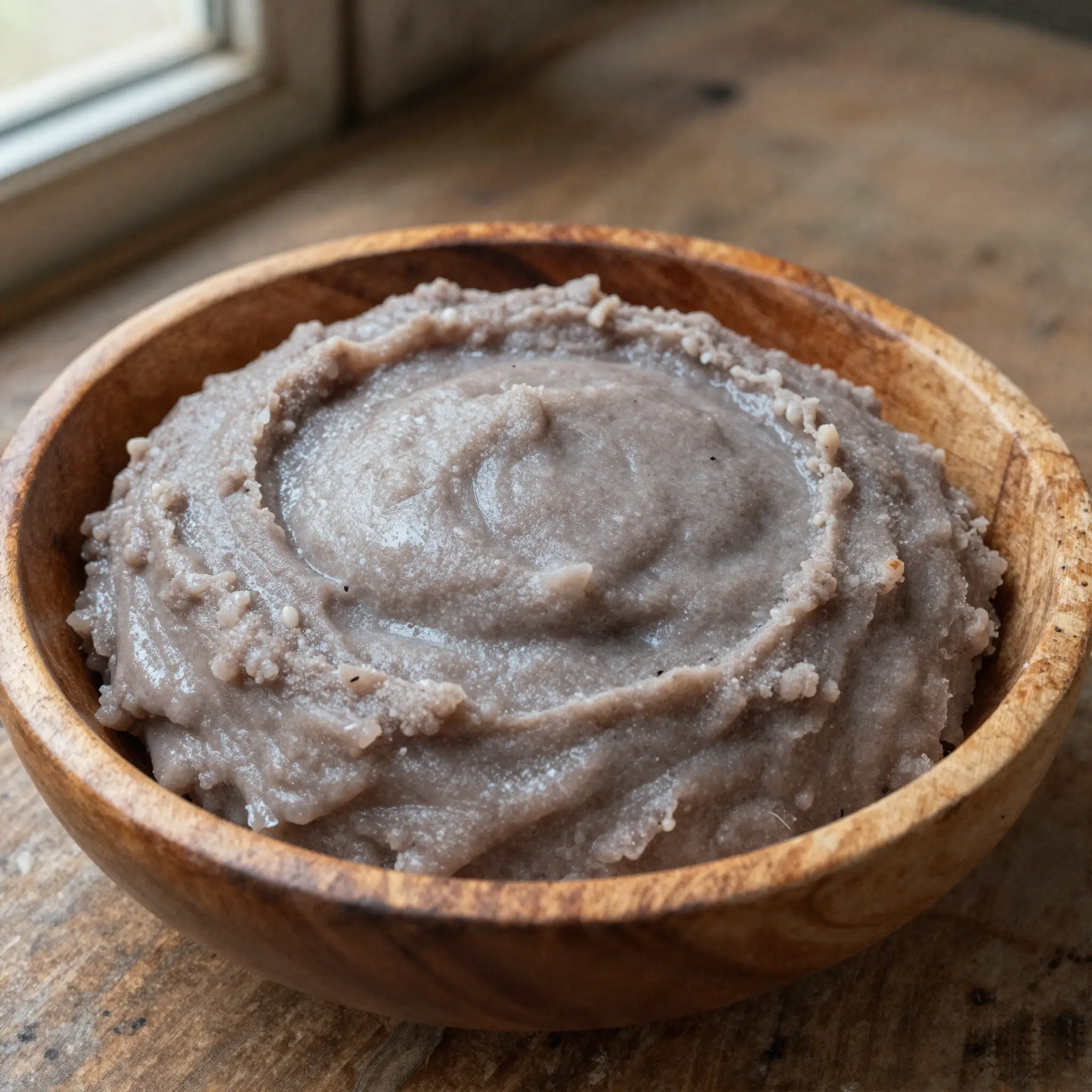
Poi (lacto-fermented taro paste)
Poi (Hawaiian/Polynesian lacto-fermented taro paste)
Root-tuber ferment/staple food
Facts
| Category | Vegetable |
|---|---|
| Product family | Poi |
Safety
- Documented risk-factor logic, reasoned by analogy from the general mechanism of spontaneous ambient-temperature starch-paste fermentation (no poi-specific quantified safety literature is present in our sources):
(a) taro corm itself contains calcium oxalate crystals and must be adequately cooked before pounding — inadequate cooking is a distinct, well-documented raw-taro handling risk, separate from the fermentation step itself, and is noted here for completeness though it is a pre-fermentation preparation hazard rather than a fermentation-safety one;
(b) an ambient-temperature paste left uncovered or in an unclean vessel is subject to the same general spoilage-organism-establishment risk as any spontaneous starch/vegetable ferment — covering the paste and using clean vessels/utensils is a recognized practical control;
(c) a properly souring poi develops a mild, pleasant tang; a putrid odour, unusual colour change beyond the expected greyish-purple hue, or visible mould are actionable discard/rework signals, consistent with general spontaneous-ferment spoilage indicators used elsewhere in this content set. Safe-practice guidance: cook taro thoroughly before pounding (pre-fermentation food-safety step, not itself a fermentation control); keep the pounded paste covered during ambient standing; use clean pounding/mixing implements and storage vessels; refrigerate once at desired sourness to slow further fermentation; discard on putrid odour, off-colour beyond the normal greyish hue, or visible mould. Precise regulatory-grade pH/temperature/duration thresholds for poi fermentation are not established.
Method
Poi (Hawaiian/Polynesian Lacto-Fermented Taro Paste)
- Taro corm (Colocasia esculenta), peeled — ~1000 g
- Water — added incrementally during pounding to reach a smooth, thick-paste consistency, then further thinned with additional water to serving consistency once fermented (illustrative quantities; no fixed ratio is documented in the reviewed source base)
- No salt, starter culture, or other additive is documented in traditional preparation — poi is traditionally just cooked taro and water
- 1
Step 1
Peel raw taro corms.
- 2
Step 2
Cook thoroughly (traditionally steamed or baked in an underground imu oven; a covered steamer/oven is a reasonable modern equivalent) until fully soft — thorough cooking is a pre-fermentation food-safety step, see linked Variant item 8.
- 3
Step 3
Pound the cooked taro (traditionally with a stone or wooden pounder on a wooden board) while adding water incrementally, working it into a smooth, cohesive paste.
- 4
Step 4
Set aside a portion to eat fresh ("sweet poi") if desired — this fresh portion is out of scope as a fermented Variant, per linked Variant item 4 boundary note.
- 5
Step 5
Transfer the remaining paste to a clean, covered container.
- 6
Step 6
Leave to stand, covered, at ambient temperature for one or more days, tasting periodically as it sours.
- 7
Step 7
Once the desired sourness ("sour poi") is reached, thin with additional water to the preferred serving consistency.
- 8
Step 8
Refrigerate to slow further souring; serve chilled or at room temperature.
Frequently asked questions
- What is Poi (lacto-fermented taro paste)?
- Root-tuber ferment/staple food
- Is Poi (lacto-fermented taro paste) safe to make at home?
- Documented risk-factor logic, reasoned by analogy from the general mechanism of spontaneous ambient-temperature starch-paste fermentation (no poi-specific quantified safety literature is present in our sources):
(a) taro corm itself contains calcium oxalate crystals and must be adequately cooked before pounding — inadequate cooking is a distinct, well-documented raw-taro handling risk, separate from the fermentation step itself, and is noted here for completeness though it is a pre-fermentation preparation hazard rather than a fermentation-safety one;
(b) an ambient-temperature paste left uncovered or in an unclean vessel is subject to the same general spoilage-organism-establishment risk as any spontaneous starch/vegetable ferment — covering the paste and using clean vessels/utensils is a recognized practical control;
(c) a properly souring poi develops a mild, pleasant tang; a putrid odour, unusual colour change beyond the expected greyish-purple hue, or visible mould are actionable discard/rework signals, consistent with general spontaneous-ferment spoilage indicators used elsewhere in this content set. Safe-practice guidance: cook taro thoroughly before pounding (pre-fermentation food-safety step, not itself a fermentation control); keep the pounded paste covered during ambient standing; use clean pounding/mixing implements and storage vessels; refrigerate once at desired sourness to slow further fermentation; discard on putrid odour, off-colour beyond the normal greyish hue, or visible mould. Precise regulatory-grade pH/temperature/duration thresholds for poi fermentation are not established.
Community results
No community results published for this ferment yet.