
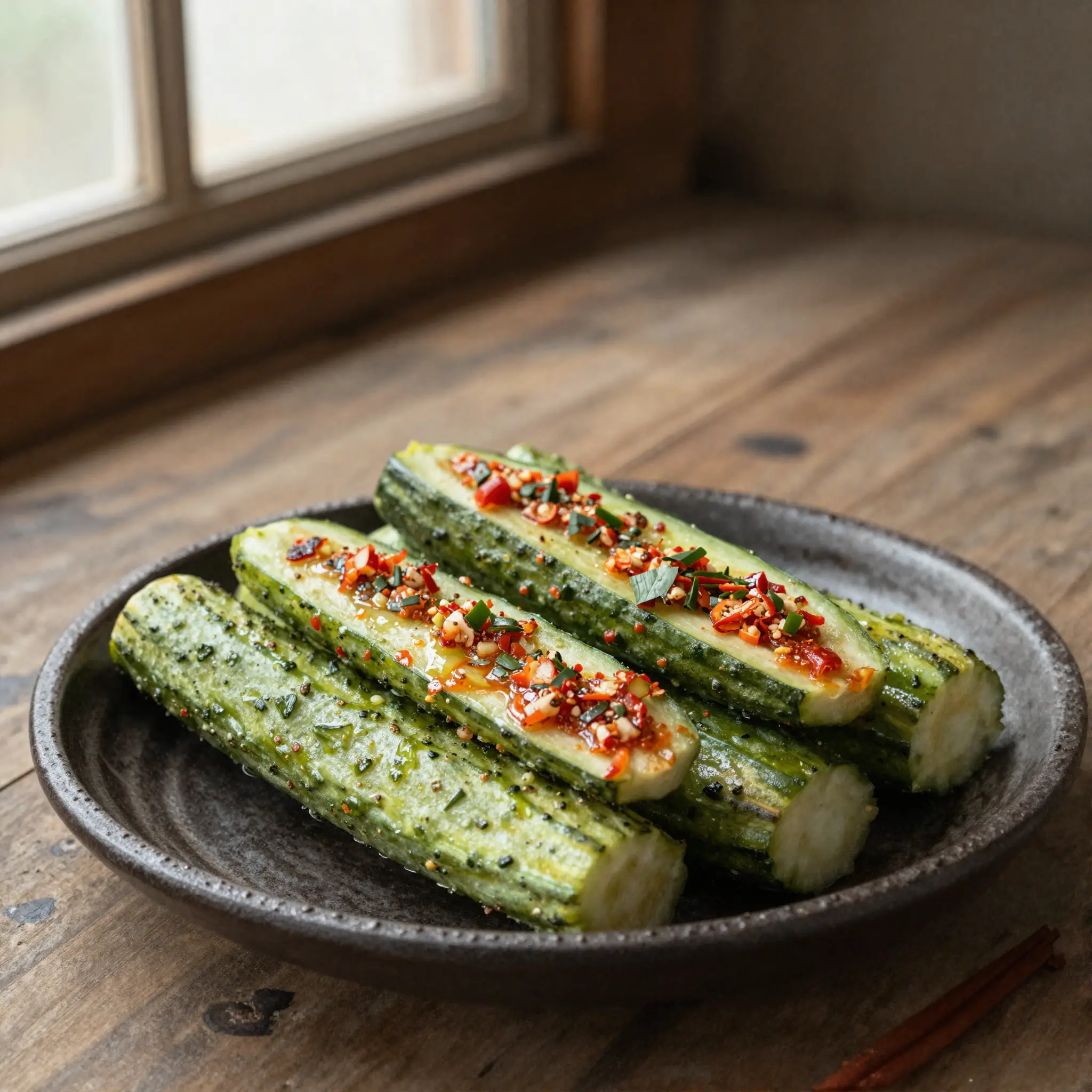
Oi-sobagi (Korean stuffed cucumber kimchi)
vegetable-ferment-pickle
Facts
| Category | Vegetable |
|---|---|
| Product family | Kimchi |
| Origin | 🇰🇷 South Korea |
Safety
- Cucumber's high water content and the short fermentation window make this Variant's safety profile closer to a fast vegetable ferment than to a long brine cure — the operative concern is the same general anaerobic/salinity-floor logic as other kimchi Variants, scaled to a short timeframe. Safe-practice guidance:
(a) adequate initial salting of the cucumber before stuffing to draw out water and begin acidification;
(b) refrigerate promptly, especially for the short-fermented canonical Variant, since the brief window and high-moisture substrate leave less acid "safety margin" than a long-brined ferment;
(c) the fresh/same-day boundary-note version is not a fermented food-safety case at all and should be treated and stored as a fresh perishable salad, not under fermented-food guidance;
(d) if a fermented-seafood seasoning ingredient is used, source it from a food-safe supply chain, consistent with the same inherited consideration noted for kkakdugi.
Method
Oi-Sobagi (Korean Stuffed Cucumber Kimchi)
- Small Korean cucumbers — ~1000 g
- Non-iodized salt — quantity for the initial dry-salt step (illustrative) — SAFETY CONTROL, see linked Variant
- Garlic chives (or scallion) — a handful, chopped
- Gochugaru (Korean chili powder) — ~3–4 tbsp
- Garlic, ginger — minced, a few cloves/a small knob
- Optional: a little fish sauce or jeotgal-family seasoning (traditional; source from a food-safe supply chain — see linked Variant item 8)
- 1
Step 1
Trim small cucumbers; cut a lengthwise cross-slit into each, without cutting all the way through.
- 2
Step 2
Dry-salt the slit cucumbers and let stand briefly to draw out water and slightly soften; drain.
- 3
Step 3
Mix garlic chives/scallion, gochugaru, garlic, ginger, and optional seafood seasoning into a stuffing.
- 4
Step 4
Stuff each slit cucumber with the seasoning mixture.
- 5
Step 5
Pack stuffed cucumbers into a clean container.
- 6
Step 6
Hold at cool ambient/refrigerated temperature for a short period to allow brief lactic fermentation to develop sourness.
- 7
Step 7
Taste from ~1 day onward; refrigerate once at desired flavour.
- 8
Step 8
Serve chilled, typically within a few days for best texture.
Frequently asked questions
- What is Oi-sobagi (Korean stuffed cucumber kimchi)?
- vegetable-ferment-pickle
- Where does Oi-sobagi (Korean stuffed cucumber kimchi) come from?
- Oi-sobagi (Korean stuffed cucumber kimchi) is traditionally made in South Korea.
- Is Oi-sobagi (Korean stuffed cucumber kimchi) safe to make at home?
- Cucumber's high water content and the short fermentation window make this Variant's safety profile closer to a fast vegetable ferment than to a long brine cure — the operative concern is the same general anaerobic/salinity-floor logic as other kimchi Variants, scaled to a short timeframe. Safe-practice guidance:
(a) adequate initial salting of the cucumber before stuffing to draw out water and begin acidification;
(b) refrigerate promptly, especially for the short-fermented canonical Variant, since the brief window and high-moisture substrate leave less acid "safety margin" than a long-brined ferment;
(c) the fresh/same-day boundary-note version is not a fermented food-safety case at all and should be treated and stored as a fresh perishable salad, not under fermented-food guidance;
(d) if a fermented-seafood seasoning ingredient is used, source it from a food-safe supply chain, consistent with the same inherited consideration noted for kkakdugi.
Community results
No community results published for this ferment yet.