
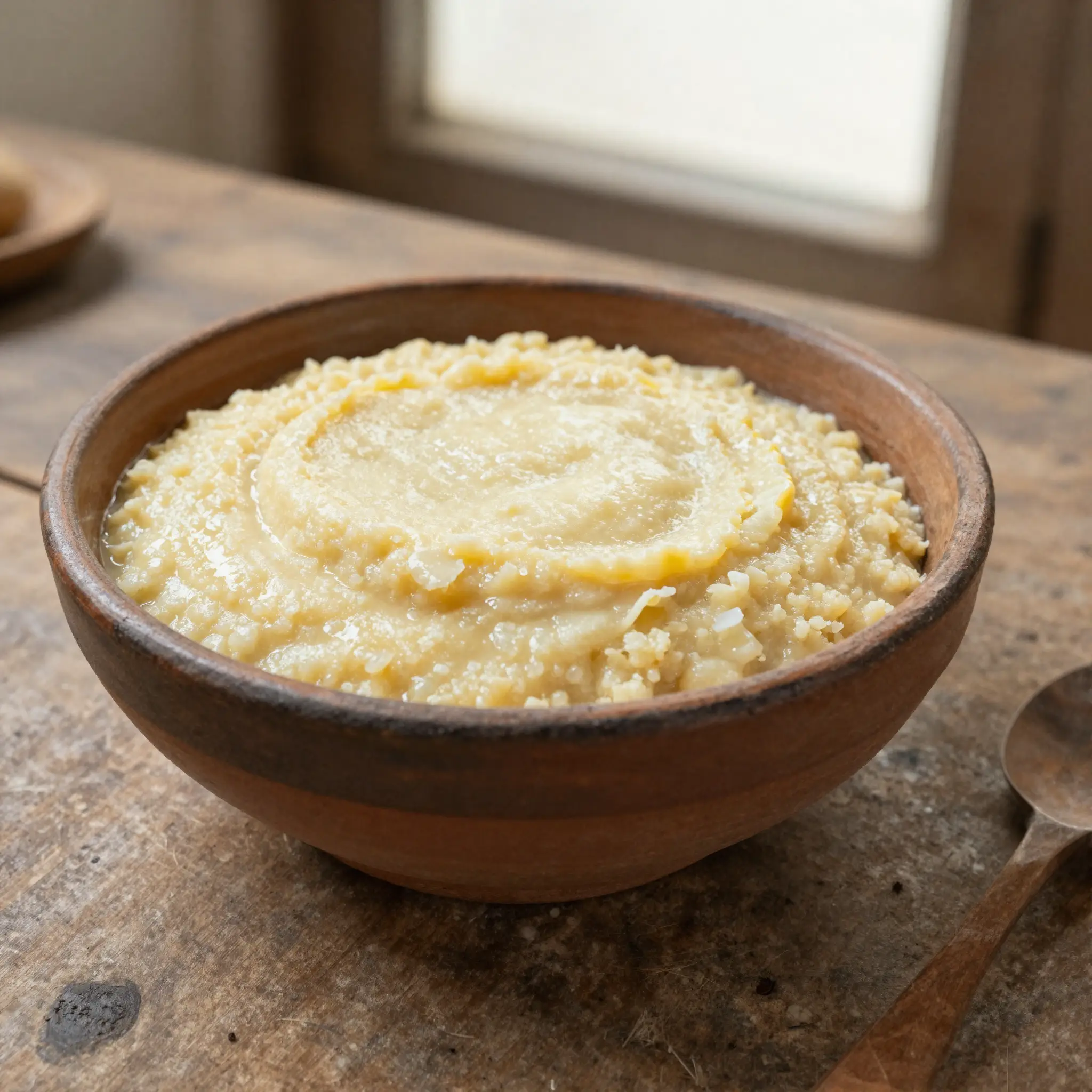
Ogi/Akamu/Pap (Nigerian fermented cereal porridge)
Ogi/Akamu/Pap (Nigerian fermented maize/sorghum/millet porridge)
Porridge/staple
Facts
| Category | Grain / Legume |
|---|---|
| Product family | West African Fermented Cereal Porridge |
| Origin | 🇳🇬 Nigeria |
| Key microorganisms | lactic-acid-bacteria, yeasts |
Safety
- Documented considerations (honest, grain-staple-appropriate):
(a) ogi/akamu is a spontaneous fermentation with no defined starter culture, so adequate souring/acidification of the steeping grain (a genuinely sour aroma and taste) is the primary indicator that fermentation has proceeded safely, rather than the grain having simply soaked unfermented;
(b) cereal substrates carry a general, honestly-disclosed mycotoxin/mould-contamination awareness applicable to any stored or steeped grain product — grain that shows visible mould, discoloration, or a musty/off odour before or during steeping should be discarded, not used, and this is not independently confirmed as specific to this product, concentration, or regulatory threshold;
(c) the final cooking step (briefly boiling the wet starch with water into pap, stirring continuously) is a genuine safety-relevant step — it heat-treats the fermented starch immediately before consumption, particularly relevant given ogi/akamu/pap's documented role as a weaning food for infants, where thorough cooking is especially important;
(d) the wet, settled starch is traditionally stored under water at ambient or cool temperature and should be used within a reasonably short window and/or have its steeping water changed periodically to limit spoilage — no specific numeric shelf-life or water-change-interval is asserted, any such figure is illustrative or not established;
(e) potable water must be used throughout — for steeping the grain, wet-milling, storage, and final cooking. Safe-practice guidance: use clean equipment and potable water throughout; discard grain showing visible mould, discoloration, or musty off-odour before steeping; confirm a genuinely sour steeping-grain aroma/taste as the sign of a safely proceeding ferment; cook the wet starch thoroughly into pap immediately before serving, especially for infant/weaning use; store the settled wet starch under clean water and use within a reasonably short interval, discarding on any off-odour or visible spoilage. No specific pathogen thresholds, pH figures, mycotoxin concentrations, or storage-duration numerics are asserted — any such figure is illustrative or not established.
Method
Ogi/Akamu/Pap (Nigerian Fermented Maize/Sorghum/Millet Porridge)
- Maize, sorghum, or millet (dried grain) — ~1 kg
- Water — sufficient to steep the grain fully submerged, potable; additional potable water for wet-milling and final cooking
- Optional: sugar, milk, or condensed milk to taste at serving (flavour only, non-safety, common breakfast serving custom)
- 1
Step 1
Clean the dried grain, removing debris and any visibly mouldy or discoloured kernels.
- 2
Step 2
Submerge the cleaned grain fully in potable water in a clean vessel.
- 3
Step 3
Leave to steep and ferment spontaneously at ambient temperature.
- 4
Step 4
Check daily: naturally-occurring LAB and yeasts sour the steeping grain (typically 1–3 days, illustrative, tradition- and household-variable).
- 5
Step 5
Once genuinely sour, drain and wet-mill the softened grain to a smooth slurry, adding potable water as needed.
- 6
Step 6
Sieve the slurry through a clean cloth or fine sieve to remove bran/chaff, yielding a smooth wet starch.
- 7
Step 7
Allow the sieved starch to settle; store it submerged under clean water until needed, changing the water periodically.
- 8
Step 8
At time of eating, mix a portion of the wet starch with hot potable water and cook briefly over heat, stirring continuously, until it thickens into a smooth porridge (pap).
- 9
Step 9
Serve warm, optionally sweetened or with milk.
Frequently asked questions
- What is Ogi/Akamu/Pap (Nigerian fermented cereal porridge)?
- Porridge/staple
- Which microorganisms ferment Ogi/Akamu/Pap (Nigerian fermented cereal porridge)?
- Ogi/Akamu/Pap (Nigerian fermented cereal porridge) is primarily driven by lactic-acid-bacteria, yeasts.
- Where does Ogi/Akamu/Pap (Nigerian fermented cereal porridge) come from?
- Ogi/Akamu/Pap (Nigerian fermented cereal porridge) is traditionally made in Nigeria.
- Is Ogi/Akamu/Pap (Nigerian fermented cereal porridge) safe to make at home?
- Documented considerations (honest, grain-staple-appropriate):
(a) ogi/akamu is a spontaneous fermentation with no defined starter culture, so adequate souring/acidification of the steeping grain (a genuinely sour aroma and taste) is the primary indicator that fermentation has proceeded safely, rather than the grain having simply soaked unfermented;
(b) cereal substrates carry a general, honestly-disclosed mycotoxin/mould-contamination awareness applicable to any stored or steeped grain product — grain that shows visible mould, discoloration, or a musty/off odour before or during steeping should be discarded, not used, and this is not independently confirmed as specific to this product, concentration, or regulatory threshold;
(c) the final cooking step (briefly boiling the wet starch with water into pap, stirring continuously) is a genuine safety-relevant step — it heat-treats the fermented starch immediately before consumption, particularly relevant given ogi/akamu/pap's documented role as a weaning food for infants, where thorough cooking is especially important;
(d) the wet, settled starch is traditionally stored under water at ambient or cool temperature and should be used within a reasonably short window and/or have its steeping water changed periodically to limit spoilage — no specific numeric shelf-life or water-change-interval is asserted, any such figure is illustrative or not established;
(e) potable water must be used throughout — for steeping the grain, wet-milling, storage, and final cooking. Safe-practice guidance: use clean equipment and potable water throughout; discard grain showing visible mould, discoloration, or musty off-odour before steeping; confirm a genuinely sour steeping-grain aroma/taste as the sign of a safely proceeding ferment; cook the wet starch thoroughly into pap immediately before serving, especially for infant/weaning use; store the settled wet starch under clean water and use within a reasonably short interval, discarding on any off-odour or visible spoilage. No specific pathogen thresholds, pH figures, mycotoxin concentrations, or storage-duration numerics are asserted — any such figure is illustrative or not established.
Community results
No community results published for this ferment yet.