
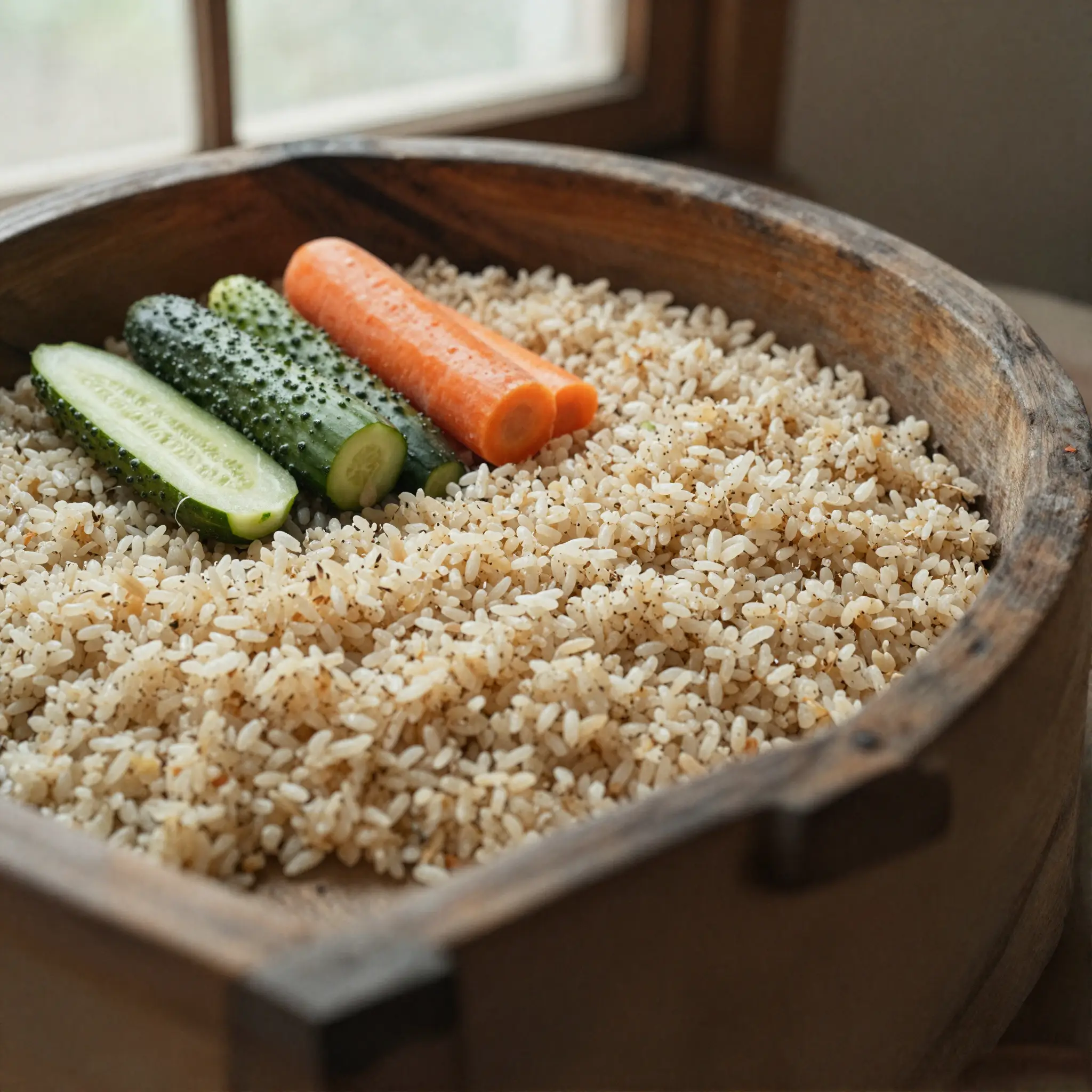
Nukazuke (rice-bran-bed fermented pickles)
Nukazuke (Japanese rice-bran-bed lactic-fermented vegetable pickle)
vegetable-ferment-pickle
Facts
| Category | Vegetable |
|---|---|
| Product family | Tsukemono |
| Origin | 🇯🇵 Japan |
Safety
- Documented risk-factor logic follows the same anaerobic/salinity-floor pattern as other salt-dependent solid-state vegetable ferments:
(a) an inadequately salted or poorly maintained bed can allow spoilage organisms or pathogenic contamination to establish, particularly if daily mixing lapses and the bed develops a stagnant, poorly-aerated pocket;
(b) hands/utensils used to mix the bed are a recognized contamination vector in home practice, making hygiene during daily maintenance a practical control point;
(c) a healthy, actively-maintained bed is characterized by a pleasant sour/fermented smell — a rotten, putrid, or unusual odour, persistent surface mould (beyond an occasional harmless kahm-type film), or visible discoloration are actionable discard/rework warnings. Safe-practice guidance: maintain adequate salt content in the bed (a home-scale bed is typically kept distinctly salty to the taste — precise regulatory-grade percentage floors are not established; mix by hand or clean utensil daily to keep the bed aerobic-at-the-surface/anaerobic-at-depth and evenly fermented; discard/rebuild the bed on persistent off-odour or contamination signs; do not treat this Variant's safety statement as applicable to any non-fermented "nuka-flavoured" quick product.
Method
Nukazuke (Japanese Rice-Bran-Bed Lactic-Fermented Pickle)
- Rice bran (nuka), fresh/toasted — ~1000 g (to establish the nukadoko bed)
- Non-iodized salt — quantity to make a distinctly salty bran paste (illustrative; precise regulatory-grade salt-% floor for the bed is not established) — SAFETY CONTROL, see linked Variant
- Water — enough to bring the bran to a moist, dough-like paste consistency
- Vegetable scraps (e.g. cabbage core, carrot peel, chili) — used during initial bed maturation to build the microbial community (traditional, non-safety)
- Kombu, dried chili — optional traditional flavour additions to the bed (non-safety)
- Vegetables for pickling (cucumber, daikon, carrot, eggplant, cabbage — whole or large-cut) — as available per batch
- 1
Step 1
Toast the rice bran lightly (traditional) and mix with salt.
- 2
Step 2
Gradually add water, kneading to a moist, cohesive paste (the nukadoko).
- 3
Step 3
Bury vegetable scraps in the fresh paste and mix by hand daily over an initial maturation period to build and stabilize the bed's microbial community.
- 4
Step 4
Once the bed smells pleasantly sour/fermented (matured), bury raw vegetables to be pickled fully within the paste.
- 5
Step 5
Leave buried, anaerobic, at ambient-to-cool temperature for a short duration (hours to a few days depending on vegetable and desired sourness).
- 6
Step 6
Remove vegetables, rinse off clinging bran, slice, and serve.
- 7
Step 7
Mix the bed by hand (or clean utensil) at least once daily to redistribute moisture/salt and keep it evenly fermented — this is a recurring maintenance step, not a one-time action.
- 8
Step 8
Top up bran/salt periodically as the bed is used and its volume/salinity is depleted by repeated vegetable turnover.
- 9
Step 9
Reuse the same maintained bed indefinitely for subsequent batches; do not discard between batches.
Frequently asked questions
- What is Nukazuke (rice-bran-bed fermented pickles)?
- vegetable-ferment-pickle
- Where does Nukazuke (rice-bran-bed fermented pickles) come from?
- Nukazuke (rice-bran-bed fermented pickles) is traditionally made in Japan.
- Is Nukazuke (rice-bran-bed fermented pickles) safe to make at home?
- Documented risk-factor logic follows the same anaerobic/salinity-floor pattern as other salt-dependent solid-state vegetable ferments:
(a) an inadequately salted or poorly maintained bed can allow spoilage organisms or pathogenic contamination to establish, particularly if daily mixing lapses and the bed develops a stagnant, poorly-aerated pocket;
(b) hands/utensils used to mix the bed are a recognized contamination vector in home practice, making hygiene during daily maintenance a practical control point;
(c) a healthy, actively-maintained bed is characterized by a pleasant sour/fermented smell — a rotten, putrid, or unusual odour, persistent surface mould (beyond an occasional harmless kahm-type film), or visible discoloration are actionable discard/rework warnings. Safe-practice guidance: maintain adequate salt content in the bed (a home-scale bed is typically kept distinctly salty to the taste — precise regulatory-grade percentage floors are not established; mix by hand or clean utensil daily to keep the bed aerobic-at-the-surface/anaerobic-at-depth and evenly fermented; discard/rebuild the bed on persistent off-odour or contamination signs; do not treat this Variant's safety statement as applicable to any non-fermented "nuka-flavoured" quick product.
Community results
No community results published for this ferment yet.