
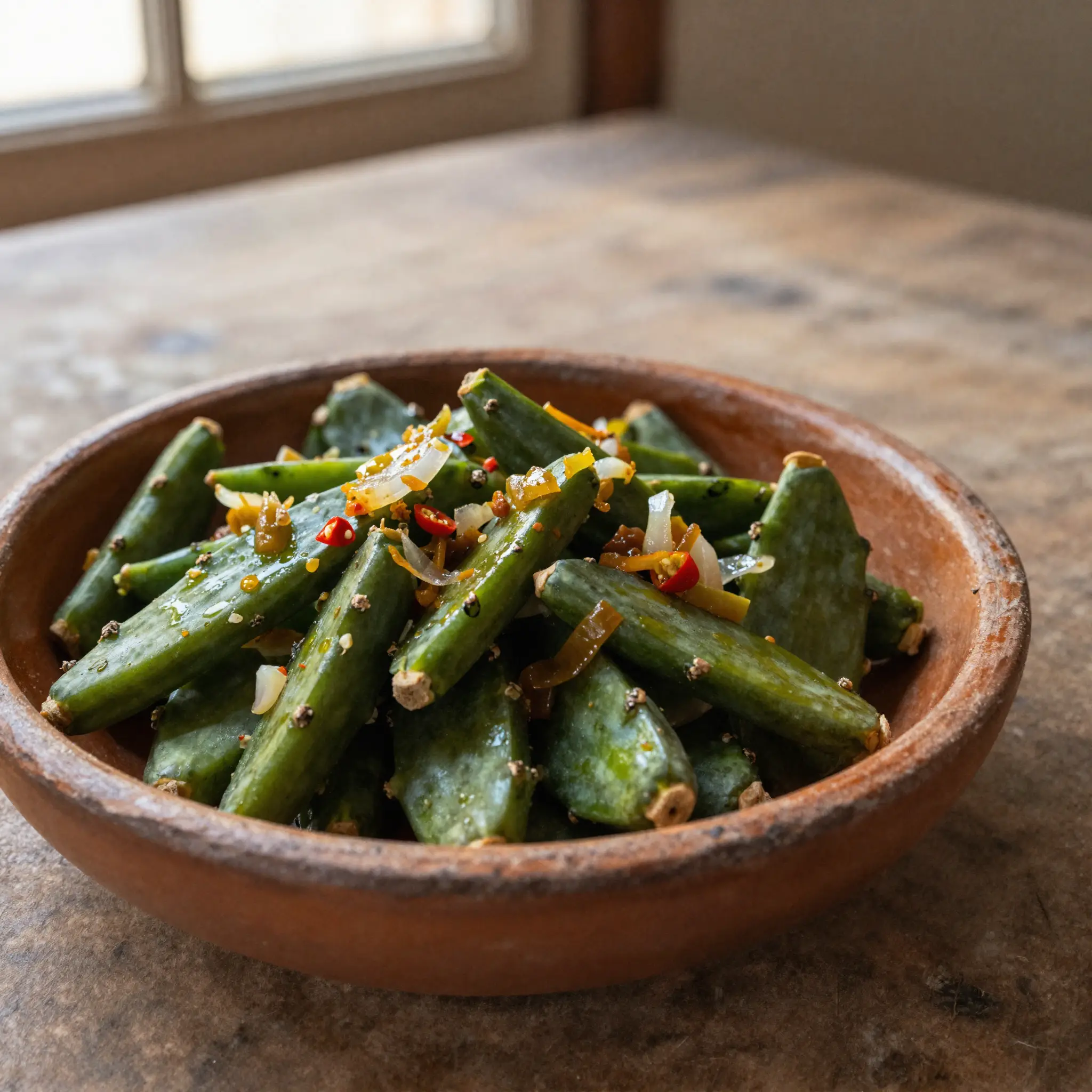
Nopalitos fermentados (Mexican fermented cactus-paddle pickle)
Nopalitos fermentados (Mexican lacto-fermented cactus paddles)
vegetable-ferment-pickle
Facts
| Category | Vegetable |
|---|---|
| Product family | Lacto-Fermented Cactus Paddle Pickle |
| Origin | 🇲🇽 Mexico |
Safety
- No nopal-specific safety literature is present in our sources; the general vegetable lactic-fermentation safety floor is inherited by analogy only, stated honestly rather than presented as nopal-specific-confirmed. Documented risk factor (by analogy): insufficient brine salinity or cactus pieces left exposed above the brine line permits spoilage organisms and, in a fully anaerobic low-acid pocket before acidification, a theoretical Clostridium botulinum concern — the same structural risk as any salt-brine vegetable ferment, with no substrate-specific elevation or reduction of that risk identified in available sources. Safe-practice guidance:
(a) maintain an adequate salt brine (~3% by weight is an illustrative home figure only — no nopal-specific regulatory-grade floor was found and none is asserted);
(b) keep all cactus pieces fully submerged below the brine;
(c) target pH ≤4.6;
(d) discard on fuzzy surface mould, putrid (not sour) odour, or unusual sliminess distinct from nopal's normal mucilaginous texture (a genuinely useful but substrate-specific judgment call worth naming explicitly, since nopal's baseline texture could otherwise mask an early spoilage signal for an inexperienced cook);
(e) do not seal into a shelf-stable, non-refrigerated low-acid state without a validated canning process.
Method
Nopalitos Fermentados (Mexican Lacto-Fermented Cactus Paddles)
- Nopal (prickly pear cactus) paddles, cleaned and de-spined — ~1000 g
- Non-iodized salt — quantity to make a ~3% brine (illustrative) — SAFETY CONTROL, see linked Variant
- Water — enough to fully submerge (~1–1.5 L)
- Garlic, onion, oregano, or chili — to taste, optional (flavour, non-safety)
- 1
Step 1
Clean and de-spine nopal paddles thoroughly; cut into strips or dice.
- 2
Step 2
Optionally, briefly blanch or dry-salt the pieces to help manage the characteristic mucilage (variable step, not safety-critical).
- 3
Step 3
Prepare the salt brine; dissolve salt fully in water.
- 4
Step 4
Pack nopal pieces into a clean jar, along with any optional flavourings.
- 5
Step 5
Pour the brine over to fully cover the nopal pieces.
- 6
Step 6
Weight or wedge the pieces so they stay submerged below the brine line.
- 7
Step 7
Cover with a breathable lid; ferment at ambient temperature.
- 8
Step 8
Check periodically: confirm submersion; skim any surface film.
- 9
Step 9
Taste from ~1 week onward; continue to desired sourness (typically 1–2 weeks).
- 10
Step 10
Refrigerate once at target flavour.
Frequently asked questions
- What is Nopalitos fermentados (Mexican fermented cactus-paddle pickle)?
- vegetable-ferment-pickle
- Where does Nopalitos fermentados (Mexican fermented cactus-paddle pickle) come from?
- Nopalitos fermentados (Mexican fermented cactus-paddle pickle) is traditionally made in Mexico.
- Is Nopalitos fermentados (Mexican fermented cactus-paddle pickle) safe to make at home?
- No nopal-specific safety literature is present in our sources; the general vegetable lactic-fermentation safety floor is inherited by analogy only, stated honestly rather than presented as nopal-specific-confirmed. Documented risk factor (by analogy): insufficient brine salinity or cactus pieces left exposed above the brine line permits spoilage organisms and, in a fully anaerobic low-acid pocket before acidification, a theoretical Clostridium botulinum concern — the same structural risk as any salt-brine vegetable ferment, with no substrate-specific elevation or reduction of that risk identified in available sources. Safe-practice guidance:
(a) maintain an adequate salt brine (~3% by weight is an illustrative home figure only — no nopal-specific regulatory-grade floor was found and none is asserted);
(b) keep all cactus pieces fully submerged below the brine;
(c) target pH ≤4.6;
(d) discard on fuzzy surface mould, putrid (not sour) odour, or unusual sliminess distinct from nopal's normal mucilaginous texture (a genuinely useful but substrate-specific judgment call worth naming explicitly, since nopal's baseline texture could otherwise mask an early spoilage signal for an inexperienced cook);
(e) do not seal into a shelf-stable, non-refrigerated low-acid state without a validated canning process.
Community results
No community results published for this ferment yet.