
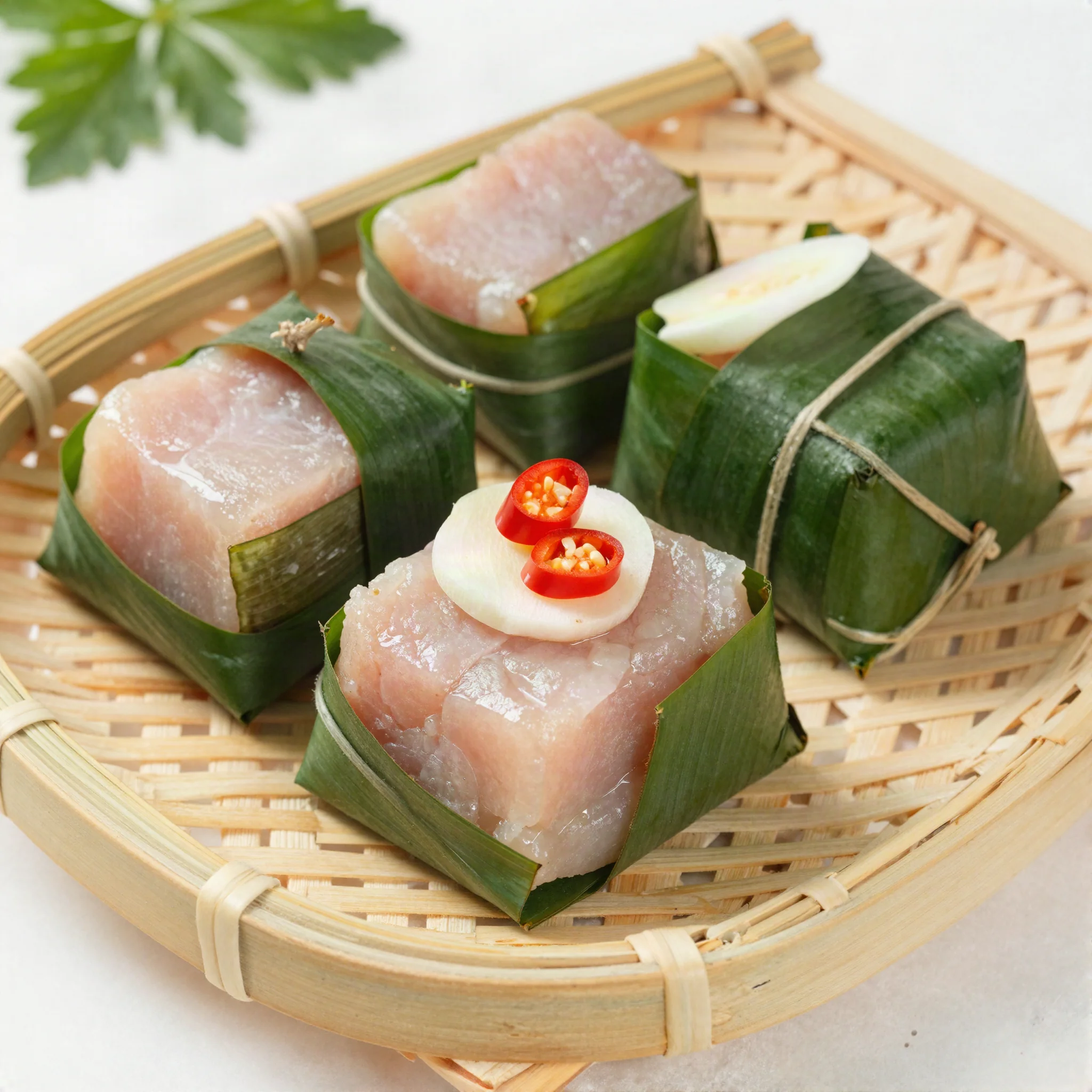
Nem chua (Vietnamese fermented pork parcel)
Meat ferment/snack
Facts
| Category | Meat / Fish |
|---|---|
| Product family | Southeast Asian Short-Fermented Pork |
| Key microorganisms | lactic-acid-bacteria |
Safety
- This product's safety rests almost entirely on a rapid, complete acidification of raw pork that is then eaten without cooking — it does not have the drying/water-activity hurdle that protects dry sausages, and it must not be reasoned about as if it did. Documented risk factors:
(a) Trichinella and other pork parasites — the primary documented hazard class for raw fermented pork in Southeast Asia; fermentation and acidification are not reliable parasite-killing steps, and the recognized controls are sourcing from inspected supply and regulated freezing or thorough cooking.
(b) Bacterial pathogens of raw pork — Salmonella, Listeria monocytogenes, and pathogenic E. coli — reduced but not reliably eliminated by a short ambient ferment.
(c) Staphylococcus aureus toxin — a hazard when the acidification is slow or stalls at ambient temperature, allowing growth before the pH falls.
(d) Clostridium botulinum — relevant wherever meat is packed tightly (anaerobic) at ambient temperature; where curing salts are used they are a safety-relevant ingredient, and where they are not used the protection depends entirely on prompt acidification and short holding.
(e) Ambient-temperature holding is inherent to the traditional method and is itself the key control variable: too cool and the ferment stalls (hazard), too warm/too long and spoilage or overacidification follows.
(f) Biogenic amines may accumulate in over-held product. Safe-practice guidance: use fresh pork from an inspected supply and treat parasite control as a sourcing/freezing question, not something the fermentation solves; keep everything scrupulously clean; pack and wrap tightly; hold at the traditional ambient conditions only for the traditional short period, then refrigerate; discard any parcel with off-odours, sliminess, gas/bloating or discolouration; understand that this is a raw pork product — vulnerable groups (pregnant people, the immunocompromised, the very young or old) should treat it as a raw-meat product and consider cooking it or avoiding it. Numerics: no pH target, fermentation temperature, holding duration, salt percentage or nitrite figure is asserted — every such figure is (illustrative) or not established.
Method
Nem chua (Vietnamese fermented pork parcel)
- Lean pork, very finely ground or pounded — ~900 g (illustrative) — SAFETY CONTROL (source: inspected supply; parasite control is a sourcing/freezing matter)
- Cooked shredded pork skin — ~100 g (common, optional; illustrative)
- Roasted ground rice (thính) — ~20 g (illustrative) — the fermentable carbohydrate source
- Salt — ~20 g (illustrative) · sugar — ~30 g (illustrative; it feeds the acidifying bacteria, so it is a process input, not only a flavouring)
- Garlic ~10 g, bird's-eye chilli to taste, black pepper ~2 g (illustrative)
- Banana leaf (or foil) for tight wrapping
- (optional, commercial practice) curing salts and/or a defined starter culture — traditional household practice does not necessarily use them, and no authority sets a figure for this product; quantity not established
- Read the salt figure correctly: in this short, undried ferment salt is not the preservation hurdle the way it is in a dry sausage. Prompt, complete acidification is the control — see the linked Variant.
- 1
Step 1
Keep the pork cold and work with scrupulously clean equipment throughout.
- 2
Step 2
Grind or pound the lean pork very finely; prepare and shred the cooked pork skin if used.
- 3
Step 3
Mix with roasted ground rice, salt, sugar, pepper and garlic until fully homogeneous.
- 4
Step 4
Pack the mixture tightly into small parcels, excluding air; wrap in banana leaf (traditionally with a garlic slice and chilli placed on top).
- 5
Step 5
Fermentation stage: hold at ambient temperature for the traditional short, days-scale period until the parcels have soured and firmed. (Target pH, temperature and duration: not established.)
- 6
Step 6
Refrigerate once soured; do not extend the ambient holding beyond the traditional period.
- 7
Step 7
Serve raw, as a snack, typically with fresh garlic and chilli.
Frequently asked questions
- What is Nem chua (Vietnamese fermented pork parcel)?
- Meat ferment/snack
- Which microorganisms ferment Nem chua (Vietnamese fermented pork parcel)?
- Nem chua (Vietnamese fermented pork parcel) is primarily driven by lactic-acid-bacteria.
- Is Nem chua (Vietnamese fermented pork parcel) safe to make at home?
- This product's safety rests almost entirely on a rapid, complete acidification of raw pork that is then eaten without cooking — it does not have the drying/water-activity hurdle that protects dry sausages, and it must not be reasoned about as if it did. Documented risk factors:
(a) Trichinella and other pork parasites — the primary documented hazard class for raw fermented pork in Southeast Asia; fermentation and acidification are not reliable parasite-killing steps, and the recognized controls are sourcing from inspected supply and regulated freezing or thorough cooking.
(b) Bacterial pathogens of raw pork — Salmonella, Listeria monocytogenes, and pathogenic E. coli — reduced but not reliably eliminated by a short ambient ferment.
(c) Staphylococcus aureus toxin — a hazard when the acidification is slow or stalls at ambient temperature, allowing growth before the pH falls.
(d) Clostridium botulinum — relevant wherever meat is packed tightly (anaerobic) at ambient temperature; where curing salts are used they are a safety-relevant ingredient, and where they are not used the protection depends entirely on prompt acidification and short holding.
(e) Ambient-temperature holding is inherent to the traditional method and is itself the key control variable: too cool and the ferment stalls (hazard), too warm/too long and spoilage or overacidification follows.
(f) Biogenic amines may accumulate in over-held product. Safe-practice guidance: use fresh pork from an inspected supply and treat parasite control as a sourcing/freezing question, not something the fermentation solves; keep everything scrupulously clean; pack and wrap tightly; hold at the traditional ambient conditions only for the traditional short period, then refrigerate; discard any parcel with off-odours, sliminess, gas/bloating or discolouration; understand that this is a raw pork product — vulnerable groups (pregnant people, the immunocompromised, the very young or old) should treat it as a raw-meat product and consider cooking it or avoiding it. Numerics: no pH target, fermentation temperature, holding duration, salt percentage or nitrite figure is asserted — every such figure is (illustrative) or not established.
Community results
No community results published for this ferment yet.