
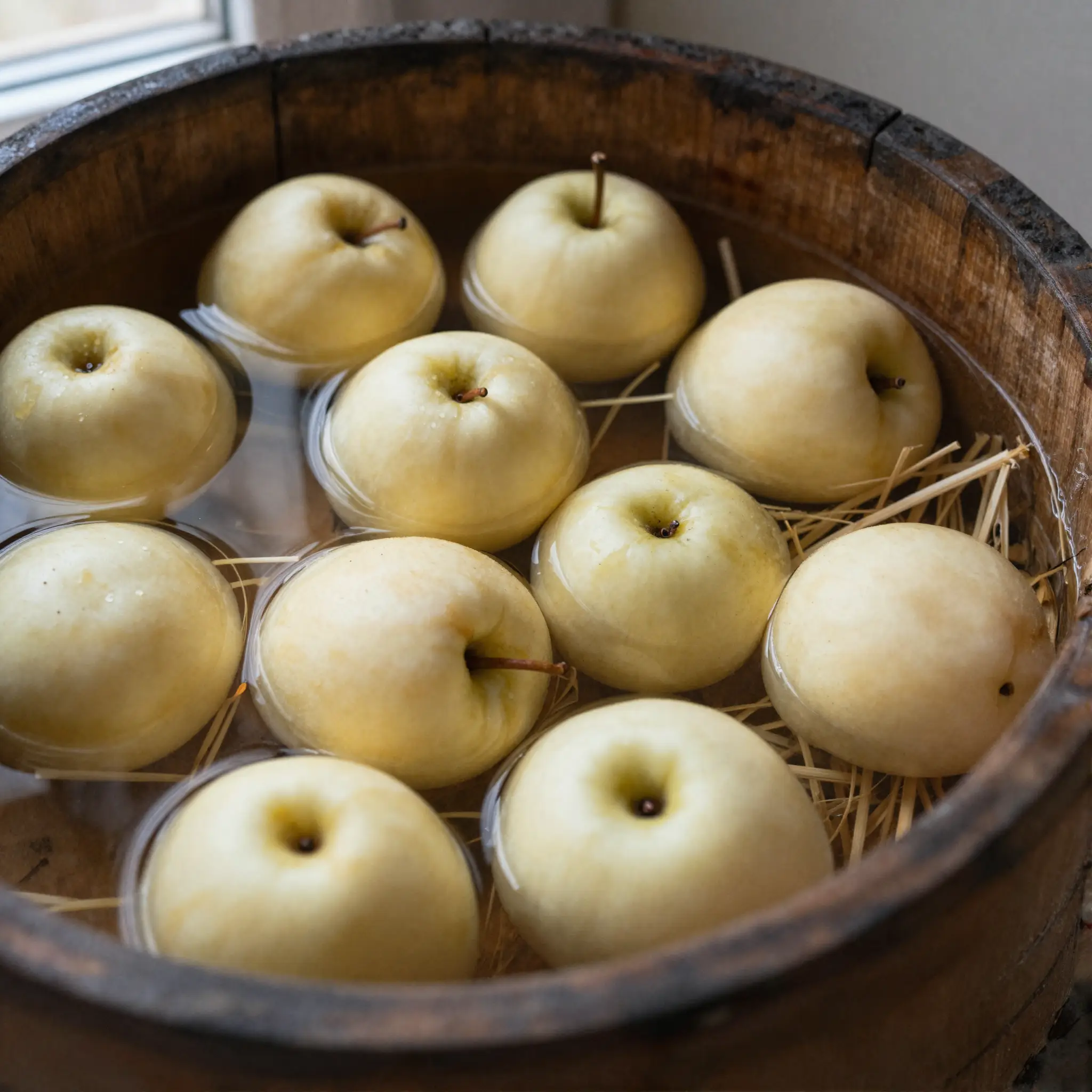
Mochyonye yabloki (Russian/Slavic brine-fermented apples)
Mochyonye yabloki (Russian/East Slavic brine-fermented whole apples)
vegetable-ferment-pickle
Facts
| Category | Fruit |
|---|---|
| Product family | Brine/Solution-Fermented Whole Fruit |
| Origin | 🇷🇺 Russia |
Safety
- Documented risk factor — as with any whole-fruit or whole-vegetable brine ferment, inadequate salinity or loss of submersion (fruit floating above the brine line) permits surface spoilage; whole apples with intact skins, like whole tomatoes, can acidify unevenly relative to cut produce, making full submersion and adequate fermentation time before consumption/storage the operative controls. Safe-practice guidance:
(a) maintain an adequate salt concentration in the brine (exact traditional salt-to-honey-to-water ratios are recipe-variable and not fully standardized in the reviewed source base — treat any single percentage as illustrative only and re-confirm before publishing a hard number);
(b) keep all apples fully submerged below the brine/weighted down throughout the ferment;
(c) discard on fuzzy surface mould, putrid odour, or sliminess (the general vegetable/fruit-ferment spoilage signal set);
(d) the honey/sugar component feeds fermentation but is not itself a substitute for adequate salt as the primary safety control.
Method
Mochyonye Yabloki (Russian/Slavic Brine-Fermented Whole Apples)
- Whole apples, firm and tart, unblemished — ~2 kg
- Non-iodized salt — quantity for a brine, exact traditional ratio not standardized — treat any percentage as illustrative only — SAFETY CONTROL, see linked Variant
- Honey or sugar — traditional sweetening component, dissolved into the brine (illustrative quantity, non-precise)
- Optional traditional additions: rye flour or rye malt (solod), rye straw (traditional barrel-lining), fresh mint, sour cherry leaf, black currant leaf (flavour/tradition, non-safety)
- Water — enough to fully submerge
- 1
Step 1
Sort apples; discard any bruised or damaged fruit.
- 2
Step 2
(Traditional, optional) line the bottom of a crock or barrel with rye straw.
- 3
Step 3
Layer whole apples into the vessel, interleaving with mint/currant leaf if using.
- 4
Step 4
Prepare the brine: dissolve salt and honey/sugar (and rye flour/malt if using) fully in water.
- 5
Step 5
Pour brine over the apples until fully submerged.
- 6
Step 6
Cover with more straw/cloth if using the traditional method; weight the apples so all fruit stays below the brine.
- 7
Step 7
Ferment at room temperature for approximately 7–10 days, checking submersion and watching for active fermentation (mild bubbling, brine clouding).
- 8
Step 8
Move to a cool cellar or refrigerator; allow to mature and mellow for several weeks to a few months before eating, tasting periodically.
Frequently asked questions
- What is Mochyonye yabloki (Russian/Slavic brine-fermented apples)?
- vegetable-ferment-pickle
- Where does Mochyonye yabloki (Russian/Slavic brine-fermented apples) come from?
- Mochyonye yabloki (Russian/Slavic brine-fermented apples) is traditionally made in Russia.
- Is Mochyonye yabloki (Russian/Slavic brine-fermented apples) safe to make at home?
- Documented risk factor — as with any whole-fruit or whole-vegetable brine ferment, inadequate salinity or loss of submersion (fruit floating above the brine line) permits surface spoilage; whole apples with intact skins, like whole tomatoes, can acidify unevenly relative to cut produce, making full submersion and adequate fermentation time before consumption/storage the operative controls. Safe-practice guidance:
(a) maintain an adequate salt concentration in the brine (exact traditional salt-to-honey-to-water ratios are recipe-variable and not fully standardized in the reviewed source base — treat any single percentage as illustrative only and re-confirm before publishing a hard number);
(b) keep all apples fully submerged below the brine/weighted down throughout the ferment;
(c) discard on fuzzy surface mould, putrid odour, or sliminess (the general vegetable/fruit-ferment spoilage signal set);
(d) the honey/sugar component feeds fermentation but is not itself a substitute for adequate salt as the primary safety control.
Community results
No community results published for this ferment yet.