
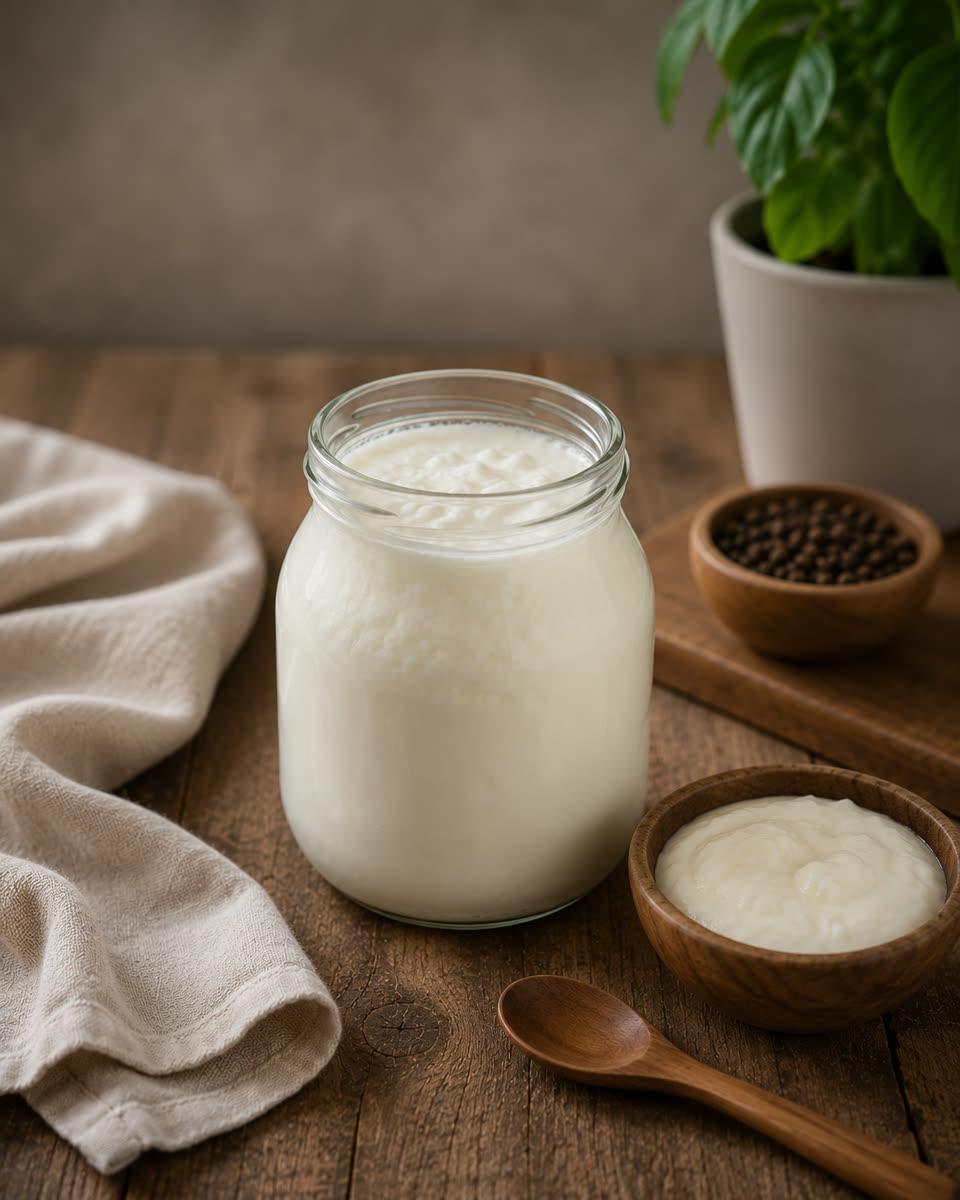
Matsoni (Georgian set soured milk)
Dairy product
Facts
| Category | Dairy |
|---|---|
| Product family | Regional Set/Soured Milk |
| Origin | 🇬🇪 Georgia |
Safety
- Inherits the general dairy-lactic-fermentation safety floor documented. Documented risk factors:
(a) raw-milk vs. pasteurized-milk considerations — starting from unpasteurized milk carries materially higher pathogen risk (e.g. Listeria, Salmonella, pathogenic E. coli) that the fermentation's own acidification does not reliably eliminate within typical timeframes, particularly relevant for a fresh, short-incubation, undisturbed-set product like matsoni;
(b) adequate acidification — holding milk in an intermediate "danger-zone" temperature too long before the starter establishes dominance can allow competing/pathogenic organisms a foothold;
(c) refrigeration — matsoni is a fresh, perishable set-milk product and should be refrigerated promptly once set to slow further acidification and limit spoilage risk. Safe-practice guidance: use pasteurized milk unless the raw-milk risk profile is explicitly accepted and understood; maintain the thermophilic incubation temperature range consistently rather than a prolonged intermediate hold; refrigerate promptly once set; discard on off-odour, visible mould, or gas production, none of which are characteristic of a properly-set ferment. All numerics above are (illustrative); no regulatory-grade pH/temperature/duration thresholds are asserted.
Method
Matsoni (Georgian Set Soured Milk)
- Whole cow's milk (traditionally also buffalo or goat milk in some households) — ~1 L
- Matsoni starter — a small spoonful (~1–2 tbsp, illustrative) of previous-batch matsoni, or a commercial thermophilic yogurt-type starter culture if no back-slop is available — SAFETY CONTROL, see linked Variant
- 1
Step 1
Heat the milk (traditionally brought to a boil, then cooled) to a warm thermophilic incubation temperature.
- 2
Step 2
Whisk the back-slopped starter (or starter culture) into the cooled, warm milk until evenly distributed.
- 3
Step 3
Pour into a shallow earthenware or ceramic vessel.
- 4
Step 4
Cover and leave completely undisturbed in a warm location.
- 5
Step 5
Incubate without moving or stirring until a firm, custard-like curd sets throughout.
- 6
Step 6
Check for a clean-set curd (no visible whey pooling excessively, a light tang on smell).
- 7
Step 7
Refrigerate once set to halt further acidification.
- 8
Step 8
Reserve a small portion, unrefrigerated briefly, as the starter for the next batch.
Frequently asked questions
- What is Matsoni (Georgian set soured milk)?
- Dairy product
- Where does Matsoni (Georgian set soured milk) come from?
- Matsoni (Georgian set soured milk) is traditionally made in Georgia.
- Is Matsoni (Georgian set soured milk) safe to make at home?
- Inherits the general dairy-lactic-fermentation safety floor documented. Documented risk factors:
(a) raw-milk vs. pasteurized-milk considerations — starting from unpasteurized milk carries materially higher pathogen risk (e.g. Listeria, Salmonella, pathogenic E. coli) that the fermentation's own acidification does not reliably eliminate within typical timeframes, particularly relevant for a fresh, short-incubation, undisturbed-set product like matsoni;
(b) adequate acidification — holding milk in an intermediate "danger-zone" temperature too long before the starter establishes dominance can allow competing/pathogenic organisms a foothold;
(c) refrigeration — matsoni is a fresh, perishable set-milk product and should be refrigerated promptly once set to slow further acidification and limit spoilage risk. Safe-practice guidance: use pasteurized milk unless the raw-milk risk profile is explicitly accepted and understood; maintain the thermophilic incubation temperature range consistently rather than a prolonged intermediate hold; refrigerate promptly once set; discard on off-odour, visible mould, or gas production, none of which are characteristic of a properly-set ferment. All numerics above are (illustrative); no regulatory-grade pH/temperature/duration thresholds are asserted.
Community results
No community results published for this ferment yet.