
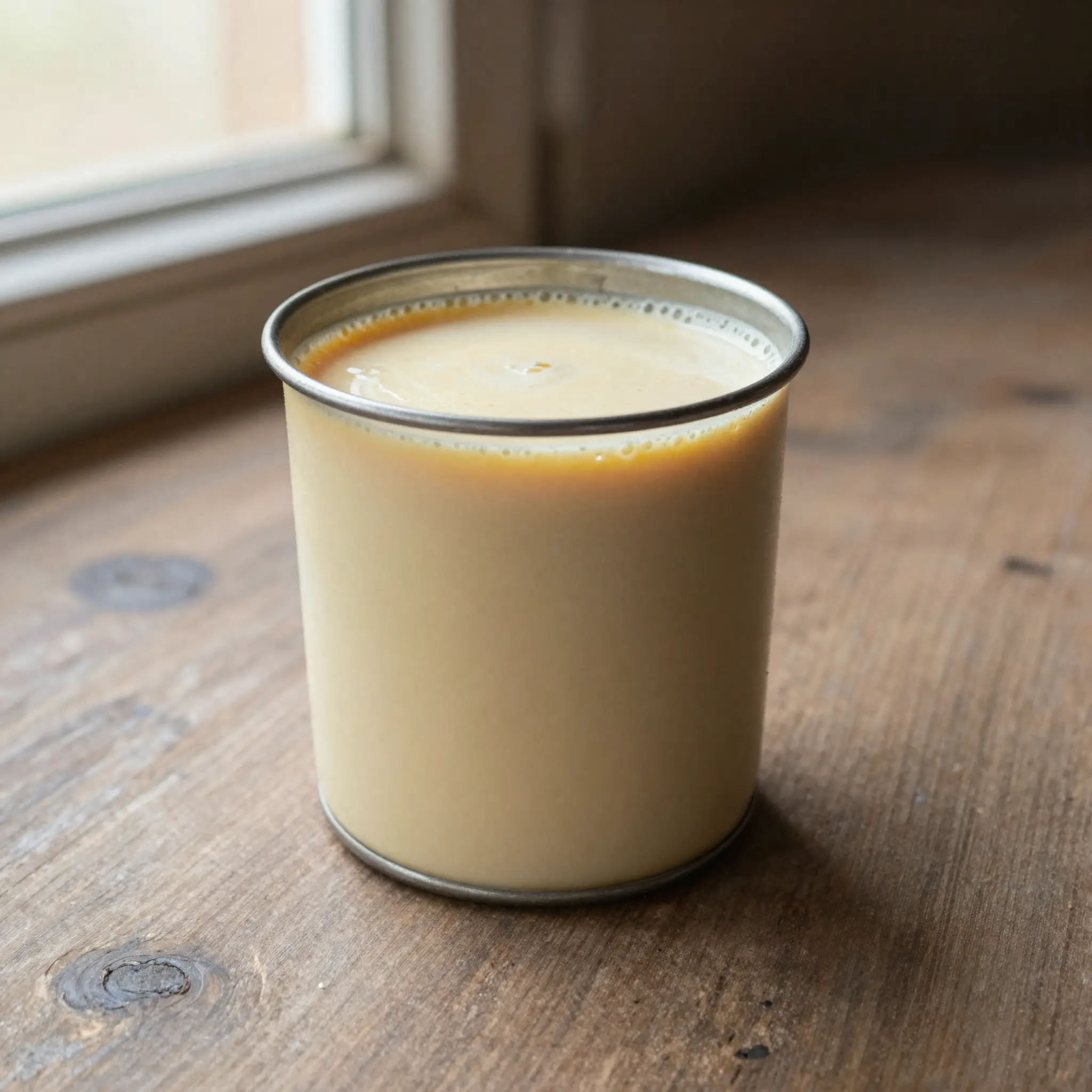
Mahewu (Southern African fermented maize-meal beverage)
Beverage
Facts
| Category | Grain / Legume |
|---|---|
| Product family | Fermented Maize-Meal Beverage |
| Key microorganisms | lactic-acid-bacteria |
Safety
- Documented considerations (honest, beverage-appropriate):
(a) mahewu is traditionally a spontaneous or informally back-slopped fermentation with no defined commercial starter culture in the home-preparation tradition, so adequate acidification (a genuinely sour, tangy porridge, consistent with LAB activity) is the primary indicator that fermentation has proceeded as intended rather than the porridge merely sitting unfermented;
(b) visible mould growth or a markedly putrid/off odour (as opposed to the expected sour, mildly yeasty-tangy aroma) signals spoilage — such batches should be discarded, not consumed;
(c) potable water must be used throughout, both for cooking the maize meal and for any subsequent thinning;
(d) unlike Kvass and Borde in this sub-batch, mahewu's documented fermentation type is purely lactic with no alcoholic component recorded in the source, so no alcohol-disclosure note applies here;
(e) as with any fermenting beverage in a covered vessel, a tightly sealed container can allow gas/pressure buildup from incidental microbial activity even in a predominantly lactic ferment — traditional practice uses a loosely covered vessel, an honest mechanical consideration rather than a fabricated numeric pressure threshold. Safe-practice guidance: use clean equipment and potable water; ferment in a loosely covered (not airtight) vessel at ambient temperature; taste/smell-check before consuming and discard on any mould growth or clearly putrid off-odour; refrigerate once at the desired sourness to slow further fermentation. No specific pathogen thresholds, pH figures, or fermentation-duration numerics are asserted — any such figure is illustrative or not established.
Method
Mahewu (Southern African Fermented Maize-Meal Beverage)
- Maize meal (mielie-meal) — ~1 cup (illustrative, home-scale)
- Water — ~4–5 cups (illustrative — enough to cook into a thin porridge and later thin further)
- Optional: a small quantity of wheat flour or sugar, per widely-documented home practice (flavour/fermentation-support only, non-safety, illustrative)
- Optional: a small portion ("mother") of a previously-fermented batch, as back-slop starter (illustrative quantity — a few tablespoons)
- 1
Step 1
Cook the maize meal with water into a thin, smooth porridge.
- 2
Step 2
Cool the porridge to a fermentation-appropriate (near-ambient) temperature.
- 3
Step 3
If using back-slop, stir in a small portion of a previously-fermented batch; otherwise, leave to inoculate from naturally-occurring environmental/grain microbiota.
- 4
Step 4
Cover loosely (cloth or lid ajar, not airtight) and hold at ambient temperature.
- 5
Step 5
Allow the lactic fermentation to proceed, tasting periodically for developing sourness.
- 6
Step 6
Once at the desired tanginess (roughly 1–2 days, illustrative, tradition- and household-variable), stir or strain to a smooth, drinkable consistency.
- 7
Step 7
Chill and serve, optionally lightly sweetened.
Frequently asked questions
- What is Mahewu (Southern African fermented maize-meal beverage)?
- Beverage
- Which microorganisms ferment Mahewu (Southern African fermented maize-meal beverage)?
- Mahewu (Southern African fermented maize-meal beverage) is primarily driven by lactic-acid-bacteria.
- Is Mahewu (Southern African fermented maize-meal beverage) safe to make at home?
- Documented considerations (honest, beverage-appropriate):
(a) mahewu is traditionally a spontaneous or informally back-slopped fermentation with no defined commercial starter culture in the home-preparation tradition, so adequate acidification (a genuinely sour, tangy porridge, consistent with LAB activity) is the primary indicator that fermentation has proceeded as intended rather than the porridge merely sitting unfermented;
(b) visible mould growth or a markedly putrid/off odour (as opposed to the expected sour, mildly yeasty-tangy aroma) signals spoilage — such batches should be discarded, not consumed;
(c) potable water must be used throughout, both for cooking the maize meal and for any subsequent thinning;
(d) unlike Kvass and Borde in this sub-batch, mahewu's documented fermentation type is purely lactic with no alcoholic component recorded in the source, so no alcohol-disclosure note applies here;
(e) as with any fermenting beverage in a covered vessel, a tightly sealed container can allow gas/pressure buildup from incidental microbial activity even in a predominantly lactic ferment — traditional practice uses a loosely covered vessel, an honest mechanical consideration rather than a fabricated numeric pressure threshold. Safe-practice guidance: use clean equipment and potable water; ferment in a loosely covered (not airtight) vessel at ambient temperature; taste/smell-check before consuming and discard on any mould growth or clearly putrid off-odour; refrigerate once at the desired sourness to slow further fermentation. No specific pathogen thresholds, pH figures, or fermentation-duration numerics are asserted — any such figure is illustrative or not established.
Community results
No community results published for this ferment yet.