
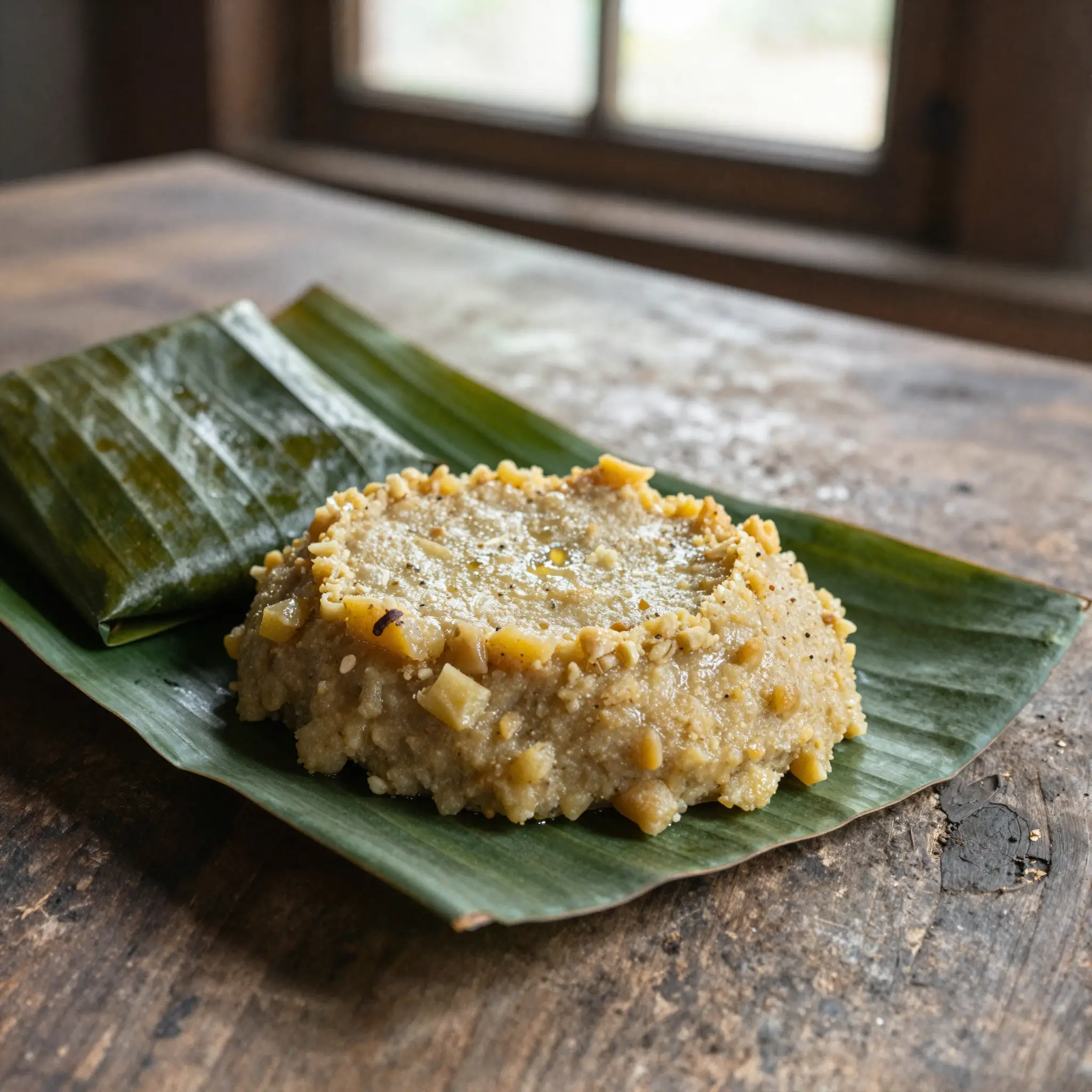
Ma (pit-fermented breadfruit)
Ma (Micronesian/Polynesian pit-fermented breadfruit paste)
Fruit ferment/staple food
Facts
| Category | Fruit |
|---|---|
| Product family | Ma |
Safety
- Documented risk-factor logic, reasoned by analogy from general anaerobic pit/solid-state fermentation mechanisms used elsewhere in this content set (no ma-specific quantified safety literature is present in our sources):
(a) an inadequately sealed or poorly excluded-from-air pit permits aerobic spoilage organisms or mould to establish at the surface/edges;
(b) as with any extended-duration anaerobic pit ferment, maintaining full exclusion of air and adequate packing density is a plausible practical control point, reasoned by analogy rather than confirmed ma-specific literature;
(c) a properly fermenting/stored ma is expected to show the general spontaneous-ferment spoilage-indicator pattern used across this content set — putrid odour, unusual sliminess, or unexpected mould beyond an established/understood surface layer are actionable discard/rework signals; this specific sensory-indicator claim is a reasoned analogy, not itself independently confirmed for ma in the source base. Safe-practice guidance: line and pack the pit/vessel to exclude air as thoroughly as practical; monitor for off-odour, sliminess, or unexpected mould when accessing stored portions over the ferment's long duration; cook/prepare removed portions per traditional practice before eating. Precise regulatory-grade pH/temperature/duration thresholds for ma fermentation are not established.
Method
Ma / Masi (Micronesian/Polynesian Pit-Fermented Breadfruit)
- Breadfruit (Artocarpus altilis), ripe or near-ripe, peeled — quantity per available harvest/pit size (illustrative, no fixed batch size is documented in the reviewed source base)
- Leaves for lining the pit (traditional practice, e.g. banana or breadfruit leaves, per general Pacific ethnobotanical knowledge — not established as to the exact species used in any specific locale)
- No salt, starter culture, or other additive is documented in traditional preparation in the reviewed source base
- 1
Step 1
Harvest ripe or near-ripe breadfruit.
- 2
Step 2
Peel the breadfruit; mash or slice per local practice (exact traditional preparation detail beyond this general step is not established in the reviewed source base).
- 3
Step 3
Line a pit (or, in a modern adaptation, a comparable sealed anaerobic container) with leaves.
- 4
Step 4
Pack the prepared breadfruit into the lined pit, pressing to minimize trapped air pockets.
- 5
Step 5
Cover thoroughly to exclude air.
- 6
Step 6
Leave to ferment at ambient temperature over an extended period — traditionally long enough to serve as a stored reserve across a season of scarcity.
- 7
Step 7
When needed, uncover and remove a portion, re-sealing the remainder to continue storage.
- 8
Step 8
Prepare the removed portion per traditional practice (commonly further cooked) before eating.
Frequently asked questions
- What is Ma (pit-fermented breadfruit)?
- Fruit ferment/staple food
- Is Ma (pit-fermented breadfruit) safe to make at home?
- Documented risk-factor logic, reasoned by analogy from general anaerobic pit/solid-state fermentation mechanisms used elsewhere in this content set (no ma-specific quantified safety literature is present in our sources):
(a) an inadequately sealed or poorly excluded-from-air pit permits aerobic spoilage organisms or mould to establish at the surface/edges;
(b) as with any extended-duration anaerobic pit ferment, maintaining full exclusion of air and adequate packing density is a plausible practical control point, reasoned by analogy rather than confirmed ma-specific literature;
(c) a properly fermenting/stored ma is expected to show the general spontaneous-ferment spoilage-indicator pattern used across this content set — putrid odour, unusual sliminess, or unexpected mould beyond an established/understood surface layer are actionable discard/rework signals; this specific sensory-indicator claim is a reasoned analogy, not itself independently confirmed for ma in the source base. Safe-practice guidance: line and pack the pit/vessel to exclude air as thoroughly as practical; monitor for off-odour, sliminess, or unexpected mould when accessing stored portions over the ferment's long duration; cook/prepare removed portions per traditional practice before eating. Precise regulatory-grade pH/temperature/duration thresholds for ma fermentation are not established.
Community results
No community results published for this ferment yet.