
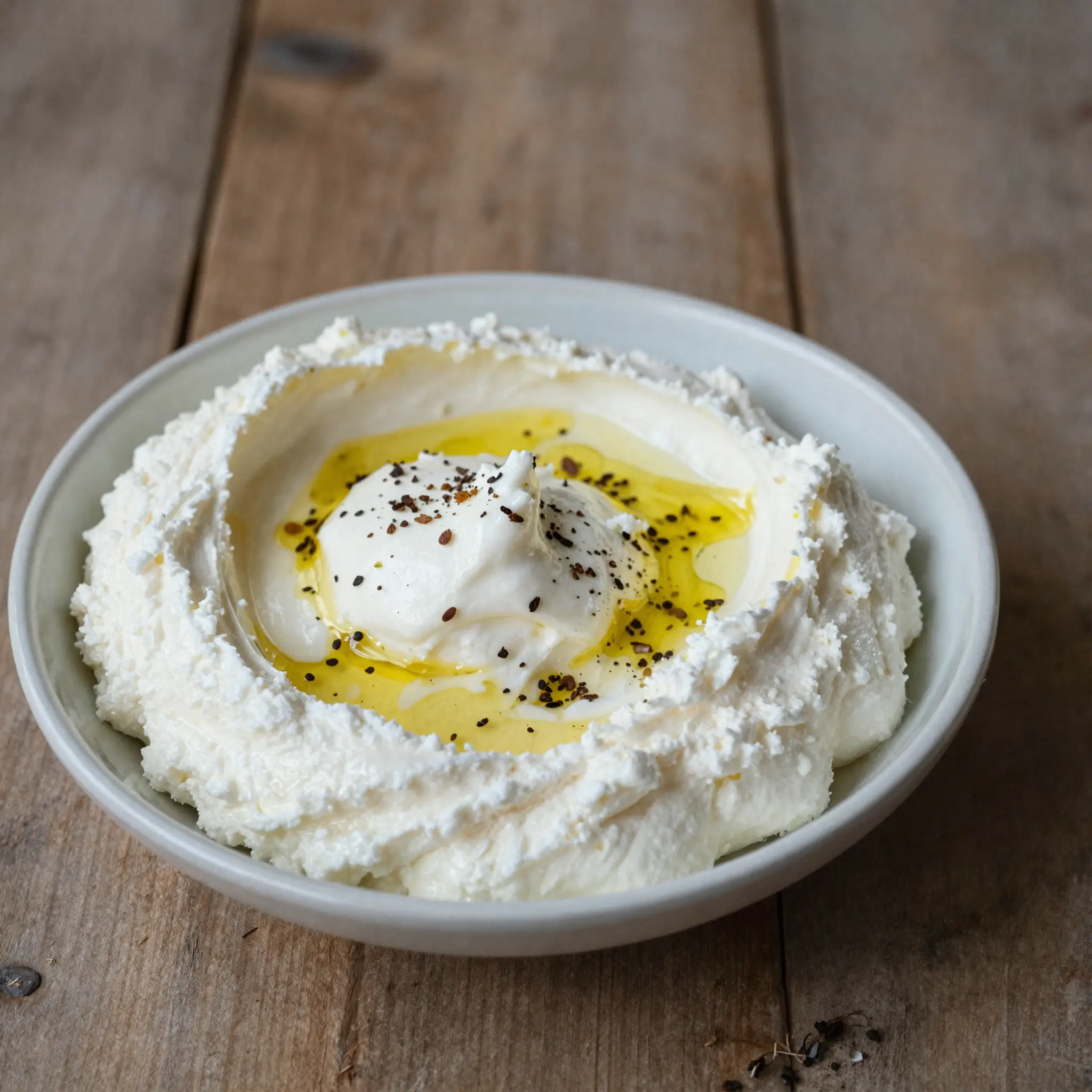
Labneh (Levantine strained yogurt cheese)
Dairy product
Facts
| Category | Dairy |
|---|---|
| Product family | Strained Fermented-Milk Cheese |
| Origin | 🇹🇷 Türkiye |
Safety
- Inherits the base dairy-lactic safety floor with straining-specific considerations layered on top. Documented risk factors:
(a) raw-milk vs. pasteurized-milk — starting from unpasteurized milk carries materially higher pathogen risk (e.g. Listeria, Salmonella, pathogenic E. coli) that the yogurt fermentation's own acidification does not reliably eliminate within typical timeframes; pasteurized milk is the safer default for home and commercial practice;
(b) adequate acidification of the base yogurt ferment before straining — the set yogurt should reach a sour, fully-coagulated state (target pH ≤4.6, typical range for set yogurt) before proceeding, as under-acidified milk strained early does not carry the same safety margin;
(c) straining hygiene — cloth/muslin bags, hands, and containers must be clean/sanitized, since the concentrated, high-moisture, low-salt product formed during multi-hour straining at ambient-adjacent temperatures is itself a favorable environment for recontamination if hygiene lapses;
(d) refrigeration — strained labneh (not preserved in oil) is a fresh, high-moisture dairy product and should be refrigerated promptly and consumed within a defined shelf window (precise numeric shelf-life floors are not established;
(e) the oil-preserved "labneh anbaris" extended-storage form changes the risk profile (lower water activity, oil barrier) but precise safety parameters for that traditional preservation step are also not established and should not be assumed safe at uncontrolled ambient storage without further sourcing.
Method
Labneh (Levantine Strained Yogurt Cheese)
- Whole milk (cow's, sheep's, or goat's) — ~1 L, or substitute plain full-fat yogurt made from same — ~1 kg
- Yogurt starter culture (commercial thermophilic culture or 2–3 tbsp live yogurt from a prior batch) — for the base ferment stage only, if starting from milk
- Salt — a small amount, to taste, folded in after straining (illustrative quantity; not the primary safety control here — see linked Variant item 8 for the acidification/hygiene controls that are) — flavor/light-preservative role
- Olive oil — for serving, or for the optional oil-preserved "labneh anbaris" storage form
- 1
Step 1
If starting from milk: heat milk to just below boiling, then cool to thermophilic inoculation range.
- 2
Step 2
Inoculate with yogurt starter culture; incubate at thermophilic temperature until fully set and sour (a standard yogurt-set endpoint).
- 3
Step 3
Cool the set yogurt; lightly salt.
- 4
Step 4
Line a colander or bowl with clean muslin/cheesecloth; pour in the set yogurt.
- 5
Step 5
Gather the cloth corners and tie into a bag; suspend over a bowl or sink (or set in a colander with a light weight on top) to drain at cool/refrigerated temperature.
- 6
Step 6
Drain for several hours to 1–2 days (illustrative, longer draining yields a firmer paste), checking periodically and discarding collected whey (or reserving it for other culinary uses).
- 7
Step 7
When a thick, spreadable consistency is reached, transfer to a clean container; drizzle with olive oil to serve, or continue to the optional extended-storage step below.
- 8
Step 8
(Optional, traditional extended storage) Roll the very thick strained curd into small balls; submerge fully in olive oil in a clean jar for longer ambient/cool storage.
Frequently asked questions
- What is Labneh (Levantine strained yogurt cheese)?
- Dairy product
- Where does Labneh (Levantine strained yogurt cheese) come from?
- Labneh (Levantine strained yogurt cheese) is traditionally made in Türkiye.
- Is Labneh (Levantine strained yogurt cheese) safe to make at home?
- Inherits the base dairy-lactic safety floor with straining-specific considerations layered on top. Documented risk factors:
(a) raw-milk vs. pasteurized-milk — starting from unpasteurized milk carries materially higher pathogen risk (e.g. Listeria, Salmonella, pathogenic E. coli) that the yogurt fermentation's own acidification does not reliably eliminate within typical timeframes; pasteurized milk is the safer default for home and commercial practice;
(b) adequate acidification of the base yogurt ferment before straining — the set yogurt should reach a sour, fully-coagulated state (target pH ≤4.6, typical range for set yogurt) before proceeding, as under-acidified milk strained early does not carry the same safety margin;
(c) straining hygiene — cloth/muslin bags, hands, and containers must be clean/sanitized, since the concentrated, high-moisture, low-salt product formed during multi-hour straining at ambient-adjacent temperatures is itself a favorable environment for recontamination if hygiene lapses;
(d) refrigeration — strained labneh (not preserved in oil) is a fresh, high-moisture dairy product and should be refrigerated promptly and consumed within a defined shelf window (precise numeric shelf-life floors are not established;
(e) the oil-preserved "labneh anbaris" extended-storage form changes the risk profile (lower water activity, oil barrier) but precise safety parameters for that traditional preservation step are also not established and should not be assumed safe at uncontrolled ambient storage without further sourcing.
Community results
No community results published for this ferment yet.