
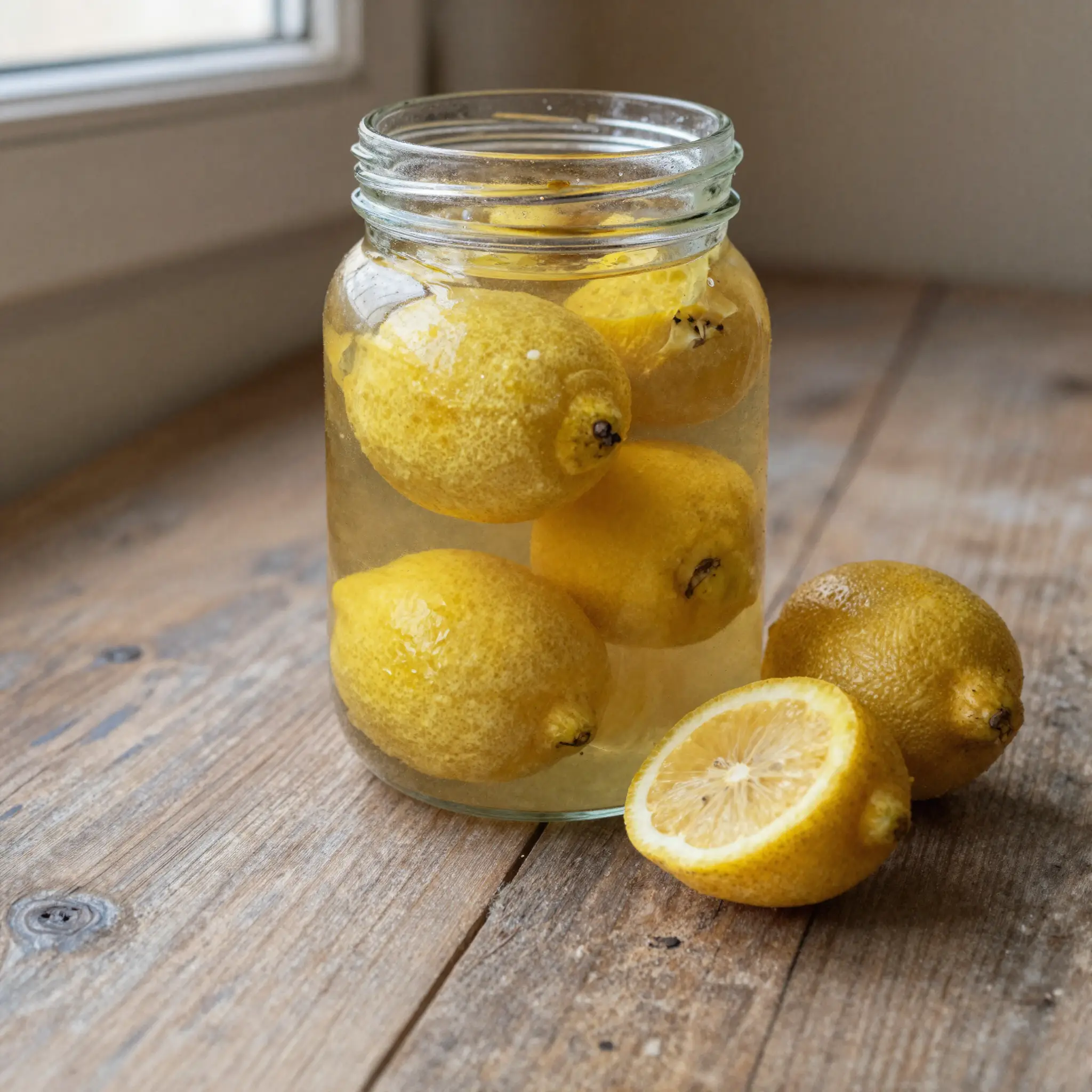
L'hamd markad (Moroccan preserved lemon)
L'hamd markad (Moroccan/North African salt-fermented preserved lemon)
vegetable-ferment-pickle
Facts
| Category | Fruit |
|---|---|
| Product family | Salt-Fermented Whole-Fruit Preserve |
| Origin | 🇲🇦 Morocco |
Safety
- Documented risk-factor logic follows the same core anaerobic/salinity-floor pattern as other salt-fermented whole-produce preserves in this content set (turşu, Greek table olives, mochyonye yabloki):
(a) inadequate salt concentration or lemons left exposed above the juice/brine line permits spoilage organisms to establish;
(b) citrus's own high natural acidity is a contributing safety factor distinct from purely vegetable ferments, but this does not eliminate the need for adequate salt and full submersion — it is an additional favourable factor, not a substitute control point;
(c) a properly progressing jar shows a pleasant sour-salty citrus aroma and softened, translucent rind — putrid odour, unusual sliminess, or unexpected surface mould (beyond an occasional harmless surface film) are actionable discard/rework warnings. Safe-practice guidance: use generous coarse salt on all cut surfaces; keep lemons fully submerged under their own/added juice throughout; use a clean jar and utensils; discard on off-odour or contamination signs; precise regulatory-grade salt-percentage or pH floors for this specific product are not established (general culinary sourcing cites salt "generously," not a validated percentage).
Method
L'hamd Markad (Moroccan Preserved Lemons)
- Fresh lemons (thin-skinned variety preferred where available) — 6–8 whole, plus 4–6 additional for juice
- Coarse salt (non-iodized) — generous packing quantity, roughly 3–4 tbsp per lemon (illustrative) — SAFETY CONTROL, see linked Variant
- Additional fresh lemon juice — enough to fully submerge the packed lemons, roughly 1–2 cups depending on jar size (illustrative)
- Optional: bay leaf, cinnamon stick, whole coriander seed, dried chili (flavour only, non-safety)
- 1
Step 1
Wash lemons thoroughly; trim the stem end.
- 2
Step 2
Quarter each lemon from the top, leaving the base intact (not cutting all the way through), or cut fully into quarters/halves depending on tradition.
- 3
Step 3
Pack the cut surfaces of each lemon generously with coarse salt.
- 4
Step 4
Press salted lemons tightly into a clean, sterilized jar, pressing firmly to release juice as you pack.
- 5
Step 5
Add any optional flavourings (bay leaf, cinnamon, coriander, chili).
- 6
Step 6
Top up with additional fresh lemon juice until the lemons are fully submerged.
- 7
Step 7
Seal the jar and hold at ambient room temperature.
- 8
Step 8
Invert or gently agitate the jar every few days to redistribute salt and juice.
- 9
Step 9
Check periodically that lemons remain fully submerged; top up juice if needed.
- 10
Step 10
Allow to cure until the rind has softened and turned translucent (commonly cited as roughly 3–4 weeks minimum in general culinary sourcing, often longer — illustrative, not separately confirmed for this specific product against a dedicated food-science source).
- 11
Step 11
Rinse off excess salt from a lemon piece before culinary use; refrigerate after opening for extended keeping.
Frequently asked questions
- What is L'hamd markad (Moroccan preserved lemon)?
- vegetable-ferment-pickle
- Where does L'hamd markad (Moroccan preserved lemon) come from?
- L'hamd markad (Moroccan preserved lemon) is traditionally made in Morocco.
- Is L'hamd markad (Moroccan preserved lemon) safe to make at home?
- Documented risk-factor logic follows the same core anaerobic/salinity-floor pattern as other salt-fermented whole-produce preserves in this content set (turşu, Greek table olives, mochyonye yabloki):
(a) inadequate salt concentration or lemons left exposed above the juice/brine line permits spoilage organisms to establish;
(b) citrus's own high natural acidity is a contributing safety factor distinct from purely vegetable ferments, but this does not eliminate the need for adequate salt and full submersion — it is an additional favourable factor, not a substitute control point;
(c) a properly progressing jar shows a pleasant sour-salty citrus aroma and softened, translucent rind — putrid odour, unusual sliminess, or unexpected surface mould (beyond an occasional harmless surface film) are actionable discard/rework warnings. Safe-practice guidance: use generous coarse salt on all cut surfaces; keep lemons fully submerged under their own/added juice throughout; use a clean jar and utensils; discard on off-odour or contamination signs; precise regulatory-grade salt-percentage or pH floors for this specific product are not established (general culinary sourcing cites salt "generously," not a validated percentage).
Community results
No community results published for this ferment yet.