
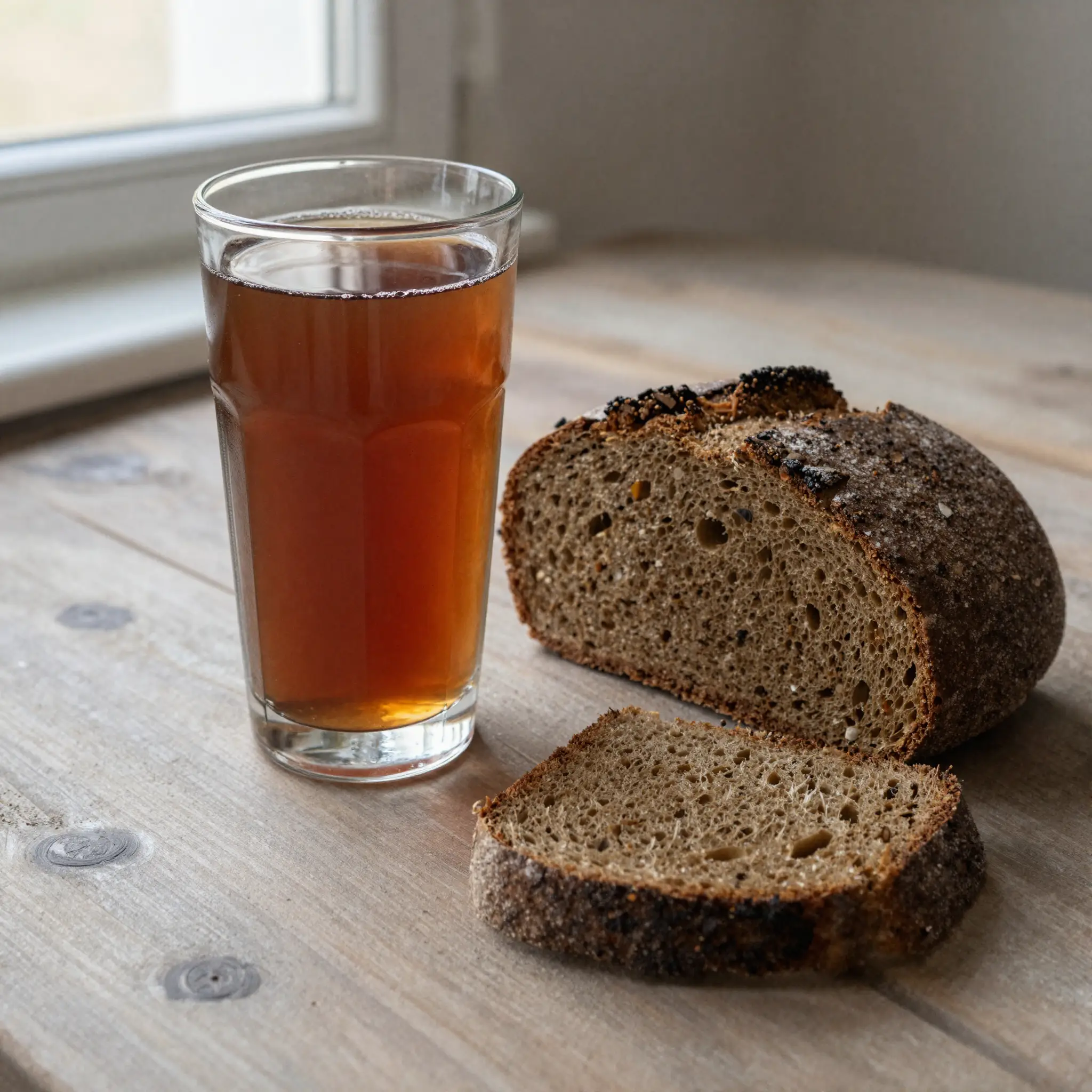
Kvass (East European fermented rye-bread beverage)
Beverage
Facts
| Category | Grain / Legume |
|---|---|
| Product family | Fermented Bread Beverage |
| Origin | 🇷🇺 Russia |
| Key microorganisms | lactic-acid-bacteria, yeasts |
Safety
- Documented considerations:
(a) kvass is traditionally a spontaneous or informally back-slopped fermentation with no defined commercial starter culture in the home-preparation tradition, so adequate acidification and visible fermentation activity (bubbling, sour aroma) are the primary indicators that the process is proceeding safely;
(b) mould growth or a markedly putrid/off odour (as opposed to the expected sour-sweet, mildly yeasty bread aroma) signals spoilage — such batches should be discarded, not consumed;
(c) the mild alcohol content that develops, particularly with extended fermentation, should be disclosed to consumers avoiding alcohol (children, pregnant individuals, those abstaining for health/religious/personal reasons), per the same boundary-note discipline as kefir/kumis/shubat/tepache/tejuino;
(d) if fermented in a sealed or tightly-capped vessel, the CO2 produced by the yeast component can build pressure — traditional practice uses a loosely covered vessel or a bottle deliberately "burped"/vented during conditioning for this reason; a tightly sealed container risks over-carbonation/bottle-pressure buildup and potential vessel rupture, an honest mechanical risk rather than a fabricated numeric pressure threshold;
(e) potable water must be used throughout. Safe-practice guidance: use clean equipment and potable water; ferment in a loosely covered (not airtight) vessel at ambient temperature, or vent sealed bottles periodically during any secondary carbonation stage; taste/smell-check before consuming and discard on any mould growth or clearly putrid off-odour; refrigerate once at the desired sourness/carbonation level to slow further fermentation and further alcohol development; disclose the mild alcohol content where relevant. No specific pathogen thresholds, pH figures, or alcohol percentages are asserted — any such figure is illustrative or not established.
Method
Kvass (East European Fermented Rye-Bread Beverage)
- Rye bread (traditionally stale or dried, sometimes lightly toasted) — ~300–400 g (illustrative, home-scale)
- Water — ~2–3 L (illustrative)
- Sugar or malt/malt extract — ~100–150 g (illustrative — supports fermentation and traditional sweetness; a matter of taste/tradition, not a food-safety parameter)
- A small portion of a previously-fermented batch, reserved starter dough/liquid, or a few raisins, as optional back-slop/inoculation aid (illustrative quantity — a handful)
- 1
Step 1
Dry or lightly toast the rye bread if not already stale.
- 2
Step 2
Steep the bread in hot water in a clean vessel; allow to soften and cool to a fermentation-appropriate (near-ambient) temperature.
- 3
Step 3
Stir in the sugar or malt/malt extract.
- 4
Step 4
If using back-slop (previous batch, reserved starter, or raisins), add it now; otherwise, leave to inoculate from naturally-occurring bread/environmental microbiota.
- 5
Step 5
Cover loosely (cloth or lid ajar, not airtight — see safety note on pressure buildup) and hold at ambient temperature.
- 6
Step 6
Allow the combined lactic-acid and mild alcoholic (yeast) fermentation to proceed over roughly 1–3 days (illustrative, tradition- and household-variable), tasting periodically for developing sourness and mild effervescence.
- 7
Step 7
Strain out the bread solids.
- 8
Step 8
Chill; if bottling for a secondary carbonation stage, vent ("burp") bottles periodically rather than sealing airtight for extended storage.
- 9
Step 9
Serve cold, optionally with added fruit or mint (a serving custom, not part of the core ferment).
Frequently asked questions
- What is Kvass (East European fermented rye-bread beverage)?
- Beverage
- Which microorganisms ferment Kvass (East European fermented rye-bread beverage)?
- Kvass (East European fermented rye-bread beverage) is primarily driven by lactic-acid-bacteria, yeasts.
- Where does Kvass (East European fermented rye-bread beverage) come from?
- Kvass (East European fermented rye-bread beverage) is traditionally made in Russia.
- Is Kvass (East European fermented rye-bread beverage) safe to make at home?
- Documented considerations:
(a) kvass is traditionally a spontaneous or informally back-slopped fermentation with no defined commercial starter culture in the home-preparation tradition, so adequate acidification and visible fermentation activity (bubbling, sour aroma) are the primary indicators that the process is proceeding safely;
(b) mould growth or a markedly putrid/off odour (as opposed to the expected sour-sweet, mildly yeasty bread aroma) signals spoilage — such batches should be discarded, not consumed;
(c) the mild alcohol content that develops, particularly with extended fermentation, should be disclosed to consumers avoiding alcohol (children, pregnant individuals, those abstaining for health/religious/personal reasons), per the same boundary-note discipline as kefir/kumis/shubat/tepache/tejuino;
(d) if fermented in a sealed or tightly-capped vessel, the CO2 produced by the yeast component can build pressure — traditional practice uses a loosely covered vessel or a bottle deliberately "burped"/vented during conditioning for this reason; a tightly sealed container risks over-carbonation/bottle-pressure buildup and potential vessel rupture, an honest mechanical risk rather than a fabricated numeric pressure threshold;
(e) potable water must be used throughout. Safe-practice guidance: use clean equipment and potable water; ferment in a loosely covered (not airtight) vessel at ambient temperature, or vent sealed bottles periodically during any secondary carbonation stage; taste/smell-check before consuming and discard on any mould growth or clearly putrid off-odour; refrigerate once at the desired sourness/carbonation level to slow further fermentation and further alcohol development; disclose the mild alcohol content where relevant. No specific pathogen thresholds, pH figures, or alcohol percentages are asserted — any such figure is illustrative or not established.
Community results
No community results published for this ferment yet.