
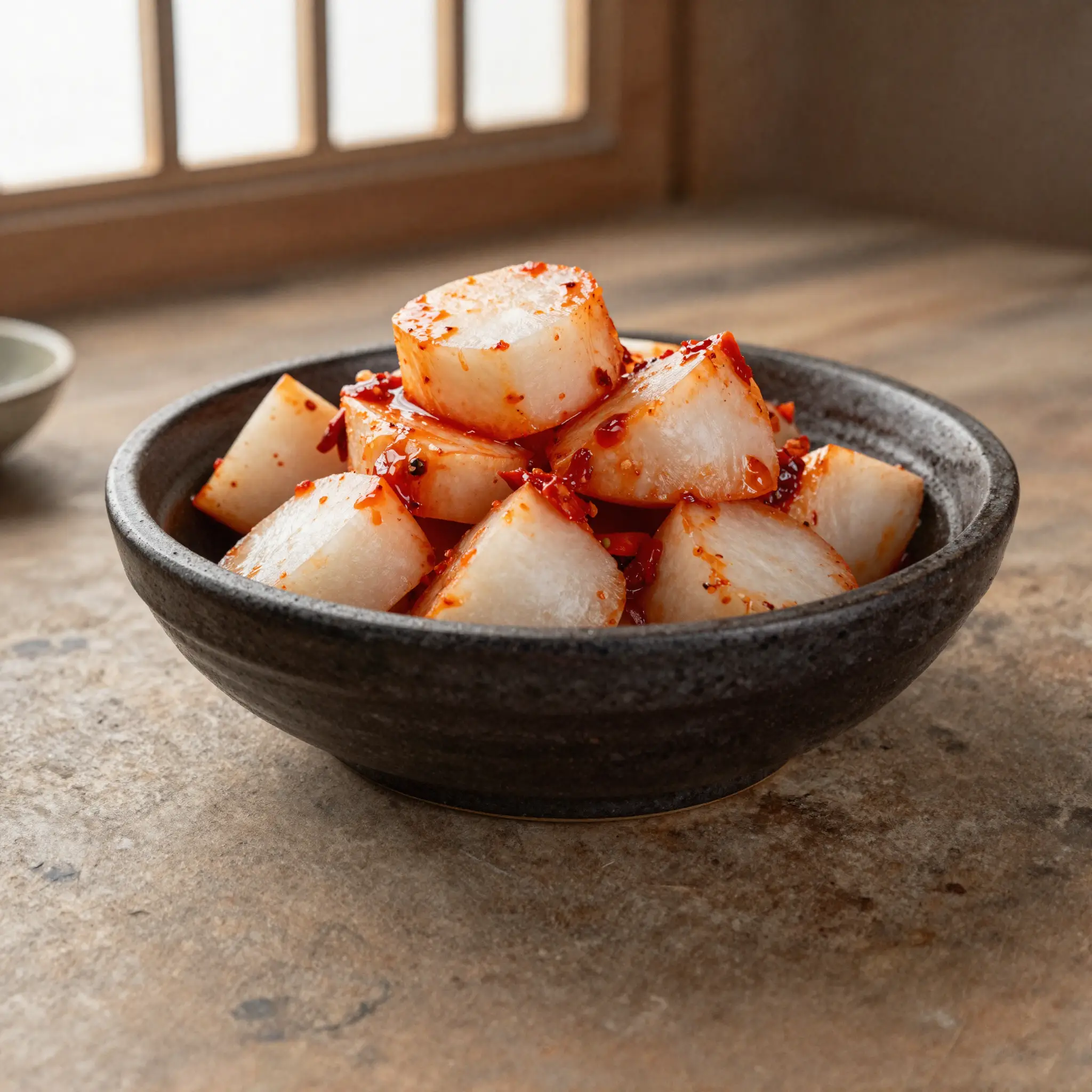
Kkakdugi (Korean cubed radish kimchi)
vegetable-ferment-pickle
Facts
| Category | Vegetable |
|---|---|
| Product family | Kimchi |
| Origin | 🇰🇷 South Korea |
Safety
- Same core logic as baechu-kimchi — the dry-salt + paste-coating + anaerobic-pack method relies on adequate initial salting and minimizing trapped air/exposed surface to avoid spoilage organisms ahead of acidification. Because jeotgal (fermented seafood) is a common seasoning ingredient, the same fish/shellfish-allergen and, if home-fermented jeotgal is used, fish-fermentation hygiene considerations documented for jeotgal apply as an inherited consideration, not a new risk newly asserted here. Safe-practice guidance:
(a) adequate initial dry-salting of the radish before seasoning;
(b) pack the seasoned radish tightly to minimize trapped air pockets, which are the main real-world spoilage-risk point for paste-coated kimchi styles;
(c) target pH ≤4.6 as the ferment progresses;
(d) refrigerate promptly once at desired flavour to control the ongoing (slow) ferment;
(e) if using a fermented-seafood seasoning ingredient, source it from a food-safe supply chain — this Variant does not independently re-verify jeotgal's own safety profile, which belongs to jeotgal's own Variant entry.
Method
Kkakdugi (Korean Cubed Radish Kimchi)
- Korean radish (mu), peeled and cut into ~2 cm cubes — ~1500 g
- Non-iodized salt — quantity for the initial dry-salt step (illustrative) — SAFETY CONTROL, see linked Variant
- Gochugaru (Korean chili powder) — ~4–6 tbsp (flavour + traditional colour)
- Garlic, ginger — minced, a few cloves/a small knob
- Scallion — a handful, chopped
- Sugar — a small amount (traditional balance)
- Jeotgal/fermented-seafood seasoning (e.g. saeujeot salted shrimp or myeolchi-jeot anchovy sauce) — a few tablespoons (traditional; source from a food-safe supply chain — see linked Variant item 8)
- 1
Step 1
Peel Korean radish and cut into even cubes.
- 2
Step 2
Dry-salt the cubes and let stand to draw out excess water; drain, reserving or discarding the liquid per preference.
- 3
Step 3
Mix gochugaru, garlic, ginger, scallion, sugar, and jeotgal seasoning into a paste.
- 4
Step 4
Toss the drained radish cubes thoroughly in the seasoning paste.
- 5
Step 5
Pack the seasoned radish tightly into a clean jar/crock, pressing to minimize trapped air pockets.
- 6
Step 6
Cover with a breathable lid or seal loosely to allow gas release.
- 7
Step 7
Ferment at cool ambient temperature for a short initial period (a day or so) to begin acidification.
- 8
Step 8
Transfer to refrigeration; continue slow fermentation/ripening over subsequent weeks.
- 9
Step 9
Taste periodically; ready from ~3–5 days, continuing to ripen and sour over following weeks.
Frequently asked questions
- What is Kkakdugi (Korean cubed radish kimchi)?
- vegetable-ferment-pickle
- Where does Kkakdugi (Korean cubed radish kimchi) come from?
- Kkakdugi (Korean cubed radish kimchi) is traditionally made in South Korea.
- Is Kkakdugi (Korean cubed radish kimchi) safe to make at home?
- Same core logic as baechu-kimchi — the dry-salt + paste-coating + anaerobic-pack method relies on adequate initial salting and minimizing trapped air/exposed surface to avoid spoilage organisms ahead of acidification. Because jeotgal (fermented seafood) is a common seasoning ingredient, the same fish/shellfish-allergen and, if home-fermented jeotgal is used, fish-fermentation hygiene considerations documented for jeotgal apply as an inherited consideration, not a new risk newly asserted here. Safe-practice guidance:
(a) adequate initial dry-salting of the radish before seasoning;
(b) pack the seasoned radish tightly to minimize trapped air pockets, which are the main real-world spoilage-risk point for paste-coated kimchi styles;
(c) target pH ≤4.6 as the ferment progresses;
(d) refrigerate promptly once at desired flavour to control the ongoing (slow) ferment;
(e) if using a fermented-seafood seasoning ingredient, source it from a food-safe supply chain — this Variant does not independently re-verify jeotgal's own safety profile, which belongs to jeotgal's own Variant entry.
Community results
No community results published for this ferment yet.