
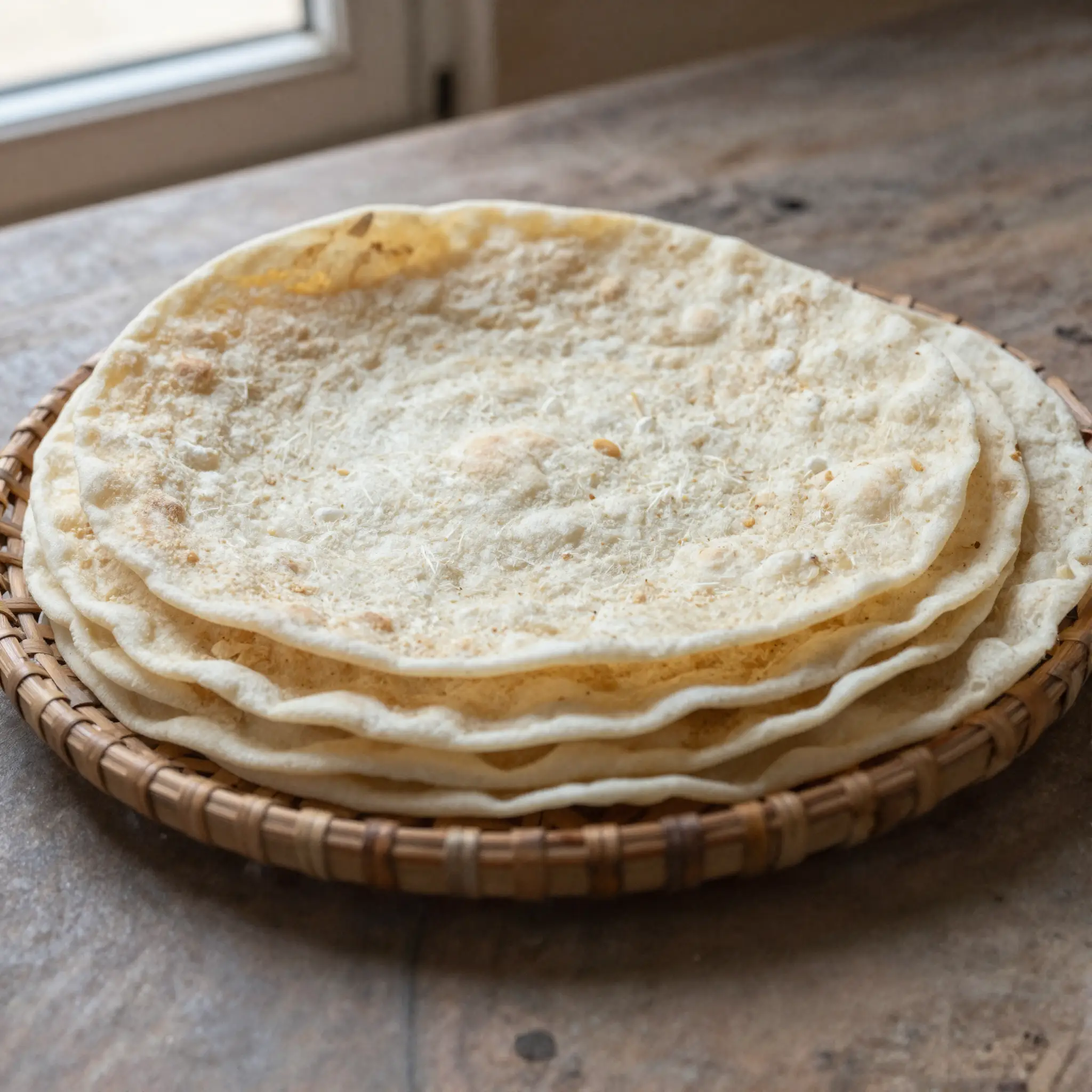
Kisra (Sudanese thin fermented sorghum flatbread)
Bread/staple
Facts
| Category | Grain / Legume |
|---|---|
| Product family | Fermented Sorghum Flatbread |
| Origin | 🇸🇩 Sudan |
| Key microorganisms | lactic-acid-bacteria |
Safety
- Documented considerations (honest, grain-staple-appropriate, general-knowledge basis flagged):
(a) Kisra is understood, per general culinary-tradition sources, to be a spontaneous or informally back-slopped fermentation with no defined commercial starter culture — adequate acidification (a genuinely sour batter aroma) is the reasonable, general indicator that fermentation has proceeded, by analogy to comparable spontaneous cereal-batter ferments; this is a general-knowledge inference, not independently confirmed against a dedicated cited source for Kisra;
(b) mould growth or a markedly putrid/off odour on the batter (as opposed to an expected sour, fermented-cereal aroma) would signal spoilage in any comparable spontaneous cereal ferment — such batter should be discarded, not cooked;
(c) the batter is griddled/cooked after fermenting, a heat step that is independently pathogen-inhibitory regardless of the fermentation stage's own safety profile;
(d) as with any cereal-based ferment, mycotoxin/mould awareness for the raw sorghum flour is a general, honest consideration — sorghum flour should be sourced from reputable suppliers and stored dry; no specific mycotoxin threshold is asserted, as none is documented for Kisra;
(e) potable water must be used throughout. Safe-practice guidance: use clean equipment and potable water; ferment the batter in a clean, covered vessel at ambient temperature; discard on any mould growth or clearly putrid off-odour; cook the batter thoroughly on the griddle before serving; store flour dry and from a reputable source. No specific pH figures, fermentation-duration numerics, or mycotoxin thresholds are asserted — any such figure is illustrative or not established.
Method
Kisra (Sudanese Thin Fermented Sorghum Flatbread)
- Sorghum flour — ~300 g
- Water — ~600–700 mL, potable, to a thin, pourable batter consistency (ratio illustrative, general-knowledge basis, not independently sourced)
- Optional: a spoonful of a previous batch's fermented batter (back-slop), per general culinary-tradition custom
- 1
Step 1
Whisk sorghum flour with water into a thin, smooth, pourable batter in a clean, non-reactive vessel.
- 2
Step 2
Cover and leave to ferment spontaneously (or with a back-slopped portion of previous batter) at ambient temperature.
- 3
Step 3
Check periodically: naturally-occurring LAB sour the batter, developing a fermented-cereal aroma (duration illustrative and household-variable, general-knowledge basis — not independently sourced).
- 4
Step 4
Once adequately soured, heat a flat griddle (or traditional flat cooking surface) until hot.
- 5
Step 5
Thinly pour/spread a portion of the fermented batter across the griddle.
- 6
Step 6
Cook briefly until set into a thin, pliable sheet (a heat step, independently pathogen-inhibitory).
- 7
Step 7
Remove and stack; repeat with remaining batter.
- 8
Step 8
Serve as an edible wrapper/base alongside stews (a serving custom, not part of the ferment itself).
Frequently asked questions
- What is Kisra (Sudanese thin fermented sorghum flatbread)?
- Bread/staple
- Which microorganisms ferment Kisra (Sudanese thin fermented sorghum flatbread)?
- Kisra (Sudanese thin fermented sorghum flatbread) is primarily driven by lactic-acid-bacteria.
- Where does Kisra (Sudanese thin fermented sorghum flatbread) come from?
- Kisra (Sudanese thin fermented sorghum flatbread) is traditionally made in Sudan.
- Is Kisra (Sudanese thin fermented sorghum flatbread) safe to make at home?
- Documented considerations (honest, grain-staple-appropriate, general-knowledge basis flagged):
(a) Kisra is understood, per general culinary-tradition sources, to be a spontaneous or informally back-slopped fermentation with no defined commercial starter culture — adequate acidification (a genuinely sour batter aroma) is the reasonable, general indicator that fermentation has proceeded, by analogy to comparable spontaneous cereal-batter ferments; this is a general-knowledge inference, not independently confirmed against a dedicated cited source for Kisra;
(b) mould growth or a markedly putrid/off odour on the batter (as opposed to an expected sour, fermented-cereal aroma) would signal spoilage in any comparable spontaneous cereal ferment — such batter should be discarded, not cooked;
(c) the batter is griddled/cooked after fermenting, a heat step that is independently pathogen-inhibitory regardless of the fermentation stage's own safety profile;
(d) as with any cereal-based ferment, mycotoxin/mould awareness for the raw sorghum flour is a general, honest consideration — sorghum flour should be sourced from reputable suppliers and stored dry; no specific mycotoxin threshold is asserted, as none is documented for Kisra;
(e) potable water must be used throughout. Safe-practice guidance: use clean equipment and potable water; ferment the batter in a clean, covered vessel at ambient temperature; discard on any mould growth or clearly putrid off-odour; cook the batter thoroughly on the griddle before serving; store flour dry and from a reputable source. No specific pH figures, fermentation-duration numerics, or mycotoxin thresholds are asserted — any such figure is illustrative or not established.
Community results
No community results published for this ferment yet.