
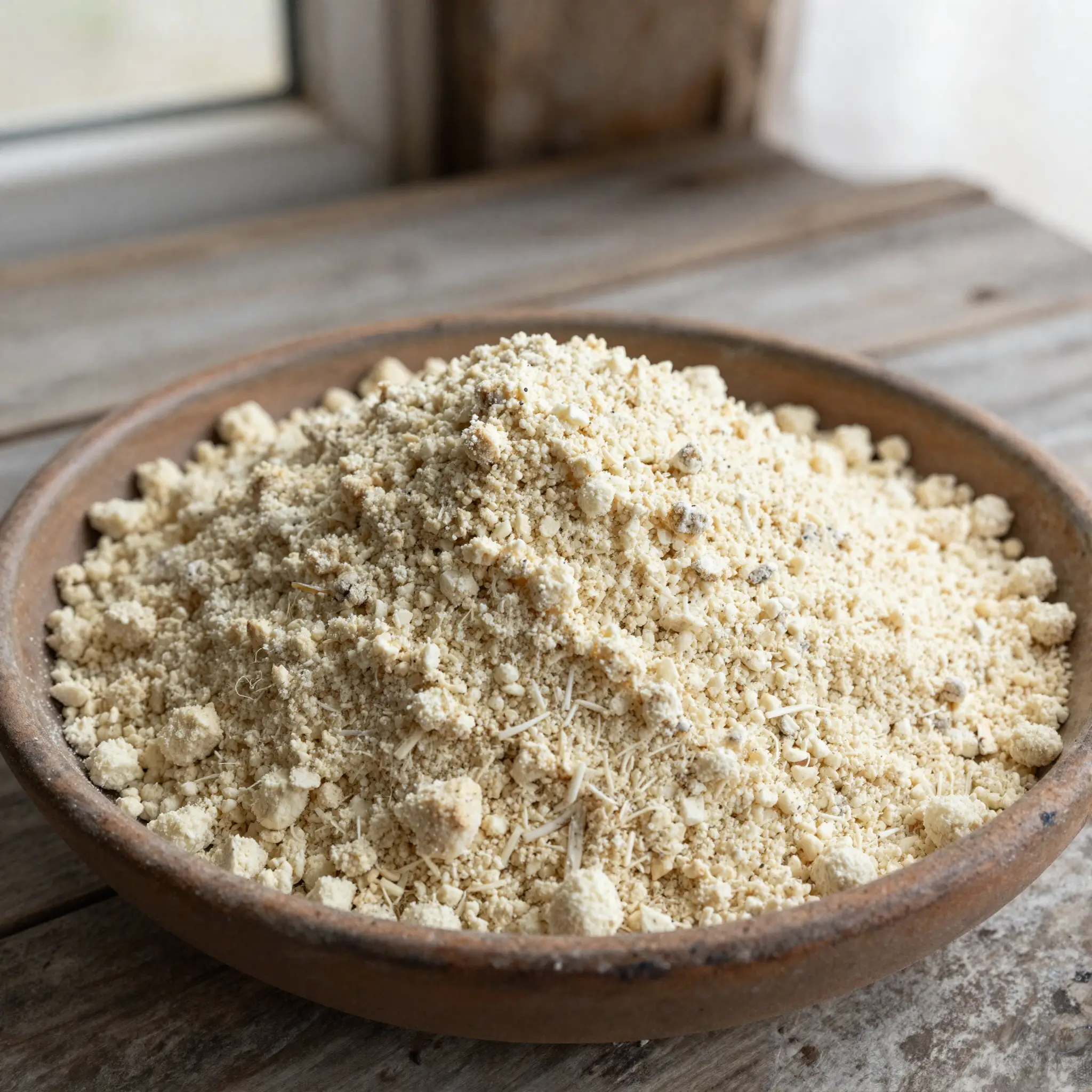
Kishk (Levantine bulgur wheat and fermented yogurt, dried)
Dairy product
Facts
| Category | Other |
|---|---|
| Product family | Grain-Dairy Composite Fermented Preservation |
| Origin | 🇱🇧 Lebanon |
Safety
- Inherits the general dairy-lactic safety floor for the yogurt component, extended honestly with drying/low-water-activity storage considerations by analogy to Qurut treatment. Documented risk factors:
(a) raw-milk vs. pasteurized-milk for the yogurt component — as with the other dairy Variants in this and, pasteurized milk is the safer default; unpasteurized milk carries materially higher pathogen risk not reliably eliminated by fermentation alone;
(b) adequate souring of the wet mash during the multi-day ambient fermentation stage before drying — an under-acidified mash dried too early does not carry the same safety margin;
(c) hygiene during the wet-mash and spreading/drying stages — cloths, trays, hands, and containers must be clean, since the wet, ambient-temperature mash stage (before drying reduces water activity) is a favorable environment for recontamination if hygiene lapses;
(d) complete drying is the primary long-term safety mechanism for the finished dried/ground product — as with qurut, incomplete or uneven drying is the most plausible failure mode for this class of dried grain-dairy preservation, by analogy, though our sources do not carry kishk-specific numeric drying/water-activity data;
(e) precise numeric safety floors (target pH for the mash, water-activity target for the dried product, safe ambient storage duration) are not present in our sources for kishk specifically and are not established.
Method
Kishk (Levantine Bulgur Wheat and Fermented Yogurt, Dried)
- Bulgur wheat (cracked, parboiled) — ~500 g
- Fermented yogurt (or soured milk) — ~1 kg
- Salt — to taste (illustrative quantity, not the primary safety control — see linked Variant item 8)
- Optional: chopped onion or a little chili (traditional regional additions, by analogy to tarhana's own optional vegetable additions, non-safety flavor role)
- 1
Step 1
Combine bulgur wheat with fermented yogurt (and any optional chopped vegetables/seasonings) into a thick, wet mash.
- 2
Step 2
Cover the mash and let it ferment/sour further at ambient temperature for several days (illustrative), stirring occasionally, until distinctly sour and the bulgur has softened and absorbed moisture.
- 3
Step 3
Once fully soured, spread the mash thinly on clean cloths or trays.
- 4
Step 4
Sun-dry the spread mash over several days (illustrative), breaking up and turning periodically to ensure even drying, until completely dehydrated and hard.
- 5
Step 5
Crumble or grind the fully dried material into a coarse, shelf-stable powder.
- 6
Step 6
Store the powder at ambient/dry conditions in a clean, sealed container, traditionally for winter use.
- 7
Step 7
To use: simmer a portion of the powder in water or stock, stirring, until reconstituted into a soup; or use as a savory ingredient base in other dishes.
Frequently asked questions
- What is Kishk (Levantine bulgur wheat and fermented yogurt, dried)?
- Dairy product
- Where does Kishk (Levantine bulgur wheat and fermented yogurt, dried) come from?
- Kishk (Levantine bulgur wheat and fermented yogurt, dried) is traditionally made in Lebanon.
- Is Kishk (Levantine bulgur wheat and fermented yogurt, dried) safe to make at home?
- Inherits the general dairy-lactic safety floor for the yogurt component, extended honestly with drying/low-water-activity storage considerations by analogy to Qurut treatment. Documented risk factors:
(a) raw-milk vs. pasteurized-milk for the yogurt component — as with the other dairy Variants in this and, pasteurized milk is the safer default; unpasteurized milk carries materially higher pathogen risk not reliably eliminated by fermentation alone;
(b) adequate souring of the wet mash during the multi-day ambient fermentation stage before drying — an under-acidified mash dried too early does not carry the same safety margin;
(c) hygiene during the wet-mash and spreading/drying stages — cloths, trays, hands, and containers must be clean, since the wet, ambient-temperature mash stage (before drying reduces water activity) is a favorable environment for recontamination if hygiene lapses;
(d) complete drying is the primary long-term safety mechanism for the finished dried/ground product — as with qurut, incomplete or uneven drying is the most plausible failure mode for this class of dried grain-dairy preservation, by analogy, though our sources do not carry kishk-specific numeric drying/water-activity data;
(e) precise numeric safety floors (target pH for the mash, water-activity target for the dried product, safe ambient storage duration) are not present in our sources for kishk specifically and are not established.
Community results
No community results published for this ferment yet.