
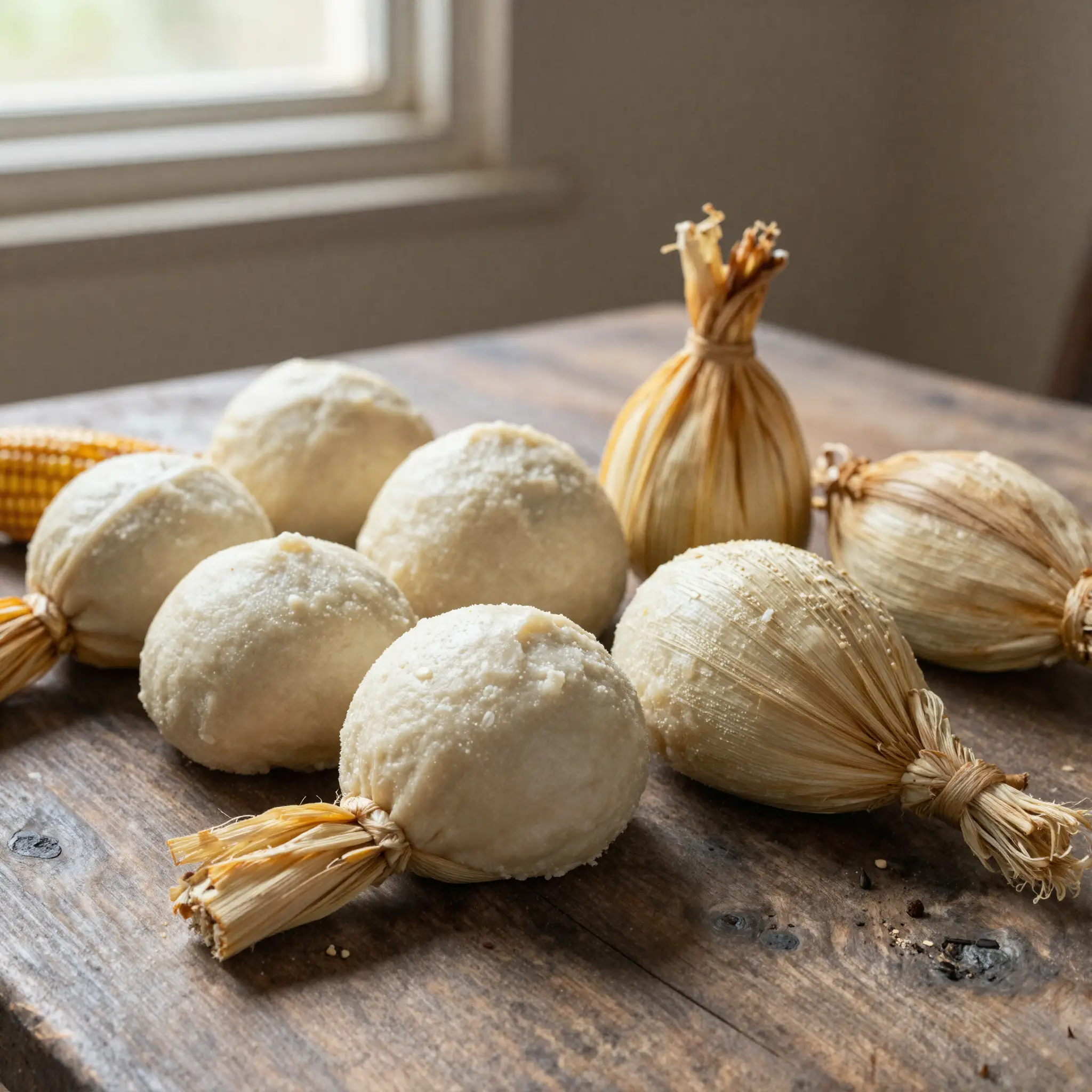
Kenkey (Ghanaian/Ivorian fermented maize dough, steamed or boiled in leaves)
Staple
Facts
| Category | Grain / Legume |
|---|---|
| Product family | West African Fermented Maize Dough |
| Origin | 🇬🇭 Ghana |
| Key microorganisms | lactic-acid-bacteria |
Safety
- Documented considerations (honest, grain-staple-appropriate):
(a) kenkey is a spontaneous fermentation with no defined starter culture, so adequate souring of the dough (a genuinely sour aroma and taste before cooking) is the primary indicator of a safely proceeding ferment;
(b) as with any stored/fermented cereal substrate, a general, honestly-disclosed mycotoxin/mould-contamination awareness applies to the dried maize before milling — grain or dough showing visible mould, discoloration, or a musty/off odour should be discarded, not used; this is not independently confirmed as specific to this product, concentration, or regulatory threshold;
(c) the final steaming/boiling step, wrapped tightly in leaves, is a genuine, defining safety-relevant cooking step — it heat-treats the fermented dough thoroughly before consumption, and traditional practice extends this cook for a substantial period to ensure the dense dough is cooked through to its center, not merely surface-heated;
(d) the leaf wrapping, while primarily traditional/functional for cooking and portioning, also helps limit direct contamination during handling;
(e) potable water must be used throughout, for both dough-mixing and any cooking-water contact. Safe-practice guidance: use clean equipment and potable water; discard maize or dough showing visible mould, discoloration, or musty off-odour; confirm a genuinely sour dough aroma/taste as the sign of a safely proceeding ferment before cooking; steam/boil the wrapped dough thoroughly and for a sufficient duration to ensure the dense interior is fully cooked, not just the surface; store cooked, leaf-wrapped kenkey appropriately and discard on any off-odour or visible spoilage. No specific pathogen thresholds, pH figures, mycotoxin concentrations, or cook-duration numerics are asserted — any such figure is illustrative or not established.
Method
Kenkey (Ghanaian/Ivorian Fermented Maize Dough, Steamed or Boiled in Leaves)
- Maize (dried kernels, milled) — ~1 kg
- Water — potable, sufficient to form a stiff dough and for the steaming/boiling cook
- Corn husks or plantain/banana leaves — for wrapping, cleaned
- 1
Step 1
Mill the dried maize and mix with potable water into a stiff dough in a clean vessel.
- 2
Step 2
Optionally partially pre-cook a portion of the dough per traditional practice (a documented regional step, not separately confirmed for this specific product).
- 3
Step 3
Cover the dough loosely and leave to ferment spontaneously at ambient temperature.
- 4
Step 4
Check periodically: naturally-occurring LAB sour the dough (typically 1–3 days, illustrative, tradition- and household-variable).
- 5
Step 5
Once genuinely sour, divide the fermented dough and shape into balls.
- 6
Step 6
Wrap each ball tightly in cleaned corn husks or plantain/banana leaves.
- 7
Step 7
Steam and/or boil the wrapped balls for an extended period until firm and cooked through to the center.
- 8
Step 8
Cool and store in the leaf wrapping until eaten.
Frequently asked questions
- What is Kenkey (Ghanaian/Ivorian fermented maize dough, steamed or boiled in leaves)?
- Staple
- Which microorganisms ferment Kenkey (Ghanaian/Ivorian fermented maize dough, steamed or boiled in leaves)?
- Kenkey (Ghanaian/Ivorian fermented maize dough, steamed or boiled in leaves) is primarily driven by lactic-acid-bacteria.
- Where does Kenkey (Ghanaian/Ivorian fermented maize dough, steamed or boiled in leaves) come from?
- Kenkey (Ghanaian/Ivorian fermented maize dough, steamed or boiled in leaves) is traditionally made in Ghana.
- Is Kenkey (Ghanaian/Ivorian fermented maize dough, steamed or boiled in leaves) safe to make at home?
- Documented considerations (honest, grain-staple-appropriate):
(a) kenkey is a spontaneous fermentation with no defined starter culture, so adequate souring of the dough (a genuinely sour aroma and taste before cooking) is the primary indicator of a safely proceeding ferment;
(b) as with any stored/fermented cereal substrate, a general, honestly-disclosed mycotoxin/mould-contamination awareness applies to the dried maize before milling — grain or dough showing visible mould, discoloration, or a musty/off odour should be discarded, not used; this is not independently confirmed as specific to this product, concentration, or regulatory threshold;
(c) the final steaming/boiling step, wrapped tightly in leaves, is a genuine, defining safety-relevant cooking step — it heat-treats the fermented dough thoroughly before consumption, and traditional practice extends this cook for a substantial period to ensure the dense dough is cooked through to its center, not merely surface-heated;
(d) the leaf wrapping, while primarily traditional/functional for cooking and portioning, also helps limit direct contamination during handling;
(e) potable water must be used throughout, for both dough-mixing and any cooking-water contact. Safe-practice guidance: use clean equipment and potable water; discard maize or dough showing visible mould, discoloration, or musty off-odour; confirm a genuinely sour dough aroma/taste as the sign of a safely proceeding ferment before cooking; steam/boil the wrapped dough thoroughly and for a sufficient duration to ensure the dense interior is fully cooked, not just the surface; store cooked, leaf-wrapped kenkey appropriately and discard on any off-odour or visible spoilage. No specific pathogen thresholds, pH figures, mycotoxin concentrations, or cook-duration numerics are asserted — any such figure is illustrative or not established.
Community results
No community results published for this ferment yet.