
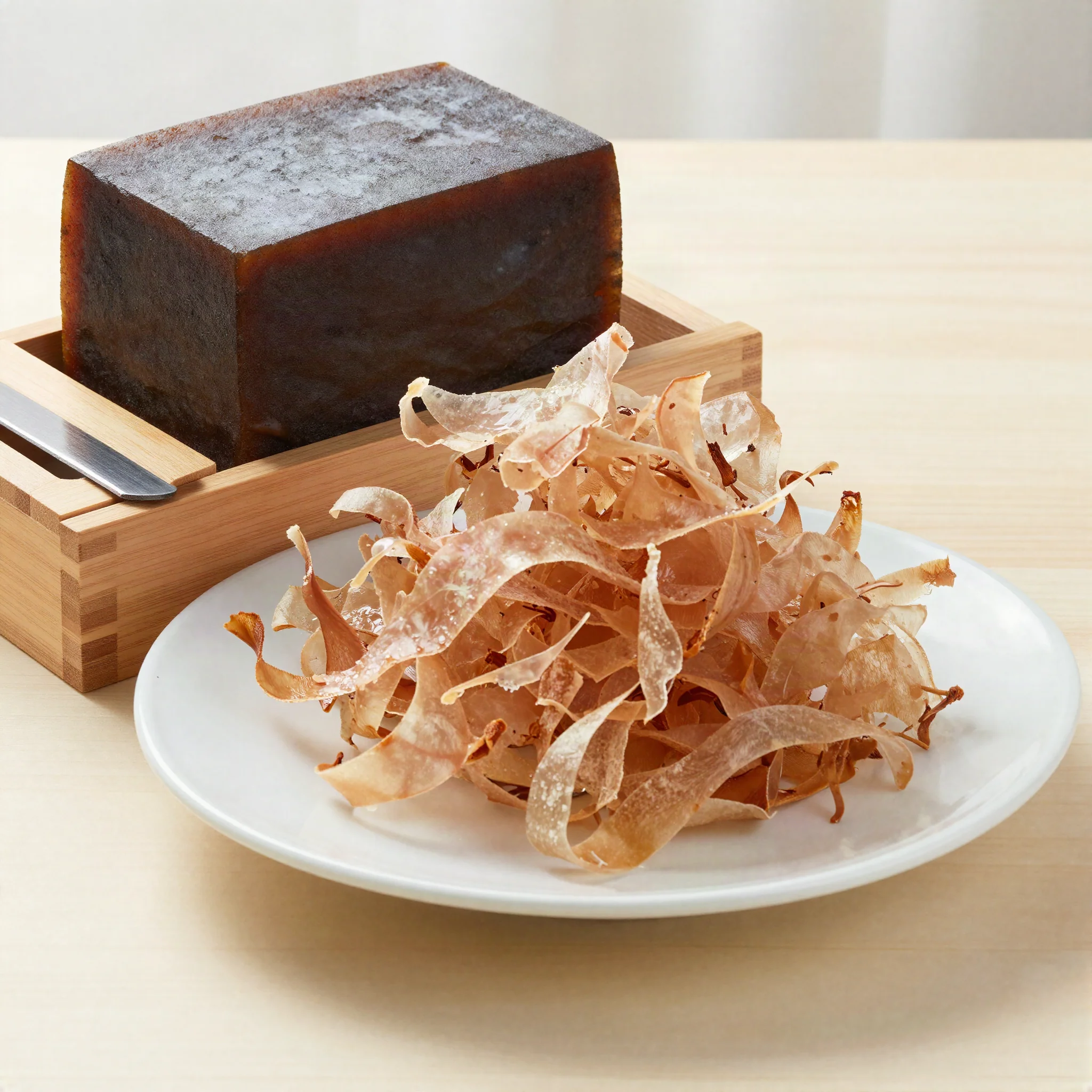
Katsuobushi (smoked, dried and mould-ripened skipjack)
Katsuobushi (Japanese smoked, dried and mould-ripened skipjack)
Fish ferment/dried seasoning
Facts
| Category | Meat / Fish |
|---|---|
| Product family | Japanese dried-bonito |
| Origin | 🇯🇵 Japan |
| Key microorganisms | filamentous-fungi-molds |
Safety
- (a) Deliberate cultivated mould vs. spoilage mould — the governing control point. The mould here is supposed to be there: inoculated on purpose, grown over the block, scraped off, repeated. That must not be generalized into "mould on fish is fine." The safe practice is a selected, food-use mould culture on a properly cooked, smoked and dried substrate under controlled conditions; ambient mould on an under-dried block is a different event, and some environmental Aspergillus/Penicillium species are mycotoxigenic. Green, black, fuzzy or slimy atypical growth, growth on an undried block, and musty/off odour are discard indicators.
(b) Histamine / scombroid poisoning — skipjack is a scombroid fish and among the species most associated with histamine formation; histamine forms when the fish is temperature-abused before processing and is heat-stable — NOT destroyed by cooking, smoking, drying or the long ripening. Nothing downstream fixes it; the catch-to-cook cold chain is the only control.
(c) Clostridium botulinum type E — the fish-associated, cold-tolerant type; the hazard belongs to the wet upstream stages, not to the finished very-low-moisture block; cooking, smoking and progressive drying are the hurdles.
(d) Salt is not the hurdle here — unlike the rest of this category, katsuobushi is unsalted: moisture reduction and the controlled mould stage carry the load, and shortcutting the drying is the failure mode.
(e) Parasites — anisakid nematodes occur in marine fish including tunas; the simmering step is a genuine control, but mould-ripening itself is not a reliable inactivation step — regulated freezing regimes are the documented control upstream.
(f) Listeria monocytogenes and Salmonella — relevant to handling and to any moist intermediate; the dry block is a hostile substrate, shavings in a wet kitchen are not.
(g) Fish allergen — a major regulated allergen and a classic hidden allergen in dashi, hence in soups, sauces and dishes that look vegetarian. Safe-practice guidance: buy finished katsuobushi from a food-safe supply chain — a months-long craft process, not a home project; store dry and sealed; discard on musty odour, damp softening or atypical mould; do not treat mould on any other fish as equivalent; declare the fish allergen wherever dashi is used. Numerics: no moisture/water-activity figure, histamine ppm, smoking or drying temperature, ripening-cycle count or duration is asserted here — regulated, authority-grade values; every such figure is (illustrative) or not established.
Method
Katsuobushi (smoked, dried and mould-ripened skipjack)
- Skipjack tuna (katsuo), whole, filleted into blocks — ~4 kg whole fish (illustrative). Freshness and an unbroken cold chain from catch — SAFETY CONTROL (skipjack is a scombroid fish; histamine formed before processing survives every later step)
- Water for simmering — enough to cover the fillets
- Hardwood for the smoking cycles (oak/ubame oak and similar are traditional)
- Fish paste (from trimmings) to repair gaps in the fillet before smoking
- Ripening mould inoculum — SAFETY CONTROL. Our sources name Aspergillus glaucus; no NCBI taxid is asserted and no substitution with an unidentified household mould is acceptable — this is a deliberate inoculation with a named organism, not a wild ferment.
- Note: no salt, no brine, no sugar, no additive — the hurdles here are cooking, smoking and drying. There is therefore no salt figure to give, and that is a property of the process rather than a gap in the record.
- 1
Step 1
Behead, gut and fillet the skipjack into blocks, keeping the fish cold throughout.
- 2
Step 2
Simmer the blocks in water until cooked through. (Temperature and time: not established.)
- 3
Step 3
Remove bones and skin; repair gaps and tears with fish paste so the block smokes and dries evenly.
- 4
Step 4
Smoking cycles (baikan): smoke over hardwood, then rest, repeatedly over many cycles, driving moisture out and laying down the smoke character. (Temperature, cycle count and duration: not established.) The product at the end of this stage is arabushi — smoked and dried fish, NOT a fermented product.
- 5
Step 5
Scrape the block clean of the surface tar/fat layer and shape it.
- 6
Step 6
Mould-ripening cycle — the fermentation proper: inoculate the block with the ripening mould; hold in a humid ripening room until the mould covers the surface; sun-dry; scrape the mould off.
- 7
Step 7
Repeat step 6 several times over months, each cycle drawing out more moisture and consuming more residual fat, until the block is extremely hard and gives a clear rather than clouded dashi. This is karebushi / honkarebushi — the fermented product and the referent of this recipe.
- 8
Step 8
Shave the finished block into paper-thin flakes on a plane box (kezuriki) as needed; store block and flakes dry and sealed.
Frequently asked questions
- What is Katsuobushi (smoked, dried and mould-ripened skipjack)?
- Fish ferment/dried seasoning
- Which microorganisms ferment Katsuobushi (smoked, dried and mould-ripened skipjack)?
- Katsuobushi (smoked, dried and mould-ripened skipjack) is primarily driven by filamentous-fungi-molds.
- Where does Katsuobushi (smoked, dried and mould-ripened skipjack) come from?
- Katsuobushi (smoked, dried and mould-ripened skipjack) is traditionally made in Japan.
- Is Katsuobushi (smoked, dried and mould-ripened skipjack) safe to make at home?
- (a) Deliberate cultivated mould vs. spoilage mould — the governing control point. The mould here is supposed to be there: inoculated on purpose, grown over the block, scraped off, repeated. That must not be generalized into "mould on fish is fine." The safe practice is a selected, food-use mould culture on a properly cooked, smoked and dried substrate under controlled conditions; ambient mould on an under-dried block is a different event, and some environmental Aspergillus/Penicillium species are mycotoxigenic. Green, black, fuzzy or slimy atypical growth, growth on an undried block, and musty/off odour are discard indicators.
(b) Histamine / scombroid poisoning — skipjack is a scombroid fish and among the species most associated with histamine formation; histamine forms when the fish is temperature-abused before processing and is heat-stable — NOT destroyed by cooking, smoking, drying or the long ripening. Nothing downstream fixes it; the catch-to-cook cold chain is the only control.
(c) Clostridium botulinum type E — the fish-associated, cold-tolerant type; the hazard belongs to the wet upstream stages, not to the finished very-low-moisture block; cooking, smoking and progressive drying are the hurdles.
(d) Salt is not the hurdle here — unlike the rest of this category, katsuobushi is unsalted: moisture reduction and the controlled mould stage carry the load, and shortcutting the drying is the failure mode.
(e) Parasites — anisakid nematodes occur in marine fish including tunas; the simmering step is a genuine control, but mould-ripening itself is not a reliable inactivation step — regulated freezing regimes are the documented control upstream.
(f) Listeria monocytogenes and Salmonella — relevant to handling and to any moist intermediate; the dry block is a hostile substrate, shavings in a wet kitchen are not.
(g) Fish allergen — a major regulated allergen and a classic hidden allergen in dashi, hence in soups, sauces and dishes that look vegetarian. Safe-practice guidance: buy finished katsuobushi from a food-safe supply chain — a months-long craft process, not a home project; store dry and sealed; discard on musty odour, damp softening or atypical mould; do not treat mould on any other fish as equivalent; declare the fish allergen wherever dashi is used. Numerics: no moisture/water-activity figure, histamine ppm, smoking or drying temperature, ripening-cycle count or duration is asserted here — regulated, authority-grade values; every such figure is (illustrative) or not established.
Community results
No community results published for this ferment yet.