
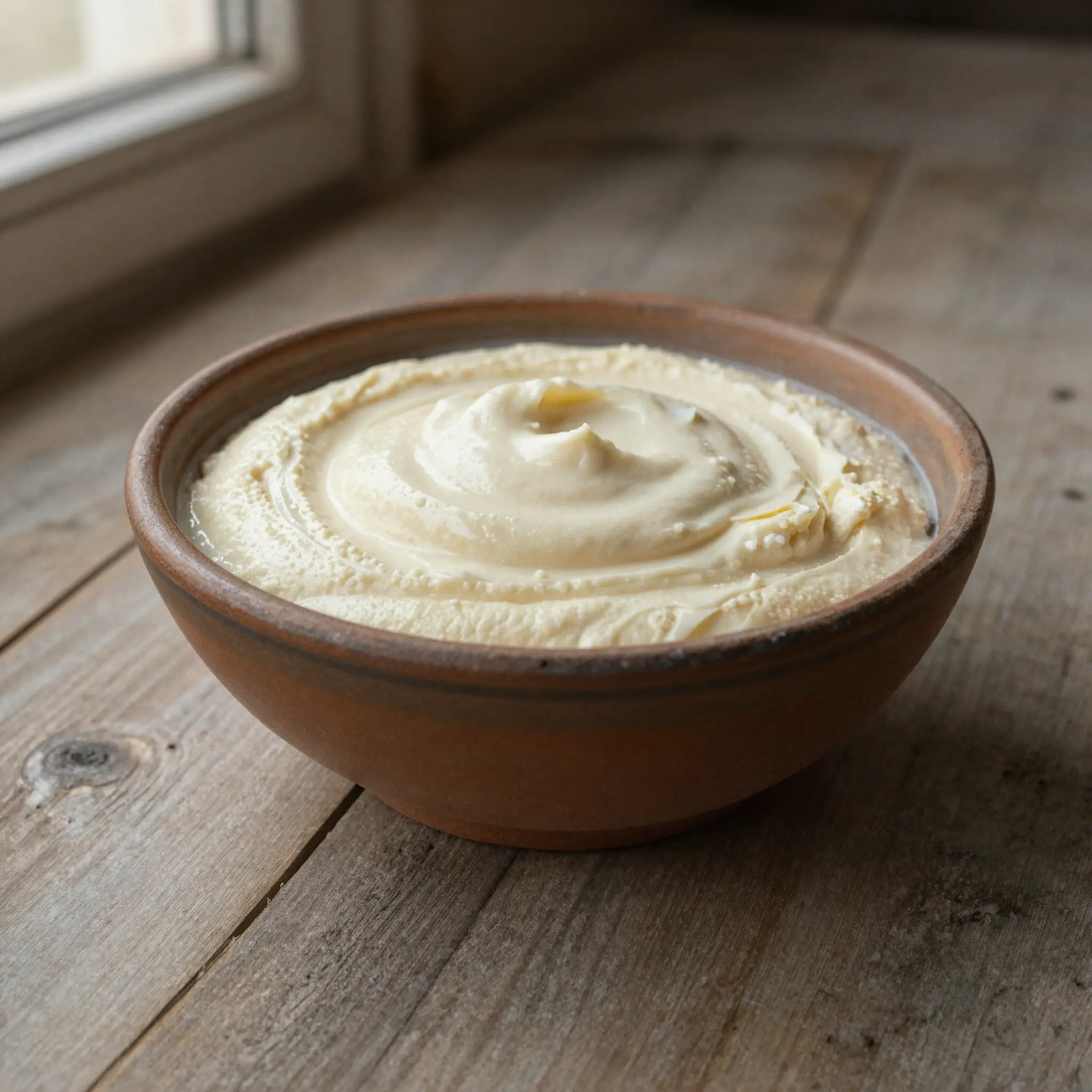
Kashk (Persian/Iraqi/Levantine fermented dried whey or buttermilk)
Dairy product
Facts
| Category | Dairy |
|---|---|
| Product family | Fermented Whey/Buttermilk Preservation |
| Origin | 🇮🇷 Iran |
Safety
- General dairy-lactic safety floor considerations, recorded honestly given kashk's genuinely thin/general-knowledge sourcing. Documented risk factors:
(a) raw vs. pasteurized source dairy — whey or buttermilk originating from unpasteurized milk carries the same materially higher pathogen risk noted for the base dairy-lactic family; pasteurized-sourced dairy by-products are the safer default;
(b) adequate souring/acidification of the whey or buttermilk before further processing — a fully fermented, sour base is the intended starting point, and our sources do not specify a numeric pH target for kashk specifically;
(c) hygiene during straining, shaping, or reduction — as with the other strained/concentrated dairy Variants in this and, clean equipment and hands are the operative control during hands-on shaping;
(d) for the dried-ball storage form, complete drying is the primary safety mechanism — as with qurut, incomplete drying (a dry crust over a moist interior) is the most plausible failure mode for this preservation route, by analogy, though this is not separately confirmed for this specific product;
(e) precise numeric safety floors (target pH, water activity, drying duration, safe storage duration) are not present in our sources for kashk and are not established
Method
Kashk (Persian/Iraqi/Levantine Fermented Dried Whey or Buttermilk)
- Whey (from straining yogurt/cheese) or buttermilk (from churning butter) — ~1 L
- Salt — a moderate amount, to taste, worked in during souring or shaping (illustrative quantity, not a safety control) — flavor/preservative role
- Water — for rehydrating the dried-ball form before use, if that route is followed
- 1
Step 1
Collect fresh whey or buttermilk as a by-product of yogurt-straining or butter-churning.
- 2
Step 2
Allow the whey/buttermilk to sour further at ambient temperature, optionally with added salt, until distinctly fermented/sour (per household/regional practice — our sources do not specify a single defined regime, see linked Variant item 6).
- 3
Step 3
Choose a storage route:
(a) liquid/paste route — simmer and reduce the soured liquid to a thick paste, pack into clean jars for storage; or
(b) dried-ball route — strain further if needed, shape by hand into small balls or patties. - 4
Step 4
For the dried-ball route: arrange the shaped pieces on a clean tray or cloth in full sun; sun-dry over several days (illustrative), turning periodically, until fully hardened throughout.
- 5
Step 5
Store the finished paste (cool/ambient, sealed) or dried balls (dry, ambient, clean container) until needed.
- 6
Step 6
To use: for the dried-ball form, rehydrate in water (soaking or simmering) before incorporating into a dish; for the liquid/paste form, use directly as a sour seasoning base, e.g. in kashk-e bademjan.
Frequently asked questions
- What is Kashk (Persian/Iraqi/Levantine fermented dried whey or buttermilk)?
- Dairy product
- Where does Kashk (Persian/Iraqi/Levantine fermented dried whey or buttermilk) come from?
- Kashk (Persian/Iraqi/Levantine fermented dried whey or buttermilk) is traditionally made in Iran.
- Is Kashk (Persian/Iraqi/Levantine fermented dried whey or buttermilk) safe to make at home?
- General dairy-lactic safety floor considerations, recorded honestly given kashk's genuinely thin/general-knowledge sourcing. Documented risk factors:
(a) raw vs. pasteurized source dairy — whey or buttermilk originating from unpasteurized milk carries the same materially higher pathogen risk noted for the base dairy-lactic family; pasteurized-sourced dairy by-products are the safer default;
(b) adequate souring/acidification of the whey or buttermilk before further processing — a fully fermented, sour base is the intended starting point, and our sources do not specify a numeric pH target for kashk specifically;
(c) hygiene during straining, shaping, or reduction — as with the other strained/concentrated dairy Variants in this and, clean equipment and hands are the operative control during hands-on shaping;
(d) for the dried-ball storage form, complete drying is the primary safety mechanism — as with qurut, incomplete drying (a dry crust over a moist interior) is the most plausible failure mode for this preservation route, by analogy, though this is not separately confirmed for this specific product;
(e) precise numeric safety floors (target pH, water activity, drying duration, safe storage duration) are not present in our sources for kashk and are not established
Community results
No community results published for this ferment yet.