
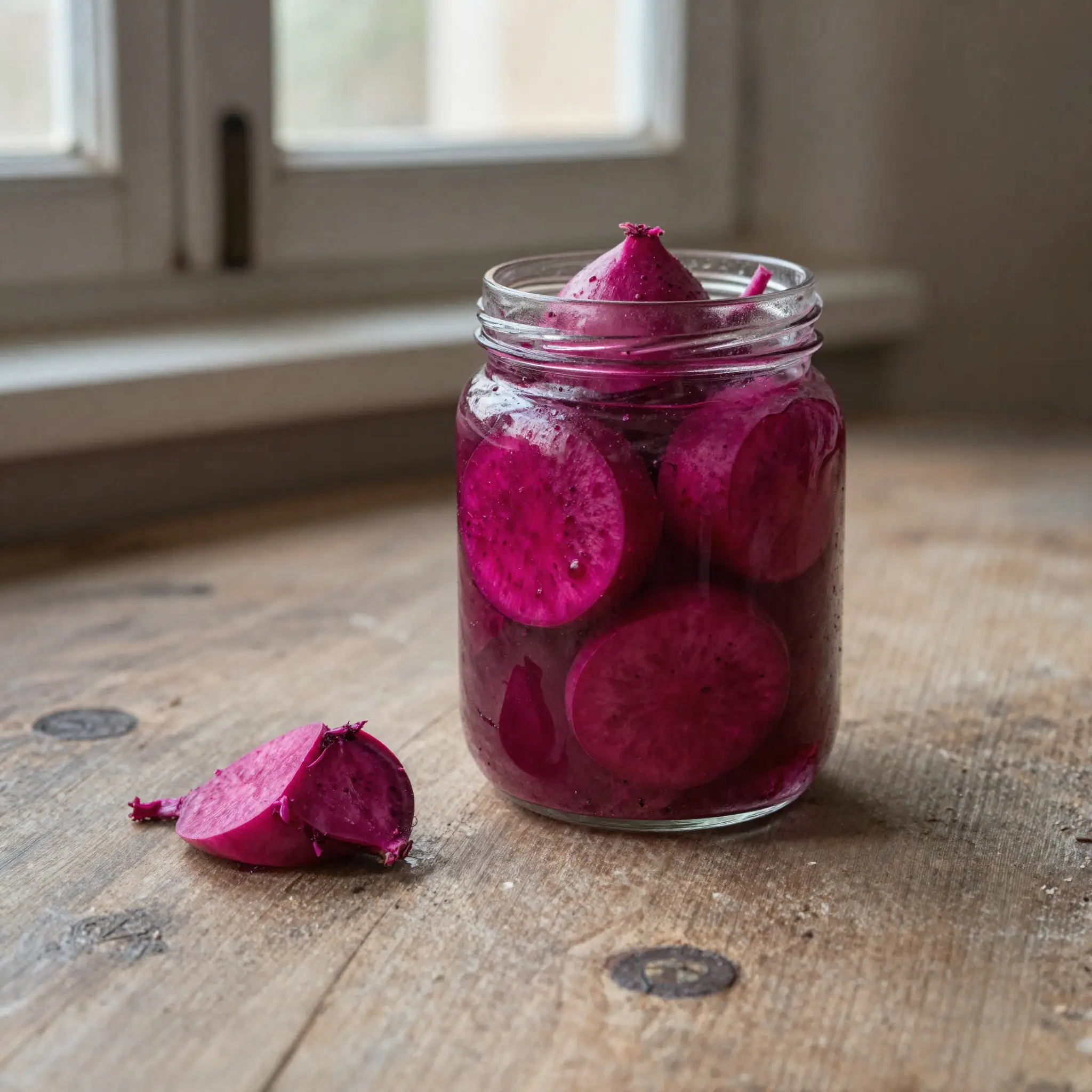
Kabees el-lift (Levantine pink turnip pickle)
Kabees el-lift (Levantine salt-brine fermented turnips)
vegetable-ferment-pickle
Facts
| Category | Vegetable |
|---|---|
| Product family | Brined Lacto-Fermented Vegetable Pickle |
| Origin | 🇱🇧 Lebanon |
Safety
- Same core anaerobic/salinity-floor logic as other brined vegetable ferments. Documented risk factor — insufficient brine salinity or turnip/beet pieces left exposed above the brine line permits spoilage organisms and, in a fully anaerobic low-acid pocket before acidification, a theoretical Clostridium botulinum concern, as with any root-vegetable brine ferment. Safe-practice guidance:
(a) maintain an adequate salt brine (~5% by weight is a widely-cited home range for root-vegetable ferments; precise regulatory-grade floors are recipe-specific — re-confirm before publishing a hard number);
(b) keep all turnip/beet pieces fully submerged below the brine — exposed vegetable above the line is the most common real-world failure point;
(c) target pH ≤4.6;
(d) do not seal into a shelf-stable, non-refrigerated low-acid state without a validated canning process;
(e) if vinegar is added per the boundary-note variant, that is a distinct acid-pickling risk profile, not this Variant's.
Method
Kabees el-Lift (Levantine Salt-Brine Fermented Turnips)
- Turnips (Brassica rapa), peeled and cut into sticks — ~1000 g
- Raw beetroot, peeled and sliced (for colour and flavour) — ~150–200 g
- Garlic — 1 head, cloves peeled
- Non-iodized salt — quantity to make a ~5% brine (illustrative) — SAFETY CONTROL, see linked Variant
- Water — enough to fully submerge (~1–1.5 L)
- Optional (boundary-note variant, non-canonical): a splash of vinegar — if used, this becomes the acid-assisted RelatedPreservationMethod variant noted in the Variant's, not this ferment
- 1
Step 1
Wash and peel turnips; cut into sticks of even thickness for consistent fermentation.
- 2
Step 2
Peel and thinly slice a smaller quantity of raw beetroot.
- 3
Step 3
Prepare the salt brine: dissolve salt fully in water to the target concentration.
- 4
Step 4
Pack turnip sticks vertically into a clean jar, interleaving with beet slices and garlic cloves.
- 5
Step 5
Pour brine over to cover completely; press solids below the surface.
- 6
Step 6
Weight or wedge the vegetables so all solids stay submerged below the brine line.
- 7
Step 7
Cover with a breathable lid or airlock; ferment at ambient-to-cool room temperature.
- 8
Step 8
Check daily for the first days: confirm submersion; skim any surface film.
- 9
Step 9
Taste from about one week onward; the brine and turnips should turn a vivid pink as the beet colour diffuses and the ferment sours.
- 10
Step 10
Move to cold storage once at target flavour and colour.
Frequently asked questions
- What is Kabees el-lift (Levantine pink turnip pickle)?
- vegetable-ferment-pickle
- Where does Kabees el-lift (Levantine pink turnip pickle) come from?
- Kabees el-lift (Levantine pink turnip pickle) is traditionally made in Lebanon.
- Is Kabees el-lift (Levantine pink turnip pickle) safe to make at home?
- Same core anaerobic/salinity-floor logic as other brined vegetable ferments. Documented risk factor — insufficient brine salinity or turnip/beet pieces left exposed above the brine line permits spoilage organisms and, in a fully anaerobic low-acid pocket before acidification, a theoretical Clostridium botulinum concern, as with any root-vegetable brine ferment. Safe-practice guidance:
(a) maintain an adequate salt brine (~5% by weight is a widely-cited home range for root-vegetable ferments; precise regulatory-grade floors are recipe-specific — re-confirm before publishing a hard number);
(b) keep all turnip/beet pieces fully submerged below the brine — exposed vegetable above the line is the most common real-world failure point;
(c) target pH ≤4.6;
(d) do not seal into a shelf-stable, non-refrigerated low-acid state without a validated canning process;
(e) if vinegar is added per the boundary-note variant, that is a distinct acid-pickling risk profile, not this Variant's.
Community results
No community results published for this ferment yet.