
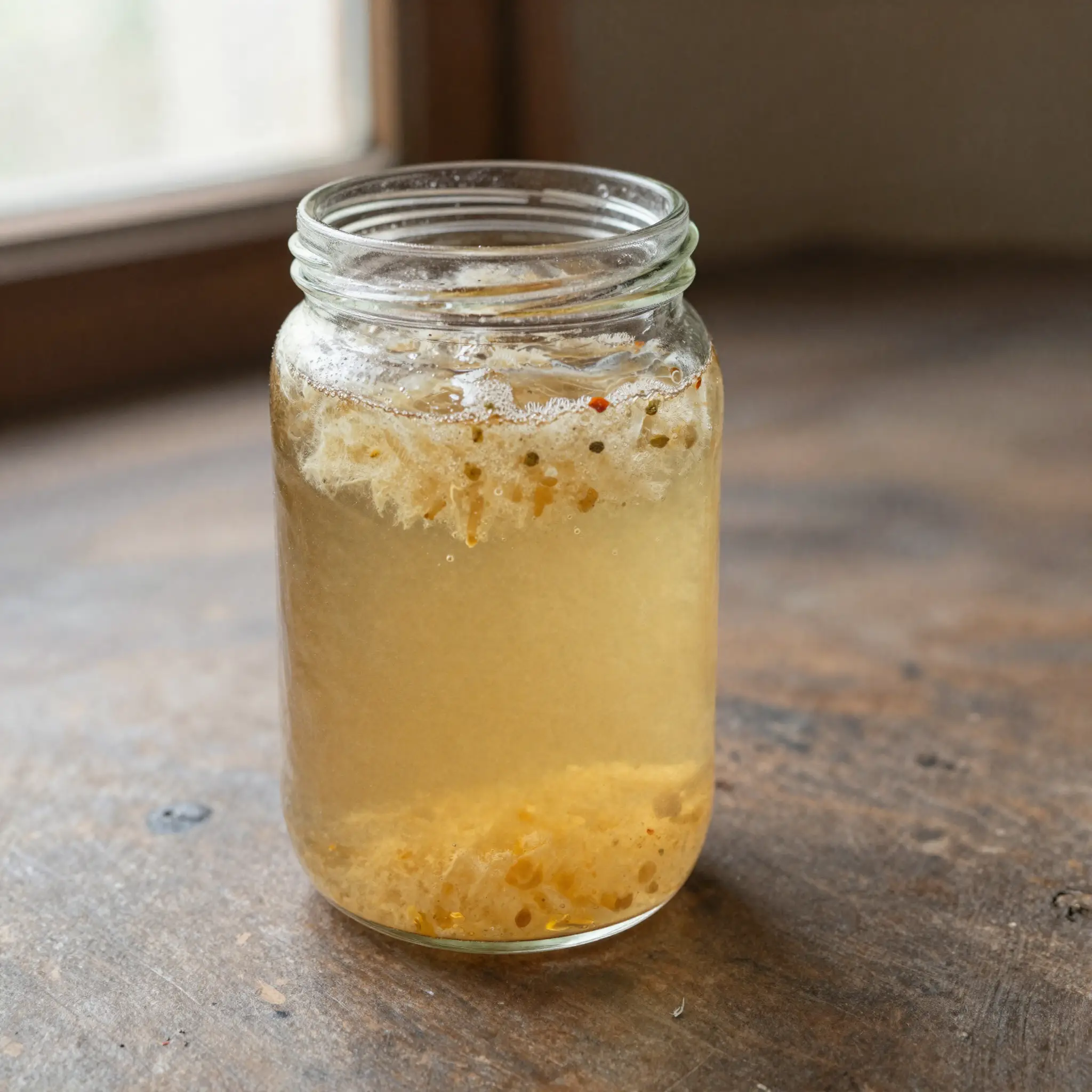
Jun (green-tea-and-honey SCOBY beverage)
Jun (green-tea-and-honey SCOBY-fermented beverage)
Beverage
Facts
| Category | Beverage |
|---|---|
| Product family | Fermented Sweetened-Tea SCOBY Beverage |
| Key microorganisms | acetic-acid-bacteria, yeasts |
Safety
- Documented considerations:
(a) as with kombucha, distinguishing a healthy SCOBY pellicle from true mould contamination is the operative safety judgement call — a healthy jun SCOBY pellicle is typically smooth and off-white/tan (possibly with brown yeast strands), while true mould contamination presents as fuzzy, raised, and typically discoloured (blue/green/black/fuzzy-white) patches, distinct in texture — any suspected mould means the batch (and potentially the SCOBY) should be discarded, not skimmed and continued;
(b) use non-reactive vessels (glass, food-grade ceramic/plastic), since reactive metals can leach into the acidic liquid, mirroring the same guidance documented for kombucha;
(c) breathable (not airtight) covering during the primary fermentation balances necessary gas exchange against contamination/pest exclusion;
(d) over-carbonation / bottle-pressure (bottle-bomb) risk: the optional sealed secondary (bottle-conditioning) fermentation carries the same genuine mechanical over-pressure/rupture hazard documented for kombucha and water kefir — continued yeast activity in a sealed bottle can build substantial internal gas pressure — this entry notes the risk honestly without asserting a specific fabricated pressure threshold or numeric time/temperature limit; general-knowledge practice manages this with pressure-tolerant bottles, periodic "burping," and prompt refrigeration once carbonation is judged adequate;
(e) the mild alcohol content should be disclosed to consumers avoiding alcohol, per the same boundary-note discipline as kombucha/kefir;
(f) potable water must be used throughout, and honey should be sourced as food-grade (this entry does not make any health claim about honey, including no claim regarding infant consumption, which is a distinct, separately-documented general food-safety consideration not specific to jun fermentation and not elaborated further here). Safe-practice guidance: use clean equipment and potable water; ferment in a loosely covered (not airtight) vessel at ambient temperature; inspect the SCOBY regularly and discard the batch on any mould growth or clearly putrid off-odour; if bottling for secondary carbonation, use pressure-tolerant bottles, burp periodically, and refrigerate promptly; disclose the mild alcohol content where relevant. No specific pathogen thresholds, pH figures, bottle-pressure figures, or alcohol percentages are asserted — any such figure is illustrative or not established.
Method
Jun (Green-Tea-and-Honey SCOBY Beverage)
- Green tea (loose-leaf or tea bags) — enough to brew roughly 1 L, per common home-fermentation practice (illustrative)
- Raw honey — commonly cited home ratio of roughly 1/4 cup (~85 g) per litre of tea, illustrative — the defining sweetener in place of kombucha's refined cane sugar
- Water — ~1 L, for brewing the tea
- A living jun SCOBY plus a portion of previously-fermented jun liquid (acidic back-slop) — ~1 cup starter liquid per litre of new tea, illustrative — general-knowledge, home-fermentation-sourced ratio
- 1
Step 1
Brew the green tea in the water using standard green-tea brewing practice (illustrative — green tea is commonly brewed at a lower temperature and shorter time than black tea per general tea-brewing knowledge, not independently re-sourced to a food-science citation).
- 2
Step 2
Cool the brewed tea to near-room temperature before adding the honey — raw honey's documented natural enzyme/yeast content is commonly described in general-knowledge sources as heat-sensitive, so cooling first is widely recommended practice (illustrative, general-knowledge).
- 3
Step 3
Dissolve the raw honey fully into the cooled tea.
- 4
Step 4
Add the living jun SCOBY and the reserved starter liquid (acidic back-slop) to the sweetened tea.
- 5
Step 5
Cover the vessel breathably (a cloth or breathable lid — not airtight).
- 6
Step 6
Ferment at ambient temperature for roughly 3–7 days (illustrative, tradition/household-variable), tasting periodically — the yeast component ferments sugars toward mild alcohol while the acetic-acid-bacteria component concurrently oxidizes some of that alcohol toward acetic acid at the surface, where the SCOBY pellicle forms/thickens.
- 7
Step 7
Remove and reserve the SCOBY (and a portion of the finished liquid) for the next batch.
- 8
Step 8
Optionally, bottle the strained liquid in a pressure-tolerant bottle for a sealed secondary fermentation to build carbonation — see linked safety control points below regarding bottle-pressure risk.
- 9
Step 9
Refrigerate the finished beverage once at the desired sourness/carbonation level.
Frequently asked questions
- What is Jun (green-tea-and-honey SCOBY beverage)?
- Beverage
- Which microorganisms ferment Jun (green-tea-and-honey SCOBY beverage)?
- Jun (green-tea-and-honey SCOBY beverage) is primarily driven by acetic-acid-bacteria, yeasts.
- Is Jun (green-tea-and-honey SCOBY beverage) safe to make at home?
- Documented considerations:
(a) as with kombucha, distinguishing a healthy SCOBY pellicle from true mould contamination is the operative safety judgement call — a healthy jun SCOBY pellicle is typically smooth and off-white/tan (possibly with brown yeast strands), while true mould contamination presents as fuzzy, raised, and typically discoloured (blue/green/black/fuzzy-white) patches, distinct in texture — any suspected mould means the batch (and potentially the SCOBY) should be discarded, not skimmed and continued;
(b) use non-reactive vessels (glass, food-grade ceramic/plastic), since reactive metals can leach into the acidic liquid, mirroring the same guidance documented for kombucha;
(c) breathable (not airtight) covering during the primary fermentation balances necessary gas exchange against contamination/pest exclusion;
(d) over-carbonation / bottle-pressure (bottle-bomb) risk: the optional sealed secondary (bottle-conditioning) fermentation carries the same genuine mechanical over-pressure/rupture hazard documented for kombucha and water kefir — continued yeast activity in a sealed bottle can build substantial internal gas pressure — this entry notes the risk honestly without asserting a specific fabricated pressure threshold or numeric time/temperature limit; general-knowledge practice manages this with pressure-tolerant bottles, periodic "burping," and prompt refrigeration once carbonation is judged adequate;
(e) the mild alcohol content should be disclosed to consumers avoiding alcohol, per the same boundary-note discipline as kombucha/kefir;
(f) potable water must be used throughout, and honey should be sourced as food-grade (this entry does not make any health claim about honey, including no claim regarding infant consumption, which is a distinct, separately-documented general food-safety consideration not specific to jun fermentation and not elaborated further here). Safe-practice guidance: use clean equipment and potable water; ferment in a loosely covered (not airtight) vessel at ambient temperature; inspect the SCOBY regularly and discard the batch on any mould growth or clearly putrid off-odour; if bottling for secondary carbonation, use pressure-tolerant bottles, burp periodically, and refrigerate promptly; disclose the mild alcohol content where relevant. No specific pathogen thresholds, pH figures, bottle-pressure figures, or alcohol percentages are asserted — any such figure is illustrative or not established.
Community results
No community results published for this ferment yet.